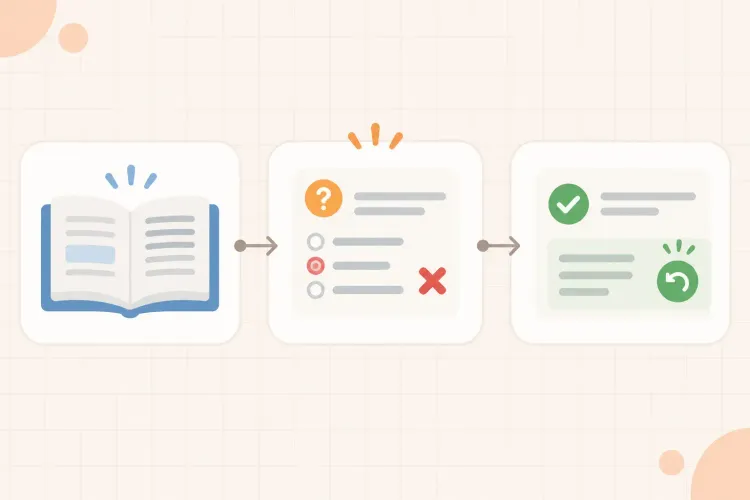

Most study sessions fail before the first page is open. The goal is vague, the task is chosen because it feels familiar, and the session ends when the timer rings rather than when you know what changed.
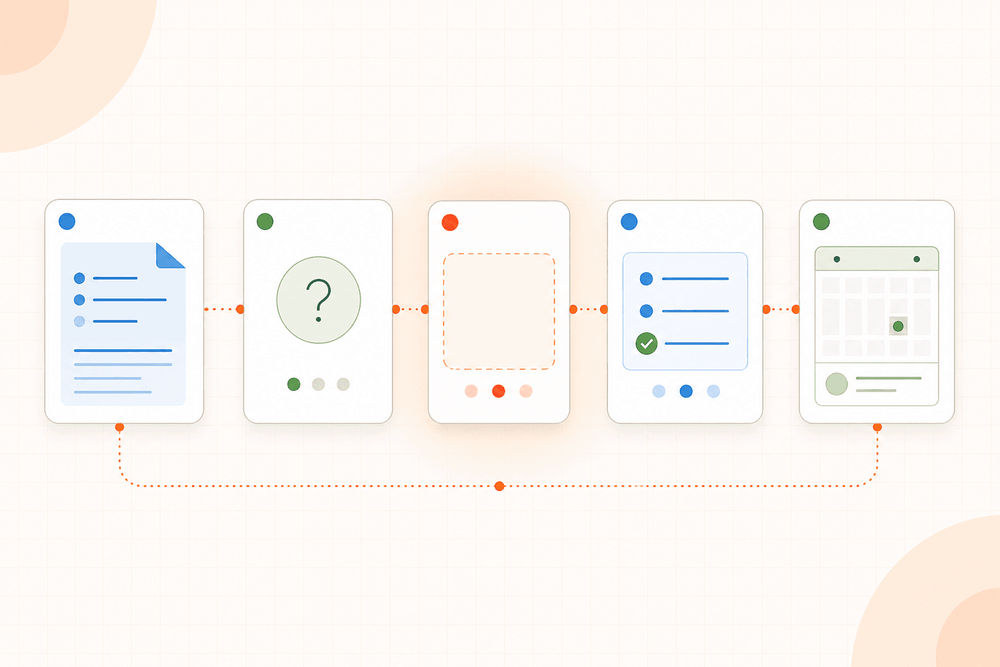
A useful study session has a different shape. It starts with a result you can check, gives you time to work with the material, asks you to produce something without looking, and uses the result to choose the next repair. You do not need to follow a rigid timetable. You need a loop that turns study time into evidence.
How to structure a useful study session
A good study session has five parts:
- Define the output. Decide what you should be able to explain, solve, compare, or recall by the end.
- Attempt before you feel ready. Work from the source, then close it and produce an answer or solution.
- Check the attempt. Compare it with the source, a worked solution, or a reliable answer key.
- Repair the specific gap. Revisit only the definition, relationship, step, or condition that caused the problem.
- Choose the next action. Record what to retry, what to practise next, and when you will return.
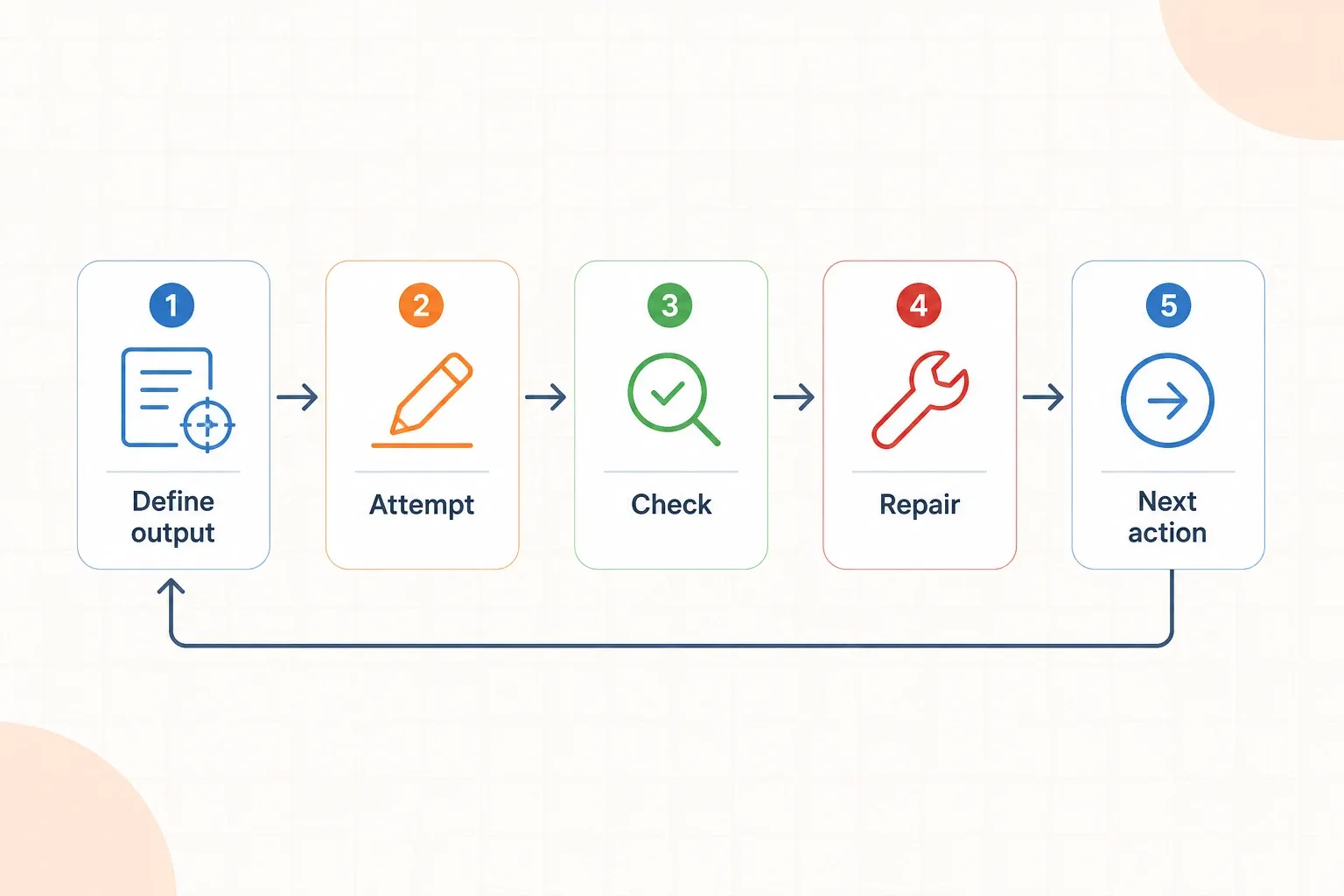
This structure is close to a study cycle, but the important detail is the feedback loop. A session is not successful because you stayed at your desk or covered a certain number of pages. It is successful when it leaves you with clearer evidence about what you can use and what still needs work. RMIT’s study-session guidance makes a similar distinction between choosing what to learn and checking what you learned.
Start with an output, not a topic
“Study chemistry” is a topic. It is not a useful session target because you cannot tell when the task is complete. Replace it with an output that fits the assessment or the next time you will use the knowledge:
- explain why oxygen is needed at the end of the electron transport chain
- solve four unfamiliar integration-by-parts problems
- compare two theories and identify the evidence that distinguishes them
- label a cell diagram and explain the function of each highlighted structure
- write a short answer using the course’s required command word
The output should be small enough to finish and specific enough to check. If it contains several unrelated tasks, split them into separate sessions. If it is so easy that you already know the answer, raise the task slightly by adding a condition, a new example, or a comparison.
Before opening your material, write three lines:
By the end: what you will produce.
Source: which lecture, chapter, problem set, or note contains the relevant material.
Evidence: how you will check whether the output is good enough.
This takes less time than deciding what to do while the session is already running. It also prevents a common failure mode: spending the whole session organizing materials without producing an answer.
Use the source for a job
Once the output is clear, give the source a narrow job. Do not read an entire chapter simply because the chapter is open. Look for the explanation, example, definition, or relationship needed for the output.
The right job depends on the source:
| Source | Useful job during the session | Evidence at the end |
|---|---|---|
| Textbook chapter | Find the mechanism, definition, or worked example behind the question | Explain it without copying the wording |
| Lecture slides | Reconstruct the instructor’s emphasis and missing connections | Summarize the argument between key slides |
| PDF or paper | Locate the claim, method, figure, or limitation that matters | Point to the supporting section and explain it |
| Problem set | Attempt a representative problem before checking the method | Solve a changed version and justify the steps |
| Existing notes | Turn a bullet point into a question or explanation | Answer without following the note line by line |
This approach keeps reading and note-taking purposeful. You may still need to read several pages, but you know what you are looking for and what you will have to do when the source is closed.
Attempt before rereading everything
Rereading can be useful when a topic is new or when your first attempt reveals a missing explanation. It becomes inefficient when it is the default response to uncertainty. The page feels clearer because you have just seen it, but that does not prove you can retrieve or use the idea later.
Make a first attempt as soon as you have enough context. Close the book, hide the notes, or put the worked solution out of reach. Then:
- answer the question in your own words
- draw the process from memory
- solve the next problem without looking at the example
- predict what changes when one condition is removed
- explain why an answer is correct, not only which option is correct
The attempt can be incomplete. Its purpose is diagnostic. It shows whether the problem is a missing fact, a broken connection, a misunderstood condition, or an execution error. That is more useful than guessing that you need to reread the entire source.
For a broader explanation of why answer-first work matters, see this guide to active recall as a way to test what you can produce.
Check with the right standard
Checking is not the same as glancing at the answer and thinking, “That makes sense.” Use a standard that matches the output you defined:
- Explanation: Is the causal chain complete? Did you state the condition or limitation?
- Calculation: Are the setup, units, signs, and final interpretation correct?
- Comparison: Did you identify a meaningful difference and support it with evidence?
- Diagram: Are the relationships and functions correct, not only the labels?
- Short answer: Does the response address the command word and the question asked?
Separate accuracy from confidence. A confident answer can still contain a small but important error, while an uncertain answer can be correct but poorly supported. Mark what happened using a simple classification:
- Correct and clear: keep it for later review.
- Correct but fragile: practise it again from a different cue.
- Partly correct: identify the missing link or condition.
- Wrong or blank: return to the source and rebuild the idea.
University study-cycle guides commonly place a recap or check at the end of a study block. The useful addition is to make the check answer-specific: you are not asking whether the material looks familiar, but whether the output meets the standard you chose.
Repair one gap at a time
A weak check often produces an unhelpful conclusion: “I do not know this chapter.” Replace it with a narrower diagnosis. Ask what exactly failed:
- Did I forget the term?
- Did I confuse two similar ideas?
- Did I miss the link between two steps?
- Did I apply the right rule under the wrong condition?
- Did I understand the example but fail on a new version?
Then reopen only the material that answers that diagnosis. Write a corrected explanation, solve a parallel problem, or add one condition to the question. Close the source and test the repaired point again.
For example, a biology student may define the electron transport chain correctly but fail to explain why oxygen matters. The repair is not another full reading of cellular respiration. It is a smaller question: “What happens to electron flow, the proton gradient, NADH, and ATP production when oxygen is unavailable?” The student can answer it, check the sequence, and then test the same mechanism under a changed condition.
This is where practice testing turns study into evidence: the missed answer tells you what to repair, rather than merely confirming that the source was familiar.
End with a next action
Do not finish with “review later.” Write an action that another version of you can start without making a new plan:
- retry the two missed questions tomorrow without notes
- solve three mixed problems, including one with a changed condition
- read the methods section and explain how it supports the claim
- turn the unresolved lecture connection into one question
- ask the instructor about the definition that remains ambiguous
Include the trigger for that action when possible: after the next lecture, during the next problem set, or at the next spaced review. A next action keeps the result of the session connected to the rest of your course instead of leaving it as an isolated burst of effort.
A study session in practice
Consider a student preparing for an integration-by-parts tutorial. “Study integration” is too broad, so the student chooses a checkable output: solve three unfamiliar problems and explain why the chosen substitution works in each one.
The student reviews one worked example, then closes the textbook and attempts the three problems. The first setup is correct, but the second uses an unsuitable choice of u and dv. Instead of rereading the whole chapter, the student checks the selection rule, writes a brief explanation in their own words, and solves a parallel problem with different numbers.
The session ends with a precise next action: retry the original second problem tomorrow without notes, then attempt one mixed problem. The result is more useful than a page count because it records what the student can do, the exact point that failed, and the evidence needed to test the repair.
Adapt the session to the time you have
A useful session can be short or long because the loop scales by output, not by a fixed number of minutes. With limited time, reduce the scope of the output and keep the check. With more time, repeat the loop with a second output or a changed application.
| Time available | Sensible scope | Do not skip |
|---|---|---|
| 15 minutes | One definition, relationship, or missed question | Close the source and produce an answer |
| 30–45 minutes | One connected concept or a small problem set | Check and repair the attempt |
| 60–90 minutes | Two linked outputs with a short break between them | End with a retry plan, not more rereading |
The clock is a constraint, not the learning method. If you have fifteen minutes, a precise answer with a check is better than an ambitious chapter target that ends in passive highlighting. If you have ninety minutes, do not fill the extra time by expanding the notes indefinitely. Add a changed example or a second retrieval attempt.
Build a session from your actual material
The workflow is easier to follow when the source and practice task remain connected. Start with the lecture slides, PDF, notes, or problem set that defines the output. Extract only enough structure to attempt the task, then return to that same source to verify the answer.
For long documents, you can study a PDF without rereading every page by turning headings and evidence into narrow questions. If your source is a lecture video, turn the lecture into notes and practice material before you start the attempt. The point is not to generate more material. It is to reduce the distance between the source, the question, the answer, and the correction.
A checklist for your next session
Before you begin, ask:
- What will I be able to produce by the end?
- Which source contains the information I need?
- What will count as a correct or useful answer?
- When will I close the source and attempt the task?
- What will I do if the attempt is incomplete?
- When will I retry the weak point?
During the session, protect the loop from two common distractions. Do not keep expanding the scope because you found another interesting section. Do not keep polishing notes after they have stopped helping the output. Return to the question and use the next check to decide whether the material needs explanation, application, or later review.
The anatomy of a useful study session is simple: define a result, work with the right source, attempt from memory, check against a real standard, repair the exact gap, and leave a next action. That structure makes a session valuable even when the answer is not perfect, because every miss becomes information about what to do next.