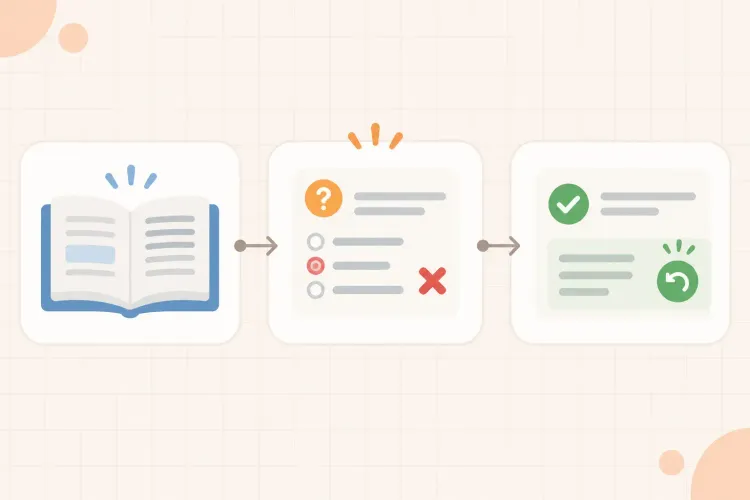

Active recall means studying by trying to bring information back from memory before looking at the answer. Instead of reading a page again and thinking, "That looks familiar," you close the source and answer a question, explain an idea, solve a problem, label a diagram, or write the main steps from memory.
That small change matters. Rereading feels smooth because the material is visible. Active recall feels slower because the answer is hidden. The effort is the point: it shows what is actually retrievable, not just what looks familiar on the page.
For PDFs, lecture slides, notes, or videos, the method is simple: turn the material into prompts, try to answer, then use mistakes to decide what to review next.
What active recall is
Active recall is a study method built around retrieval practice: deliberately bringing information to mind instead of keeping the answer visible. A useful description from The Learning Scientists is that retrieval practice asks you to recreate something learned earlier from memory.
In practice, active recall can look like:
- Answering flashcards without flipping too early.
- Covering lecture notes and writing the main ideas from memory.
- Explaining a textbook section out loud with the book closed.
- Taking a short quiz from a PDF chapter.
- Rebuilding a diagram or timeline after watching a video.
The format is flexible, but the rule is not: the answer should stay hidden while you try to produce it.
Why rereading feels productive but often fails
Rereading is comfortable because it creates fluency. The second pass through a chapter feels easier than the first. Sentences sound familiar. Highlighted lines look important. You may feel that the topic is "known" because recognition is happening quickly.
Recognition is not the same as recall. In an exam, presentation, coding interview, language test, or real project, the source is usually not open. You have to produce the answer, choose the right method, explain the idea, or apply it to a new problem.
This is why passive review can create an illusion of competence. A student may read a biology chapter three times and still freeze when asked:
- What is the difference between transcription and translation?
- Why does enzyme shape affect reaction rate?
- How would temperature change the result?
Rereading can help when the material is brand new or genuinely confusing. The mistake is using rereading as the main test of learning. Research on the testing effect supports this difference: in a well-known paper on test-enhanced learning, Roediger and Karpicke found that testing can improve later retention, not only measure what someone already knows.
The basic active recall loop
Use this loop with any study source:
- Choose a small source.
- Turn it into questions.
- Answer without looking.
- Check against the source.
- Mark what was wrong, vague, or missing.
- Review weak topics sooner than strong topics.

The source should be small enough to test properly: one subsection, one lecture topic, five slides, one worked example, or a three-minute video segment. The first answer does not need to be perfect. Its job is to expose gaps while there is still time to fix them.
How to turn study material into questions
Most active recall starts by converting what is on the page, slide, or screen into prompts. Use these transformations:
- A definition becomes: "What does this term mean, and what is one example?"
- A process becomes: "What are the steps, in order?"
- A comparison becomes: "How are these two ideas different?"
- A formula becomes: "When should this formula be used, and what does each variable mean?"
- A cause-and-effect note becomes: "Why does this happen?"
- A diagram becomes: "Can each part be labeled without looking?"
- A worked problem becomes: "Can the same method be used on a new problem?"
For example, a note that says "Monetary policy affects inflation through interest rates, borrowing, spending, and demand" can become:
- What is monetary policy?
- How can interest rates affect borrowing?
- What is the link between demand and inflation?
- What is one limitation of this explanation?
Good active recall questions are not always multiple choice. In many subjects, the best questions ask for explanation, order, comparison, or application.
How to use active recall with PDFs
PDFs are easy to reread and hard to remember because they often contain dense paragraphs, diagrams, footnotes, and examples. Active recall turns the document into something you have to use, not only scan.
Use this workflow:
- Read one section once for orientation.
- Write 3-8 questions from headings, bold terms, diagrams, and examples.
- Close the PDF or hide the answer area.
- Answer in short written form.
- Reopen the PDF and correct the answer.
- Tag unclear topics for another pass.
For dense documents, start with one chapter or section. You can make a PDF section testable, answer from memory, then check against the source.
How to use active recall with lectures and videos
Lectures and videos create the same trap: they can feel clear while the explanation is still being supplied. Active recall starts when you pause and produce the idea without help.
After a lecture, try three quick passes:
- Write the main topic from memory.
- List the 5-10 points the lecturer emphasized.
- Turn unclear or important points into questions.
For videos, use pauses as recall points:
- After a definition, restate it in plain language.
- After a process, list the steps.
- After a worked example, try the next step before the video shows it.
- After a section, write three questions the video just answered.
For a YouTube chemistry lecture, questions might include:
- What makes a bond polar?
- How can electronegativity predict bond polarity?
- Why is molecular shape still important after bond polarity is known?
When a video is long, use the lecture to generate a focused set of questions. Then answer from memory before replaying the explanation.
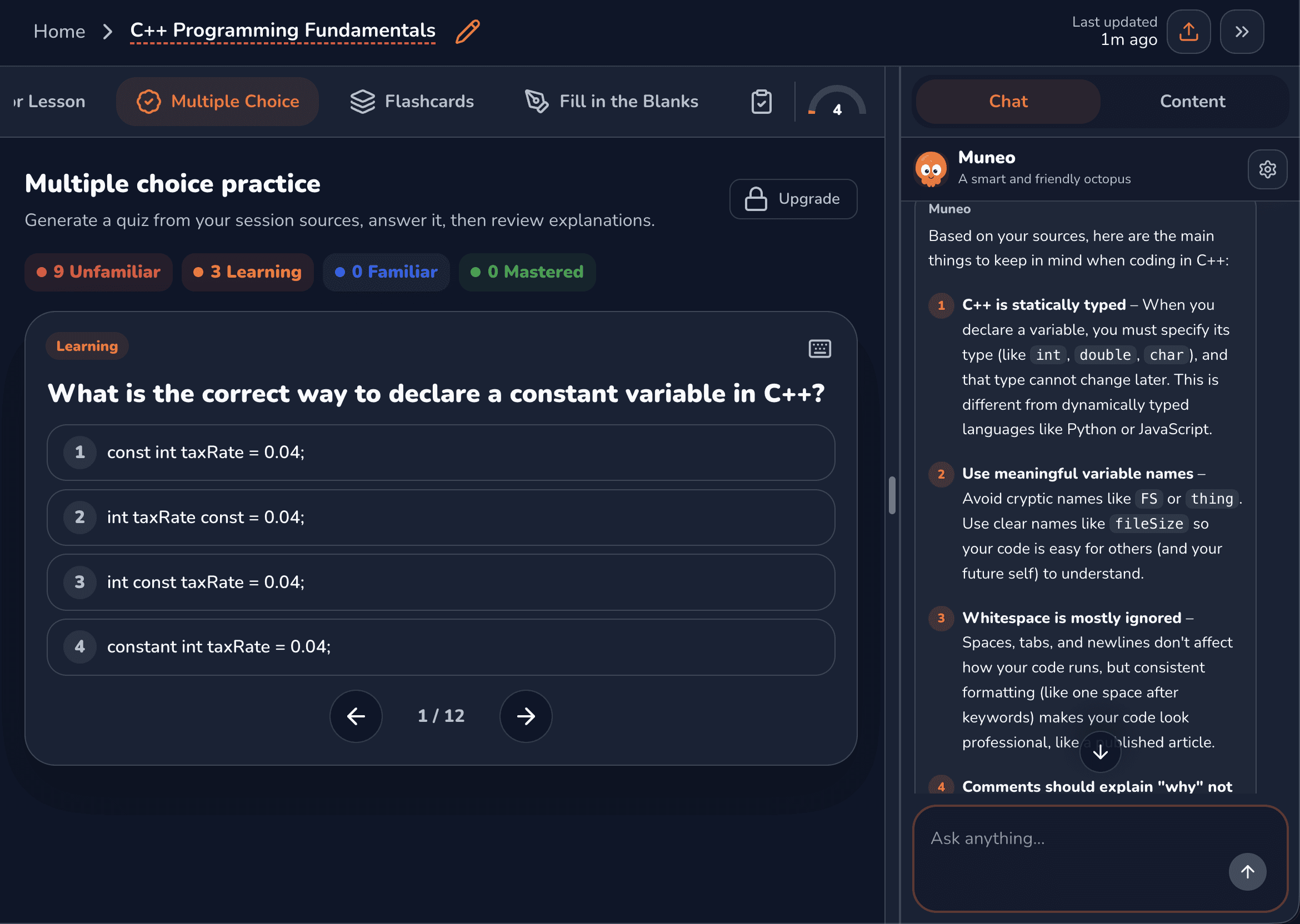
Four practical active recall formats
Different formats work for different kinds of material. The best one is usually the format closest to what you will need to do later.
| Format | Best for | Use when |
|---|---|---|
| Self-quizzing | Definitions, processes, short explanations | You need a quick check after notes, PDFs, lectures, or videos |
| Flashcards | Vocabulary, formulas, dates, compact facts | The same small prompts need repeated review over time |
| Written recall | Essays, cases, pathways, frameworks | You need to produce a structured explanation |
| Blank-page recall | Diagrams, timelines, topic maps, formula sheets | You need to rebuild the structure of a topic without help |
Self-quizzing
Self-quizzing is the simplest format. Write questions on paper, in a notes app, or in a study workspace, then hide the answers and work through the list.
A strong self-quiz question is specific enough to answer, but not so narrow that it only trains recognition. "What is photosynthesis?" is useful at the start. "How do light-dependent reactions support the Calvin cycle?" is better once the basics are known.
Flashcards
Flashcards are useful for small prompts that need repeated practice: vocabulary, formulas, symbols, dates, anatomy labels, language learning, and compact concept checks.

Good flashcards are usually atomic: one card, one idea. A card that asks for five unrelated facts is hard to grade and easy to avoid.
Better flashcard:
- Front: What is opportunity cost?
- Back: The value of the next best alternative given up when making a choice.
Weaker flashcard:
- Front: Explain all of chapter 3.
- Back: A long summary with several separate ideas.
For conceptual subjects, add "why" and "how" cards, not only definition cards.
Written and blank-page recall
Written recall is best when the final task requires explanation. Close the source and write everything remembered about a topic for 5-10 minutes. Then check the source and mark missing ideas.
Blank-page recall is stricter: start with an empty page and rebuild a topic map, formula sheet, timeline, diagram, or process from memory. If you cannot rebuild the structure, the topic may still be stored as scattered facts rather than connected knowledge.
How to review weak topics
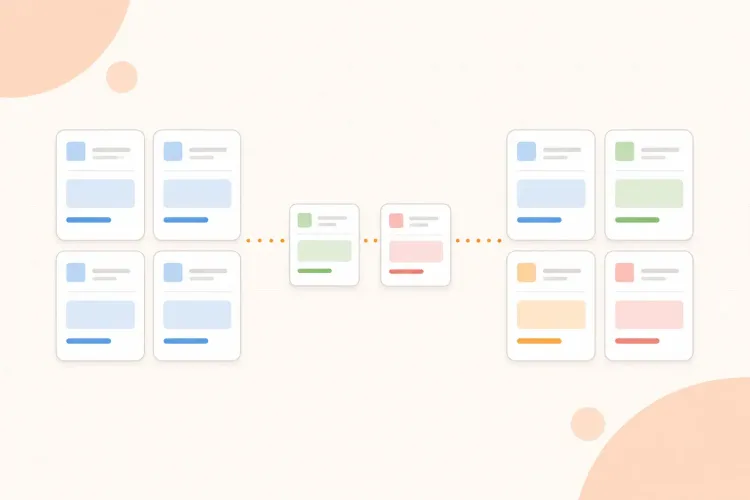
Active recall is working when review becomes more targeted. After each session, separate topics into three groups:
- Strong: correct, quick, and explainable without help.
- Unstable: partly correct, slow, or vague.
- Weak: incorrect, missing, or impossible without the source.
Weak topics are not failures. They are the point of the method. A missed question gives more useful information than a highlighted paragraph because it shows exactly what needs another round.
Use a simple review rule:
- Strong topics can wait longer.
- Unstable topics need another attempt soon.
- Weak topics need a source check, a simpler explanation, and another recall attempt.
Common mistakes
Looking too early
If the answer is checked after two seconds, you may be training recognition again. Give yourself a real attempt first. Even 20-30 seconds of effort can reveal what is missing.
Making questions too easy
Questions like "Is this important?" or "Does this look familiar?" do not create much retrieval. Better questions ask for an answer, explanation, step, comparison, label, or example.
Only using multiple choice
Multiple choice can help, but it can also make guessing too easy. Mix it with short answer, written recall, and explanation prompts.
Treating notes as the final product
Clean notes are useful, but they are not the final product. A good study system turns notes into questions, answers, feedback, and review decisions.
A 30-minute active recall study session
Use this structure when time is limited:
- Spend 5 minutes choosing the source and listing the most important subtopics.
- Spend 10 minutes creating questions from headings, examples, diagrams, or lecture points.
- Spend 10 minutes answering without looking.
- Spend 5 minutes checking answers and marking weak topics.
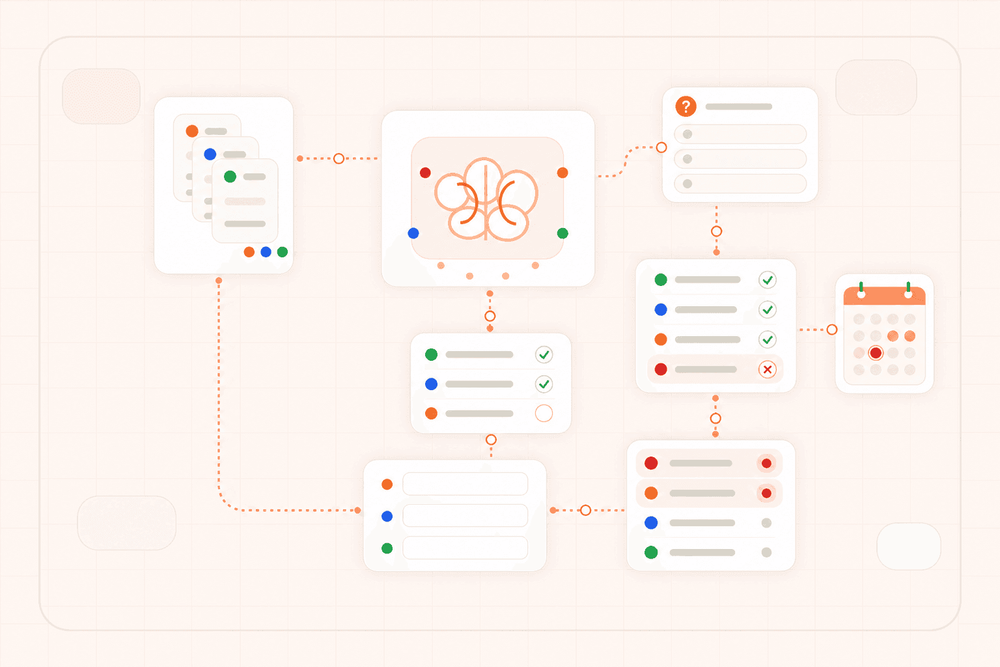
If more time is available, repeat the loop with the weakest topic first. This can happen in a notebook, a flashcard app, a document, or a source-based study workspace. If you prefer to keep sources, notes, flashcards, quizzes, and review in one place, you can keep the whole study loop in one place.
The takeaway
Active recall makes studying honest. Rereading asks, "Does this look familiar?" Active recall asks, "Can I produce this without help?"
That second question is the one that changes the session. It turns notes into prompts, PDFs into practice, lectures into explanations, and videos into memory checks. More importantly, it shows weak topics early, while there is still time to fix them.
The goal is not to feel busy with study material open. It is to close the source, try, check, and know exactly what to review next.