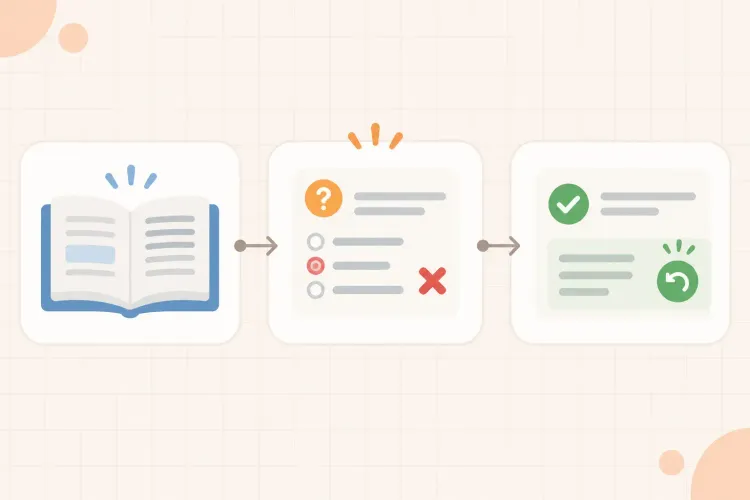


You can follow a page of notes, agree with an explanation, and still freeze when an exam question changes the example. That does not necessarily mean you learned nothing. It often means your understanding is tied to the wording, diagram, or worked example you saw rather than to the conditions that make the idea useful.
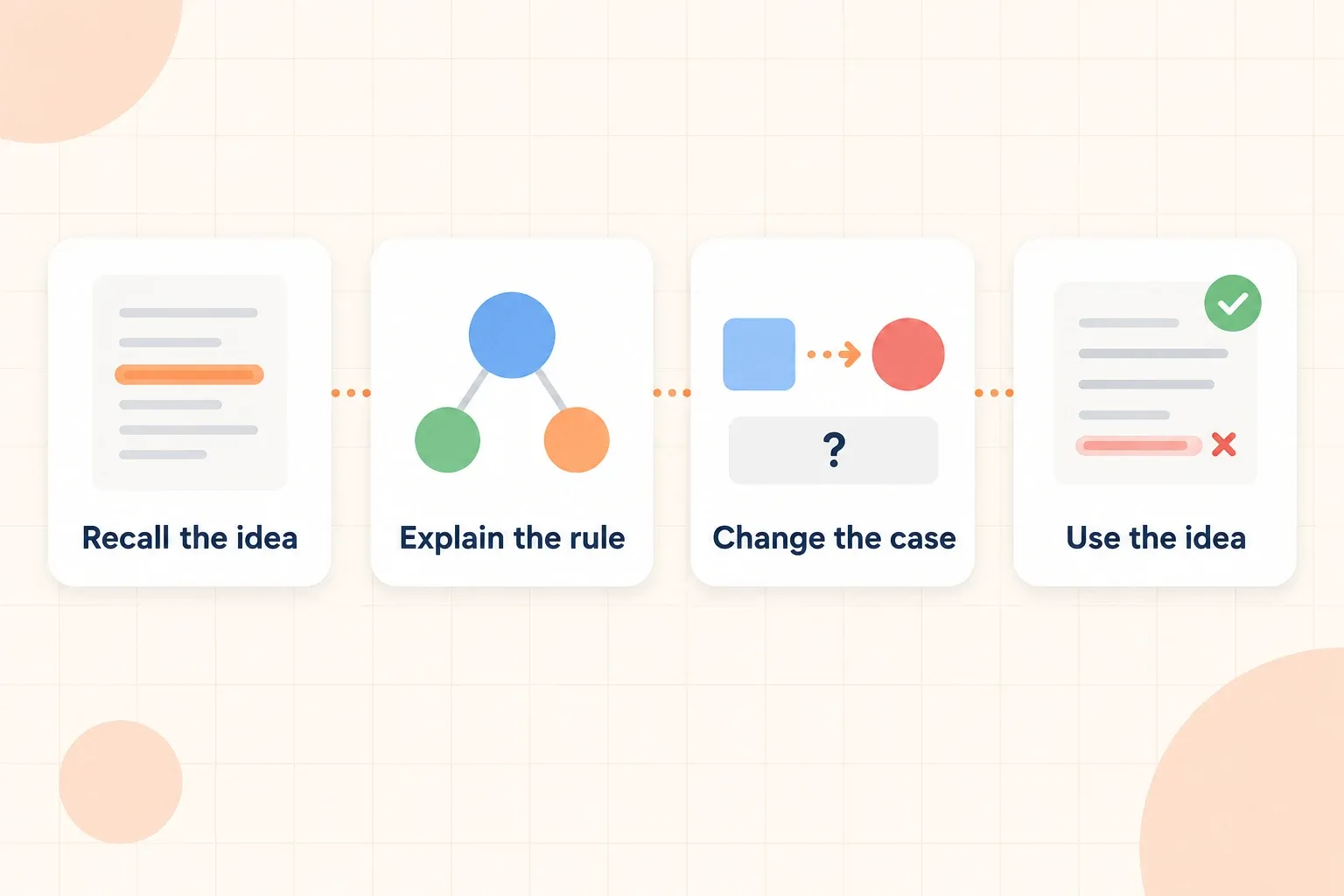
The fix is not always more rereading. First identify what you can do, then change one feature of the problem and try again. A useful study sequence moves from recognizing the idea to explaining it, predicting what changes, choosing a method, and defending the result.
Why you understand the notes but cannot apply the idea
Notes can give you a feeling of understanding because the explanation is present. You can recognize the term, follow the worked solution, or think “that makes sense.” Application asks for more: you must identify which idea matters, adapt it to the situation, and decide what the result means.
These are different levels of performance:
| What you can do | What it shows | What it does not prove |
|---|---|---|
| Recognize a definition in your notes | You can identify familiar information | You can recall or use it without the wording |
| Follow a worked example | You can track the shown steps | You can choose those steps in a new problem |
| Explain the idea in the same example | You understand one representation | You can transfer the idea to a changed case |
| Solve a changed problem and justify it | You can select and use the idea | You will never need more practice |
The gap is usually a transfer problem. You know something about the original case, but you have not yet practised deciding when the same principle applies, what must change, or what evidence would show that your choice was wrong. Carnegie Mellon’s guide to why students cannot apply what they have learned highlights related problems, including relying on cues from instruction and failing to integrate knowledge in complex contexts.
Diagnose the exact point where application breaks
Do not reduce the problem to “not understanding the topic.” Find the first step that fails. Try one question with the notes closed and compare your attempt with the source.
Use these questions to classify the gap:
- Retrieval: Can you state the relevant idea without seeing the wording?
- Selection: Can you identify which concept, formula, or method fits the situation?
- Explanation: Can you explain why that choice fits rather than naming it only?
- Execution: Can you carry out the steps without copying the worked example?
- Interpretation: Can you tell what the result means and whether it is plausible?
- Transfer: Can you use the idea when the numbers, context, representation, or goal changes?
For example, if you know the formula but choose the wrong one, the problem is selection rather than memorization. If you choose the right formula but cannot explain the answer’s unit or meaning, the problem is interpretation. Each gap needs a different repair.
Start with a familiar example, then remove one support
Do not jump from rereading directly to the hardest unfamiliar question. Use a worked example as a starting point, but gradually remove the support that tells you what to do.
Try this progression:
- Read the example and identify the goal, information, method, and result.
- Cover the solution and explain why that method was chosen.
- Rework the example without looking at the steps.
- Change one number, condition, representation, or question word.
- Solve the changed version and explain what stayed the same.
- Compare your reasoning with the source and record the first incorrect decision.
Start with a small change so you can still see the connection. Then increase the distance between the example and the problem. This gives you evidence of transfer instead of leaving you to guess whether you are ready.
Change one feature at a time
When every part of a question changes at once, a wrong answer is difficult to diagnose. Change one feature and ask what the original reasoning still explains.
Useful changes include:
- Numbers: Keep the method but alter the values.
- Context: Keep the principle but use a different real-world example.
- Representation: Move from words to a diagram, graph, table, or equation.
- Direction: Ask what happens when a variable decreases instead of increases.
- Goal: Ask for an explanation, estimate, comparison, or recommendation instead of the original calculation.
- Constraint: Remove a piece of information or add a condition that limits the method.
After each change, answer two questions: “What still applies?” and “What must be adapted?” That comparison tells you more than checking whether the final answer matches the key.
Use questions that force transfer
A question tests application when the answer is not copied directly from one sentence in the notes. Add a condition, comparison, explanation, or decision to the prompt.
Turn a basic prompt into a transfer prompt:
| Basic prompt | Transfer version |
|---|---|
| What is competitive inhibition? | How would the result change if the inhibitor concentration increased while substrate concentration stayed constant? |
| Calculate the mean | Which mean is appropriate here, and what would make the result misleading? |
| Define opportunity cost | Which option has the higher opportunity cost in this situation, and what information supports your choice? |
| State Newton’s second law | How would you use the relationship to explain this motion when the force is not constant? |
The best prompt is not simply harder. It requires you to select, adapt, explain, or evaluate. For more examples of questions that test more than recognition, read how to write useful practice questions.
Explain the rule before you calculate or conclude
Application often fails because the solver starts manipulating numbers before deciding what relationship matters. Add a short explanation before the calculation or conclusion.
Use this sentence pattern:
- The situation gives you ___
- You need to find or explain ___
- The relevant idea is ___ because ___
- The result should change or stay stable when ___
- Check the answer by looking at ___
This does not mean writing a long essay for every problem. One or two precise sentences can reveal whether you chose the method for a reason or merely recognized a familiar pattern.
Study the first wrong decision, not only the final answer
When an application attempt is wrong, do not copy the correct solution and move on. Find the first decision that sent the attempt in the wrong direction.
Your error log can use four columns:
| What happened? | First wrong decision | Why it seemed reasonable | Next variation to try |
|---|---|---|---|
| Chose the wrong equation | Treated a rate as a total amount | The question used familiar variables | Keep the variables and change the units |
| Applied the right idea to the wrong case | Ignored the limiting condition | The example did not include that constraint | Add the constraint to a similar problem |
| Explained the result too broadly | Claimed causation from an association | The graph showed a clear pattern | Ask what other explanation remains possible |
A useful error log does not just say “careless mistake.” It records what you noticed, what you assumed, and what variation would test that assumption. That turns a wrong answer into the next practice prompt.
Apply the method to your own notes and source material
Start with a section of notes, a lecture slide, a worked example, or a PDF page. Extract one idea and ask four questions:
- What problem does this idea help solve?
- What conditions must be present for it to apply?
- What would change if one condition were different?
- How could you test whether your explanation is wrong?
Then close the source and answer. If you only write new questions but never attempt them, you are building a list rather than testing transfer. A question-generation tool can help you create variations from source material, but you still need to answer and check them against the original source.
Use practice testing to expose the transfer gap
Practice testing is not limited to recalling isolated facts. It can also ask you to choose a method, explain a change, or defend a conclusion. The important part is attempting before you look at the explanation.
For each topic, create three kinds of questions:
- Same idea, new numbers: checks whether you can execute the method.
- Same principle, new context: checks whether you can recognize when it applies.
- Same context, new goal: checks whether you can adapt the explanation, calculation, or recommendation.
Answer without the notes, then compare the reasoning rather than only the final result. This is where practice testing helps reveal application gaps.
If you understand the topic but cannot do the questions
Do not decide that the topic is new just because the wording is new. When you understand the explanation but cannot solve the questions, strip each problem back to its structure:
- What is being asked?
- What information is given?
- Which relationship, rule, or process could connect the information to the goal?
- What condition could make that relationship invalid?
- What would a plausible answer look like?
If you still cannot choose a method, write two possible approaches and state what each one would require. Comparing the requirements can reveal which idea fits. If you can choose but cannot execute, return to a close variation rather than rereading the whole chapter.
Common mistakes that create the illusion of understanding
Copying the worked solution
A copied solution shows what the source says, not what you can reconstruct. Hide the steps and write the reason for each one before checking.
Changing too many things at once
If the numbers, context, format, and goal all change, a wrong answer gives you little information. Vary one feature first.
Practising only the same question type
Repetition can build fluency, but it can also teach you to follow a template. Add a new context or question goal once the method is stable.
Checking only the final answer
A correct answer can come from a weak reason, and a wrong answer can come from a small execution slip. Check the choice of method, the assumptions, and the interpretation.
Calling every failure a memory problem
Sometimes you remember the concept but do not know when it applies. Label the gap accurately before choosing the repair.
Put one idea under pressure
Take one idea from your notes and give yourself a short transfer test. Close the source and explain the idea in two or three sentences. Then change one condition in the example, solve the new version, and underline the first point where your reasoning became uncertain. Check that point against the source and write one follow-up question that changes the same condition again.
This is enough for one practice block. The aim is not to complete a large set of questions. It is to leave with a precise answer to three things: what you can use independently, what breaks when the situation changes, and what to try next.
Decide what to practise next
You are ready to move on when you can close the notes, choose an approach for a differently worded question, explain why it fits, and say what the result means. You do not need to answer every possible variation correctly. You do need to know where your reasoning changes from a decision to a guess.
If you can explain the original example but cannot choose a method in a new one, practise selection. If you choose the method but lose the steps, practise execution. If the answer is correct but your explanation is vague, practise interpretation. That diagnosis gives your next study task a clear purpose instead of sending you back to the whole chapter.
Understanding the notes is the starting point, not the test. The useful question is whether the idea still works when the wording, condition, or goal changes.