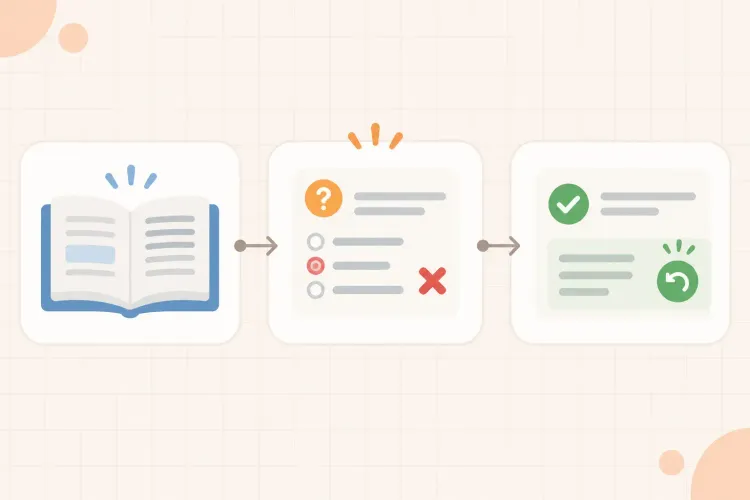

Rereading feels productive because the material looks familiar the second time. The problem is that familiarity is not the same as recall. You can recognize a highlighted paragraph on the page and still freeze when the exam asks you to explain it without the textbook in front of you.
Practice testing fixes that gap. Instead of asking, "Does this look familiar?" you ask, "Can this be brought back from memory and used correctly?" That small switch changes study time from passive review into a clear feedback loop: try, check, mark weak topics, and review again.
You can use practice testing with almost any study material: a PDF chapter, lecture slide deck, YouTube explanation, textbook section, messy notes, or a set of worked problems. The format can change, but the goal stays the same: find out what you can retrieve without the answer in front of you.
The testing effect: why practice testing beats rereading
Practice testing is a form of retrieval practice: you bring an answer back from memory before checking the source. Researchers often call the benefit the testing effect, because the act of testing can improve later retention instead of only measuring what you already know.
The useful part is the retrieval attempt. You make a real try, then compare it with the material and decide what needs another pass. That is why practice testing is closely related to active recall study: both train the habit of producing an answer instead of only recognizing one.
A good practice test can use:
- Short-answer questions from a PDF chapter
- Multiple-choice questions from lecture slides
- Flashcards for definitions, formulas, or dates
- Blank-page recalls after watching a lecture
- Practice problems without the worked solution visible
- Written explanations of diagrams, images, or screenshots
Why rereading feels easier but teaches less
Rereading lowers friction. The answer is already on the page, so your brain can follow the explanation without rebuilding it. That can help when the topic is brand new, but it becomes weak review once you already understand the basics.
The danger is false confidence. A paragraph feels clear because the textbook is doing the work. A solved example feels obvious because each step is visible. A lecture recording feels manageable because the instructor is carrying the explanation. The exam removes those supports.
Practice testing is harder in the moment because it exposes gaps. That difficulty is useful. It shows the exact difference between material you can recognize and material you can actually use.
Cognitive psychology reviews consistently place practice testing among the strongest general learning techniques, but the reason is easy to misunderstand. Testing is not useful only because it gives you a score. Dunlosky and colleagues rated practice testing and distributed practice as high-utility strategies because retrieval changes the study task: you have to rebuild the idea, notice what is missing, and then repair the gap. Rereading received a lower rating for long-term learning support because it can leave you with recognition instead of usable recall (Psychological Science in the Public Interest).
A classic Roediger and Karpicke experiment makes the timing problem clearer. Repeated studying helped more on an immediate test, which explains why rereading can feel convincing right after you do it. But after one week, the repeated-testing group remembered substantially more than the repeated-study group, even without feedback during practice (Psychological Science). The practical lesson is not that rereading is always bad. It is that rereading gives the strongest feeling of progress before the moment when students usually need memory most: later, with the source closed.
The practice testing loop
Practice testing works best as a loop, not a one-time score. The goal is not to prove that everything is already known. The goal is to discover what still breaks when the source is closed.
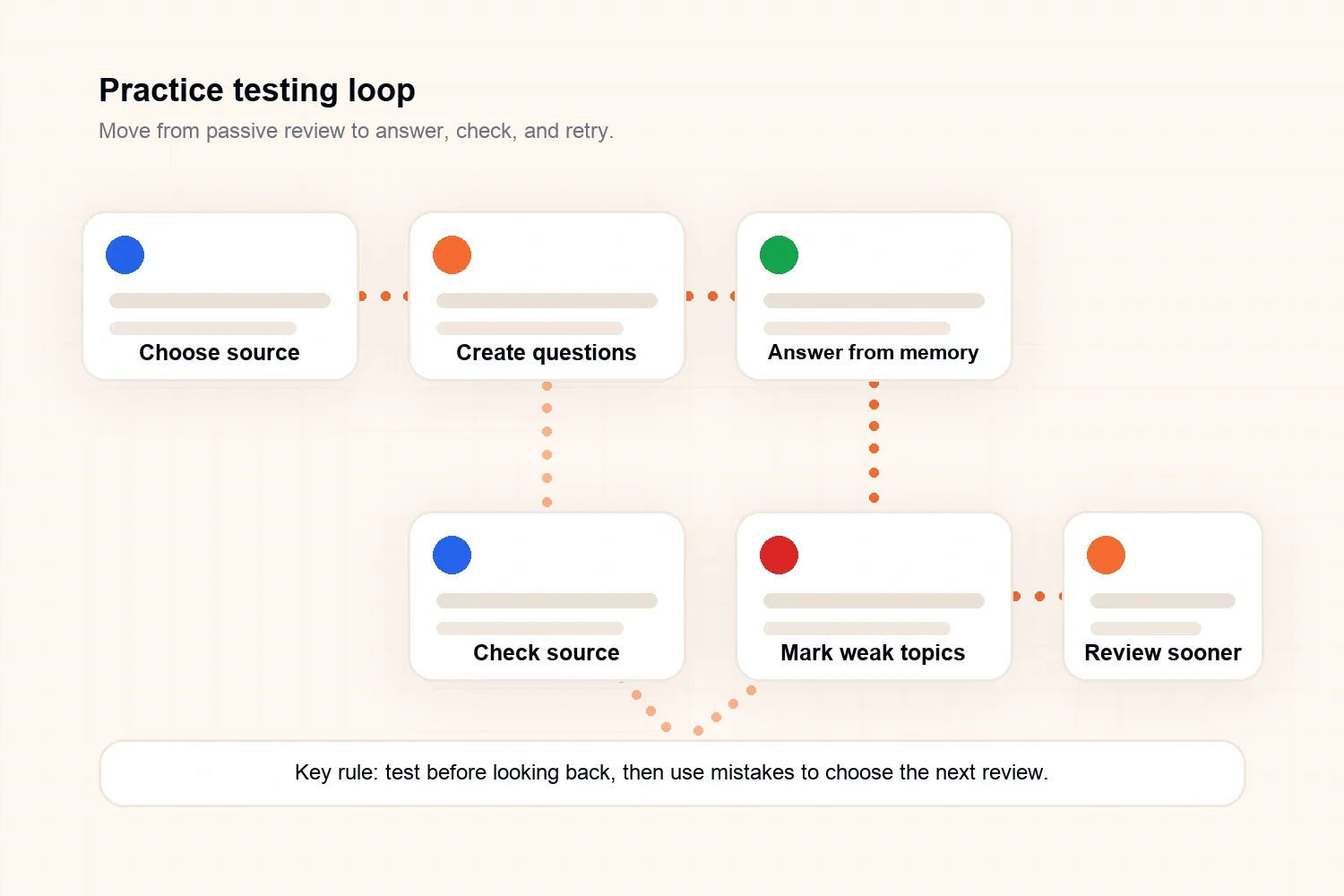
Use this sequence:
- Choose one source: a chapter section, slide deck, lecture transcript, video segment, or note page.
- Create questions from that source before rereading it.
- Answer from memory with the source closed.
- Check the source and correct missing or weak parts.
- Mark weak topics instead of simply counting a score.
- Review weak topics sooner than topics already answered well.
This loop turns review into diagnosis. A wrong answer is not wasted time; it is a map of what needs attention next.
For example, take one PDF section on osmosis. Create eight questions from that section, close the PDF, and answer them. If four answers are clear, two are partly correct, and two are wrong, do not reread the whole chapter. Review the two weak sections, rewrite the explanation in your own words, and test those ideas again tomorrow.
How to practice test from different study materials
Different sources need slightly different testing formats. The principle stays the same: turn the material into a question, try from memory, then check against the original.
| Source | Better than rereading | Practice test format |
|---|---|---|
| PDF chapter | Scanning highlighted paragraphs again | Short-answer questions by section |
| Lecture slides | Rewatching the same explanation | Explain each slide from memory |
| YouTube lecture | Playing the full video again | Pause after a segment and answer questions |
| Notes | Tidying notes without using them | Cover the notes and write a blank-page recall |
| Worked problems | Reading the solution steps | Redo the problem without looking |
For dense documents, it often helps to make a PDF section testable before rereading. For lecture videos, a better review session is to turn a video segment into questions, answer first, and replay only the part that exposes a gap.
What a good practice question looks like
A good practice question makes you retrieve meaning, not just spot a keyword. If the question can be answered by recognizing one bold term, it may be too shallow for exam prep.
Weak question: "What is osmosis?"
Stronger question: "A cell is placed in a solution with a higher solute concentration outside the cell. What happens to water movement, and why?"
The stronger version asks for a decision and an explanation. It is closer to how exams test understanding. You can still use quick definition cards, but they should not be the only practice format.
Use these question types when building a practice set:
- Definition: What does this term mean?
- Difference: How are these two ideas different?
- Cause and effect: What happens if one condition changes?
- Application: How would this idea work in a new example?
- Error check: What is wrong with this explanation?
- Process: What are the steps, and why does the order matter?
How to check answers without wasting time
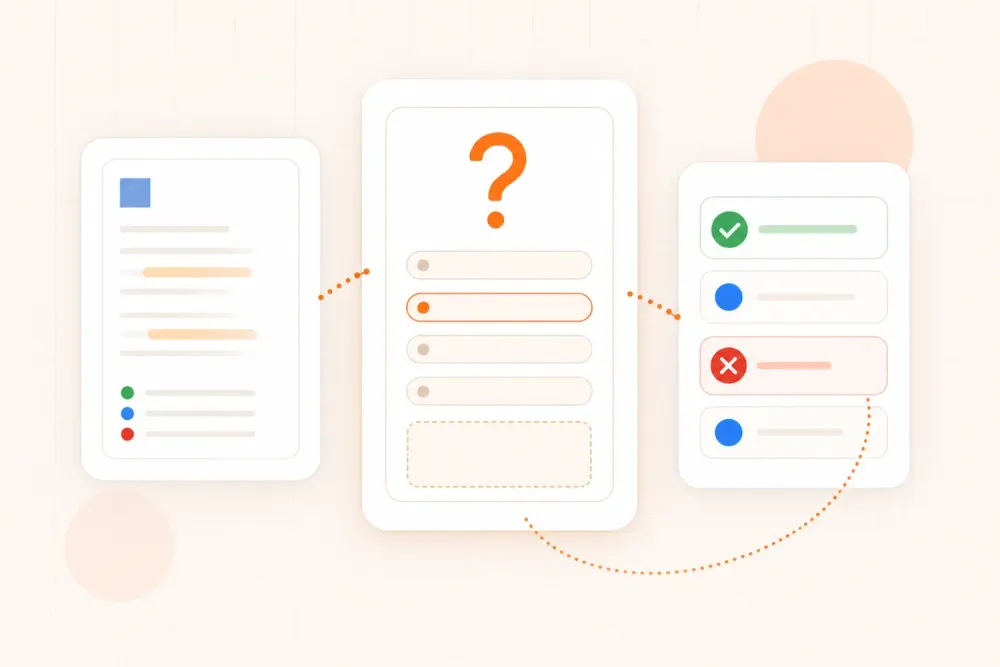
Practice testing should not turn into endless grading. After each answer, mark it with a simple code:
- Green: correct and explainable without help
- Yellow: partly correct, but missing detail or confidence
- Red: wrong, blank, or copied from the source after getting stuck
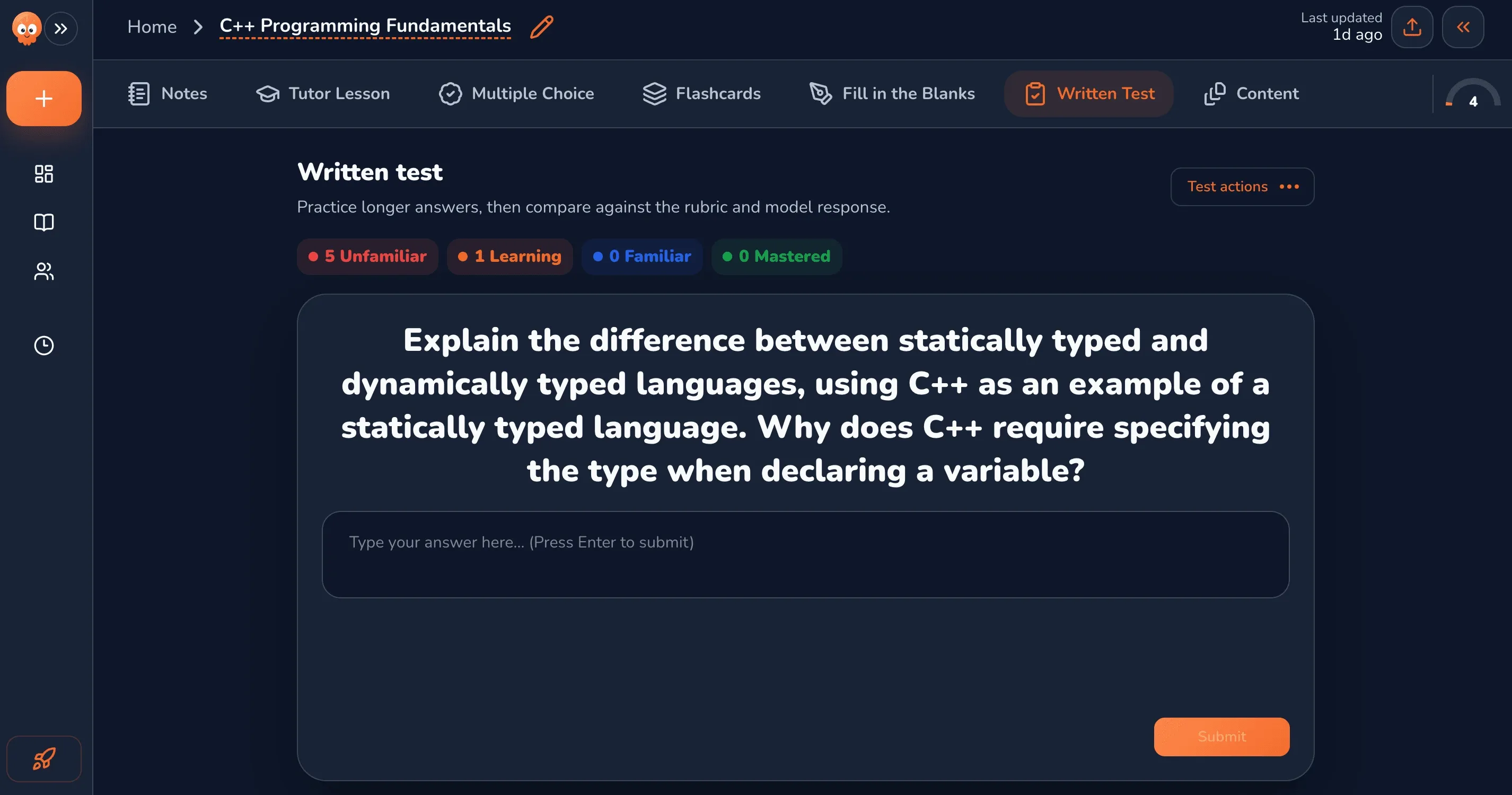
Then use the color to choose the next action. In Muneo, this is the useful part of written practice: the answer, source material, and weak-topic status stay in the same study session, so a red or yellow answer can become the next thing you review instead of disappearing into a separate notes file. Green topics can wait. Yellow topics need another question soon. Red topics need a short source review, a corrected explanation, and another retrieval attempt later.
This is where many students lose time. They reread everything after one bad quiz. A better response is targeted repair: look only at the source section connected to the missed answer, then test that idea again.
When rereading still helps
Rereading is not useless. It helps when the topic is new, when your first explanation is clearly wrong, or when you need to check exact wording, formulas, diagrams, dates, or exceptions.
The difference is timing. Reread after the retrieval attempt, not before every attempt. Testing first gives the rereading a job. You know what to look for because the quiz has already exposed the weak point.
A 30-minute practice testing session
Use this simple session when you have one focused source and about half an hour:
- Pick one focused source for 3 minutes.
- Create or collect 8 to 12 questions for 7 minutes.
- Answer with the source closed for 10 minutes.
- Check answers and mark green, yellow, or red for 7 minutes.
- Write the next review list for 3 minutes.
If you prefer to keep sources, notes, answers, flashcards, quizzes, and review together, you can build a study session from your material and keep the loop in one place.
The key is not to make studying feel harder for its own sake. The key is to stop confusing recognition with memory. Close the source, try, check, and know exactly what to review next.