
Practice questions often feel harder than rereading because they remove the support that made the material seem familiar. When the notes are open, the wording, layout, headings, and highlighted terms give you clues. A question gives you a smaller cue and asks you to produce the answer yourself.
That change can feel like forgetting, but it often reveals a more useful distinction: recognising an explanation is not the same as retrieving it. The important question is not whether practice feels easy. It is whether the difficulty is helping you identify and repair a gap.
Why do practice questions feel harder than rereading?
Rereading gives you the answer in front of you. Your task is mainly to follow the explanation and recognise information you have seen before. Practice questions reverse that direction. You see a prompt and must decide what matters, find the relevant idea in memory, organise it, and express it accurately.
That extra work creates several kinds of friction:
- Fewer cues: the page layout and exact wording no longer guide you.
- Slower access: you may know the idea but need time to reconstruct it.
- Error visibility: a blank answer shows what rereading allowed you to overlook.
- Decision pressure: you must choose a rule, formula, example, or explanation rather than simply follow one.
This is why a chapter can feel clear while it is open and suddenly feel uncertain when you close it. The two activities are measuring different abilities. Rereading mostly tests recognition. A practice question tests access and use.
The familiarity trap in rereading
Rereading can create a convincing sense of progress. The sentences move smoothly, the definitions look obvious, and the material seems easier on the second or third pass. But that fluency partly comes from seeing the same cues again. It does not necessarily mean you could explain the idea without them.
Try this quick check. After reading a section, close it and write three things you remember, one relationship between them, and one example. Then reopen the section. The difference between what you produced and what was on the page is more informative than how comfortable the rereading felt.
This does not make rereading useless. It can refresh a forgotten explanation, help you orient yourself in a difficult chapter, and provide feedback after an attempt. The problem is treating familiarity as the final test of learning.

When difficulty is useful and when it is not
Not every difficult study task is beneficial. Useful difficulty comes from trying to retrieve, explain, compare, or apply material that you have encountered. Unhelpful difficulty comes from missing prerequisites, unclear instructions, an inaccurate question, or a task that is far beyond your current level.
Use this distinction:
| What the attempt feels like | Likely problem | Better response |
|---|---|---|
| You remember part of the idea but miss a detail | Retrieval gap | Check the answer, name the missing detail, and retry later |
| You know the facts but cannot choose a method | Application gap | Work through a changed example and explain the choice |
| Every term in the question is unfamiliar | Foundation gap | Review the prerequisite concept before practising again |
| The answer key seems inconsistent or vague | Question or feedback problem | Check the source, marking guidance, or another explanation |
| You cannot begin even with a clear prompt | Task is too large or poorly scoped | Break it into a smaller question or use a worked example first |
The goal is not to make every session uncomfortable. The goal is to make the task demanding enough to reveal something you can act on.
A useful attempt usually leaves you with something to inspect: a partial answer, a plausible mistake, or a missing link between ideas. If you cannot identify what the question is asking or cannot produce even a starting point, the task is probably too broad or too advanced for the moment. Add a small amount of support, then try again. Difficulty is useful when it points to a next action, not when it leaves you guessing at random.
A hard question is not automatically a good question
Difficulty by itself is not evidence of quality. A question can feel hard because it is badly worded, tests a topic you were never taught, combines too many steps, or expects a detail that the source does not support.
Before blaming your memory, inspect the question:
- Can you identify the topic and the task word, such as explain, compare, calculate, or predict?
- Does the question contain enough information to answer it?
- Is it testing the material you intended to study?
- Can you describe what a correct answer would need to include?
- Is the expected answer appropriate for the level and format of the exam?
If the question fails these checks, rewrite it before using it as evidence about your understanding. A precise question creates useful effort. A vague question creates unnecessary confusion.
What to do when you get an answer wrong
Do not stop at marking an answer as wrong. The useful information is the type of failure underneath it. A wrong answer may come from a forgotten fact, a confused relationship, a misread command word, a calculation error, or a correct idea applied under the wrong condition.
Use a short error record:
- Question: What were you asked to do?
- Attempt: What did you answer, and what were you thinking?
- Gap: What exact fact, link, rule, or decision was missing?
- Repair: What source passage, worked example, or explanation fixes it?
- Retry: What changed question will show whether the repair worked?
For example, a biology question may ask why an enzyme reaction slows at high temperature. If you write only “the enzyme stops working,” the gap is not necessarily the definition of denaturation. You may need to connect the change in temperature to the active site’s shape and then to the reduced formation of enzyme-substrate complexes. The repair should target that chain, not send you back to reread the whole chapter.
Check the answer soon after the attempt while you can still see where your reasoning broke down. Write the correction in your own words, name the step you missed, and return to a changed version of the question later. Looking at an answer key without explaining the correction can create a second familiarity trap: the solution looks obvious, but you may still be unable to produce it next time.
Research on retrieval practice supports using questions as a learning activity, not only as a final measurement. A review of retrieval practice in the Annual Review of Psychology explains why retrieving information can improve later learning across materials and learner groups. Accurate feedback helps turn an attempt into a useful correction, so checking the answer is part of the method rather than an optional extra.
Use a difficulty ladder instead of jumping to the hardest test
If practice questions feel impossible, reduce the support gradually. This lets you locate the point where understanding breaks down without replacing retrieval with another long rereading session.
If you cannot answer any question in a set, do not treat the whole result as proof that you know nothing. Start with one prerequisite or a worked example, then close the source and answer a smaller question about the same idea. The aim is to recover enough structure for retrieval to become informative.
Try this ladder:
- Read a short explanation and underline the problem it solves.
- Answer a question with the key terms listed as prompts.
- Answer the same question with the source closed and no term list.
- Apply the idea to a familiar example.
- Apply it to a changed condition or unfamiliar example.
- Mix it with questions from other topics and answer under time pressure.
You do not need to complete every step for every topic. Move down the ladder until the attempt becomes informative rather than random. Then add only enough support to make the next attempt possible.
How to tell whether you are improving
Do not judge progress only by the feeling of confidence during a study session. Track evidence that reflects what you will need to do in the exam:
- Can you start the question without searching your notes?
- Are your answers becoming more complete, not just faster?
- Do you make fewer errors of the same type?
- Can you explain why your answer fits the question?
- Can you solve a changed version rather than repeat the example?
- Do you need fewer hints before checking the source?
Keep a small record for one topic. Write the question, your first result, the error type, and the result on the retry. A question that remains difficult but produces a more accurate explanation is evidence of progress. A question that becomes fast only because you memorised its wording may not transfer.
How to use practice questions after rereading
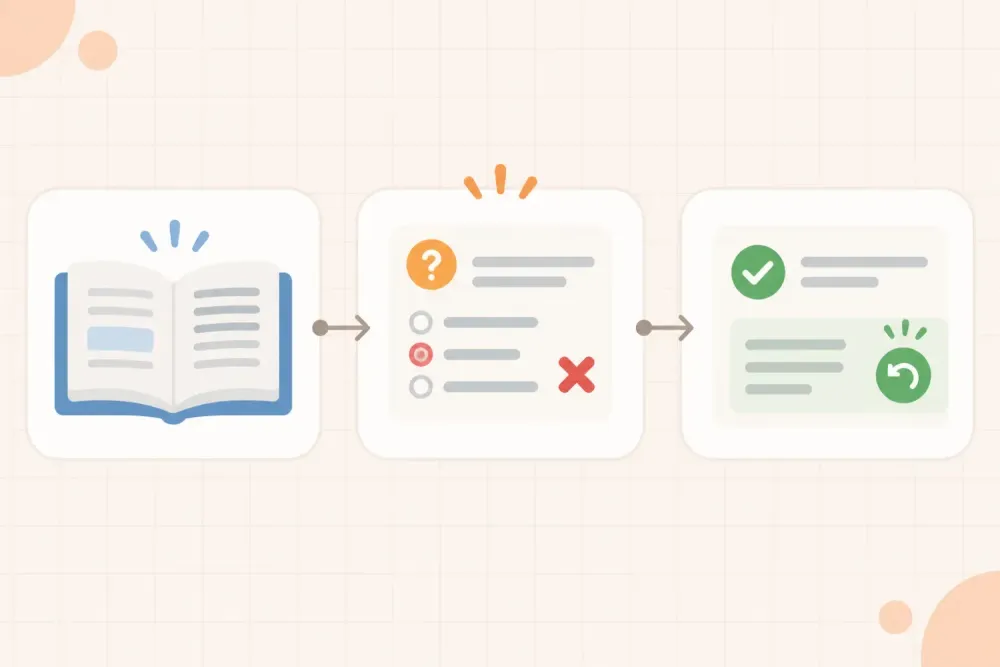
You do not have to choose between reading and testing as if one must disappear. Give each activity a different job:
- Orient: skim the section, headings, diagrams, and key terms.
- Retrieve: close the material and answer a few questions.
- Repair: check the source only for the gap you found.
- Transfer: answer a new question that changes the example, condition, or wording.
- Space: return later, when the answer is no longer immediately available.
For a long PDF or lecture, select one small section at a time and create questions that match its actual demands. If you want to turn a PDF into practice questions, use the generated questions as a starting point, then remove vague prompts and verify every answer against the source.
You can use the same sequence with your own notes. For the broader habit behind it, see this active recall guide; this article focuses on how to interpret the uncomfortable feeling that appears when you use it.
When practice feels harder because the question is too broad
“Explain this chapter” is not a useful practice question. It is too large to answer, difficult to mark, and likely to produce a list of disconnected facts. Narrow the task until the answer has a clear boundary.
Instead of asking “Explain cellular respiration,” ask:
- What is the role of oxygen at the end of the electron transport chain?
- Why does the proton gradient matter for ATP production?
- What changes when oxygen is unavailable?
- Which steps produce reduced electron carriers, and where are they used?
Each question targets a relationship or condition that can be checked. Several focused prompts also give you a better map of what to repair than one intimidating request for everything you know.
Use questions created with AI carefully
An AI tool can help you create a varied set of questions from a lecture, PDF, or notes. That is useful when the material is long or when you keep writing the same type of prompt. But generated questions can be too broad, contain a wrong premise, or test a minor detail while missing the course objective.
Ask for a mix of recall, explanation, and changed-condition questions. Then answer with the source closed and check the wording and answer against the original material. A generated question is a practice aid, not the authority.
The value comes from the loop: attempt, inspect, repair, and retry. Keeping the source beside the questions can make that loop easier to follow, but the tool is secondary to checking whether each question and answer match the material.
A better rule for deciding whether to keep practising
Keep a question in your rotation when it meets three conditions:
- It tests a concept or decision that matters for your course.
- Your answer can be checked against a reliable source or marking guide.
- A wrong answer tells you what to do next.
Rewrite or remove it when it is vague, factually unsupported, or so advanced that every attempt becomes a guess. Good practice questions are not designed to make you feel incapable. They are designed to make the next improvement visible.
The takeaway
Practice questions feel harder than rereading because they ask you to produce knowledge without the page doing part of the work. That difficulty is useful when it reveals a specific retrieval or application gap and leads to feedback, repair, and a changed retry. If the task is confusing for reasons unrelated to the material, adjust the question or add a small amount of support.
Use rereading to orient yourself, questions to expose what you can produce, and feedback to decide what deserves another look. The aim is not to make studying feel difficult for its own sake. It is to make each difficult attempt tell you what to do next.