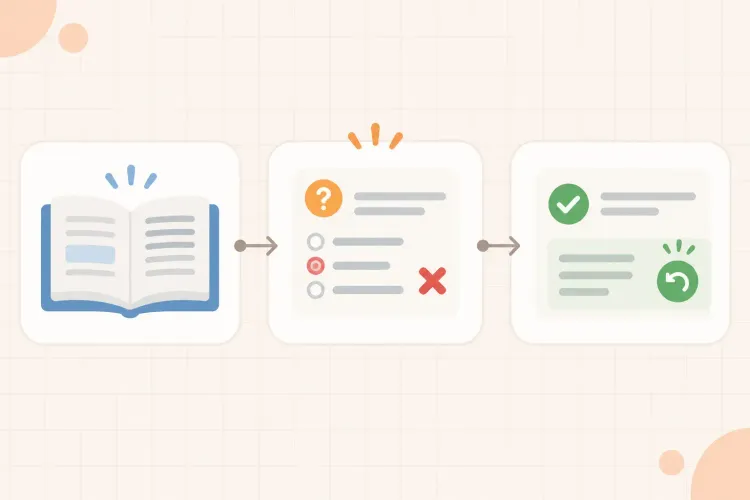

Interleaving and blocked practice are not competing study rules that you must choose once and use forever. They solve different problems. Blocked practice keeps similar problems together so you can learn the basic method. Interleaved practice mixes related problem types so you have to identify the right method before you begin.
For most subjects, a useful sequence is: learn a new type in a short block, check that you can use it, then mix it with nearby types. That gives you enough repetition to build the method without letting the practice become an exercise in recognising the next question.
Interleaving vs blocked practice: what is the difference?
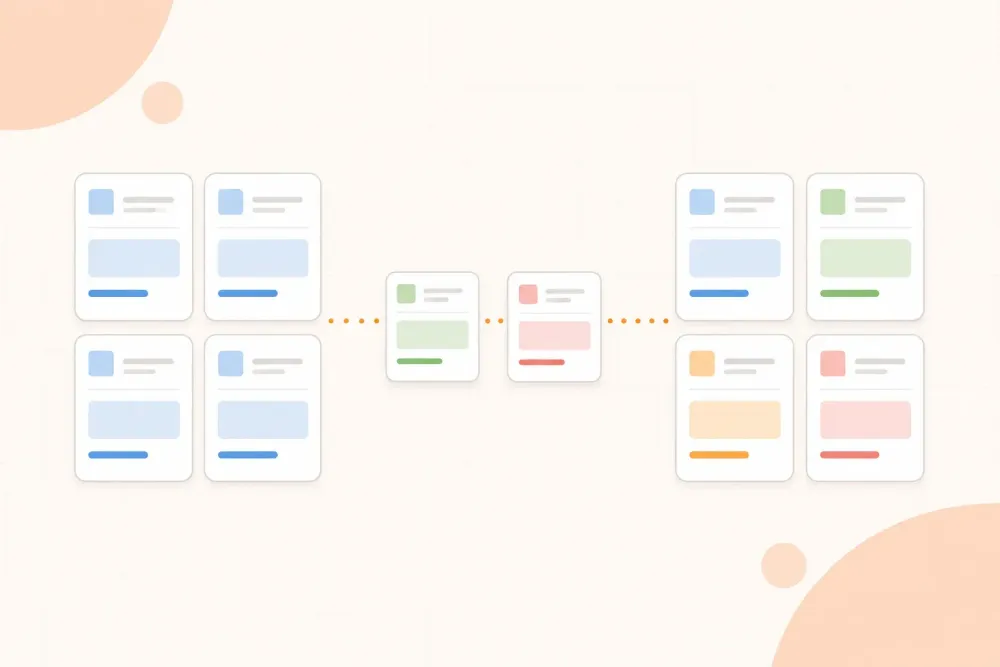
Blocked practice means completing several similar questions in a row. You might solve ten quadratic equations, label five cell diagrams, or practise one verb tense for fifteen minutes. The repeated structure reduces the decision-making load, so you can focus on learning the procedure.
Interleaved practice means alternating between related topics, question types, or skills. A maths set might move from a quadratic equation to a simultaneous equation, then to a graph interpretation. A biology set might ask about enzymes, transport, and respiration in a mixed order. Because the sequence does not tell you what comes next, you must recognise what each question requires.
| Practice arrangement | What you do | Main benefit | Main risk |
|---|---|---|---|
| Blocked | Repeat one skill or question type | Build the first workable method | Mistaking familiarity with reliable choice |
| Interleaved | Mix related skills or topics | Practise choosing and transferring the method | Mixing material before the basics are ready |
Blocked practice often feels smoother because each question gives you a clue about the next one. Interleaving can feel slower and produce more mistakes, but that difficulty may be useful when the exam will not tell you which method to use.
The research does not mean that interleaving wins every time or that blocked practice has no place. Studies have found benefits for later retention and problem solving, but the result depends on the task, the learner's starting point, and whether the basic methods are already available. For example, a study of undergraduate physics students looked at both performance and students' perceptions of interleaved homework. That is useful context because immediate comfort is not the same as evidence of learning. You can read the study on interleaved practice in undergraduate physics for the research details.
When should you use blocked practice?
Start with blocked practice when the method is new, the steps are easy to confuse, or you cannot yet complete a basic example without support. It is especially useful when you need to build a small set of prerequisite skills before asking yourself to choose between them.
Use a block when:
- you are learning a procedure for the first time
- you cannot explain why the method works
- your first few attempts fail because of the same missing step
- the subject requires a sequence that must become more fluent
- you are correcting one narrowly defined error
For example, a student learning enzyme calculations might first complete three guided rate calculations. The aim is not to memorise the position of the numbers. It is to understand the units, identify the variables, and carry out the calculation accurately.
Keep the block small enough that you are still thinking about the method. Once the questions become automatic because they all look alike, stop adding more of the same. Move to a nearby problem that requires a choice.
When should you use interleaved practice?
Interleave after you have a basic method for each item in the mix. The purpose is to practise selection, not to make every study session unpredictable. Choose topics that are related enough to be confused in an exam but different enough to require different decisions.
Interleaving is useful when:
- an exam mixes several question types
- you need to recognise which rule or process applies
- you can complete each basic method separately
- you are preparing for transfer to an unfamiliar example
- blocked sets now feel easy but performance drops on mixed questions
Suppose you have practised the chain rule and product rule separately in calculus. A mixed set can now ask you to decide which rule, or combination of rules, fits each expression. If you still cannot carry out either rule on a straightforward problem, more mixing will hide the real gap rather than fix it.
Is interleaving always better?
No. Interleaving is useful when the main challenge is selecting between methods, but it is a poor substitute for learning a method in the first place. It can also be unhelpful when the topics are so different that switching adds mental movement without creating a meaningful choice.
Use the performance you can produce after a delay, not the discomfort of the session, as your test. If a mixed set helps you identify the right method and transfer it to a new question, keep it. If it only produces guesses because the foundations are missing, return to a short block and rebuild the missing step.
A simple way to combine them
For most topics, use a gradual transition rather than switching from one extreme to the other:
- Build the method. Complete a small block with worked examples or straightforward questions.
- Remove the cues. Put the source and topic labels away, then try one or two questions without being told the method.
- Mix nearby skills. Alternate between two or three topics that could reasonably appear together.
- Check the decision and the answer. Record whether the problem was choosing the method, carrying it out, or interpreting the result.
- Return to a short block only when the error has a clear cause. Repair that specific issue, then test it again in the mixed set.
Use the block to build the components, then use mixed practice to see whether you can choose and apply them without a cue.
A concrete example: three biology topics
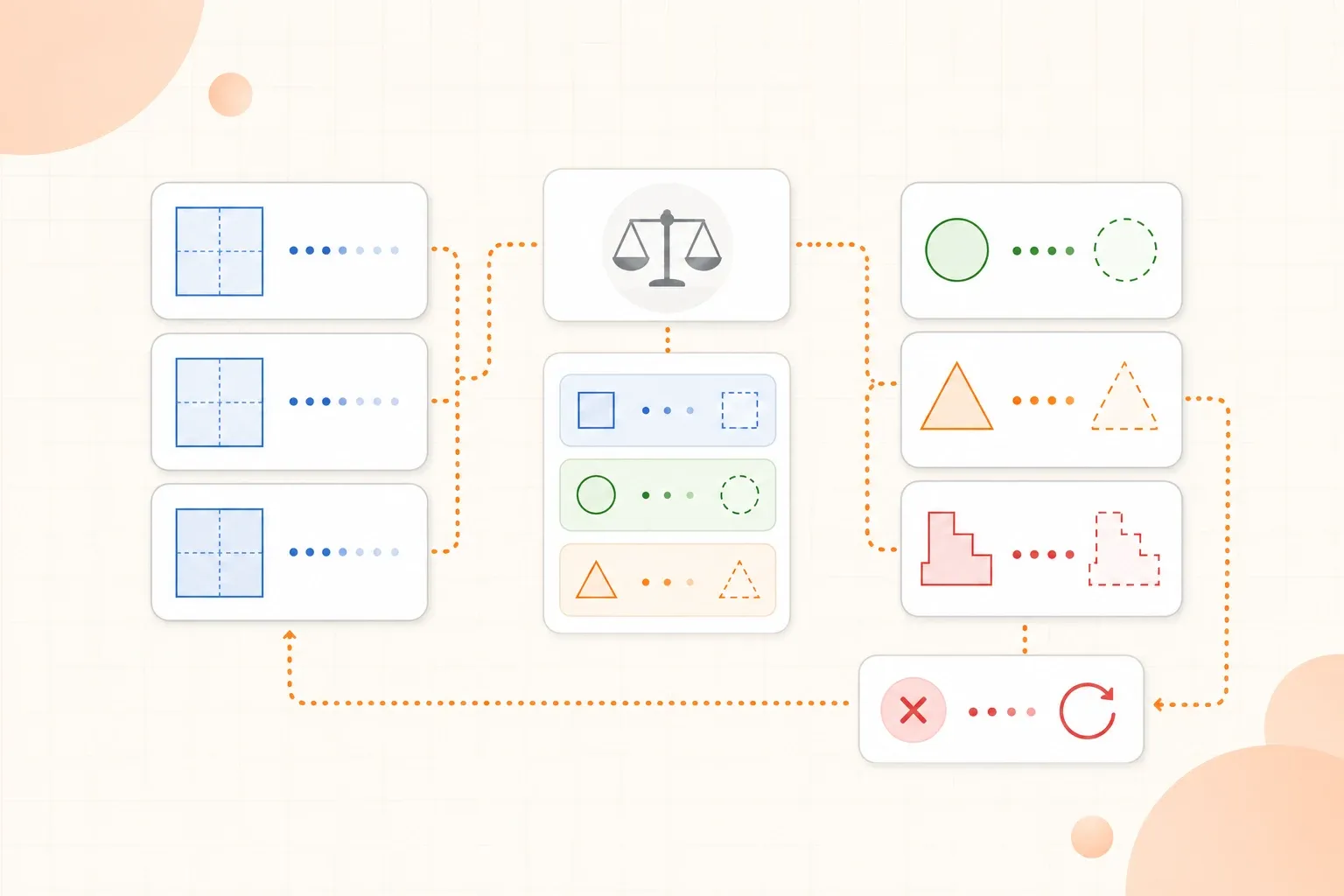
Imagine a biology student preparing for questions on membrane transport, enzymes, and respiration. A fully blocked week might look organised but leave the student unsure which explanation belongs to which question. A better progression is:
| Stage | Practice set | What the student is checking |
|---|---|---|
| Build | Three straightforward transport questions | Can you distinguish diffusion, osmosis, and active transport? |
| Build | Three enzyme-rate questions | Can you connect conditions to changes in rate? |
| Build | Three respiration sequence questions | Can you explain the role of reduced carriers and oxygen? |
| Mix | Transport, enzyme, and respiration questions in a hidden order | Can you identify the process before answering? |
| Transfer | A new data table or experimental scenario | Can you use the process when the wording and evidence change? |
If the student misses a transport question in the mixed set, the repair should match the error. They might need one short blocked pair to separate osmosis from active transport, not another hour of mixed biology questions. After that repair, they should return to a new mixed question so the correction is tested in context.
How to interleave without making study chaotic
The topics should have a reason to appear together. Start with two or three related skills, and write the target on your planning sheet before you begin. For example, mix linear equations, simultaneous equations, and rearranging formulae because all three require you to decide what operation the question is asking for. Do not combine them with an unrelated chapter simply to make the session look varied.
A useful mixed set has three properties:
- Comparable difficulty: one topic should not be so advanced that it dominates the session.
- A meaningful choice: you should need to identify a method, relationship, or command word.
- A checkable answer: you should be able to explain the decision and verify the result.
You can also use a predictable pattern at first, such as A-B-A-C-B-C, before moving to a less obvious order. The goal is to remove helpful topic cues gradually, not to create a guessing game.
How to know whether interleaving is helping
Do not judge the method only by speed or by how comfortable the session feels. Track the decisions that matter:
- Did you choose the correct method before starting?
- Could you explain why that method fit the question?
- Did the same error appear across more than one topic?
- Could you use the idea in a new diagram, data set, or wording?
- Did you remember the method after a delay rather than immediately after practising it?
A simple error log can separate three problems:
| What went wrong | Best next step |
|---|---|
| You did not recognise the question type | Add more mixed comparison questions |
| You recognised it but used the steps incorrectly | Use a short focused block, then retry in context |
| You used the method but misunderstood the evidence | Practise interpretation with a new example |
Once you have an error log, you can find your weak spots before an exam and use the error type to decide whether your next block should be focused or mixed.
How interleaving fits with spaced review
Interleaving changes the order of practice within a session or set. Spaced review changes the time between sessions. They can work together, but they are not the same technique.
For example, you might block a new genetics procedure on Monday, mix it with ecology and cell biology on Wednesday, and revisit the mixed set the following week. The gap between sessions gives recall less immediate support, while the interleaving makes you choose the relevant process.
For the separate question of how active recall differs from review timing, understand the difference between spaced repetition and active recall before combining the methods. Active recall is about producing an answer instead of simply rereading it, while spaced repetition changes the time between attempts.
Common mistakes with interleaving
Interleaving is easy to apply badly. Avoid these common mistakes:
Mixing before learning the basics
If every question feels unfamiliar, the problem may be missing knowledge rather than poor method selection. Build one clear example first, then add a second related type.
Choosing unrelated topics
Random variety does not automatically create useful difficulty. Mix topics that share a decision point, such as choosing between two equations, distinguishing biological mechanisms, or selecting an evidence-based interpretation.
Treating every mistake as evidence against interleaving
Some mistakes show that you need a short focused repair. That does not mean the whole mixed set failed. Classify the error, fix the smallest missing piece, and return to a new question.
Keeping the same order every time
If the sequence never changes, you may remember what comes next instead of recognising the problem. Vary the order while keeping the topic set stable enough to analyse.
Measuring only how much you completed
Finishing thirty questions is not the same as making thirty useful decisions. Count correct method choices, explanations, and repaired errors as well as completed items.
How to choose in your next study session
Ask one question before choosing the arrangement: Are you still learning how to do this, or are you learning when to use it?
- If you are still learning how to do it, use a short block.
- If you can do it but hesitate between methods, interleave it with the closest alternatives.
- If you can choose and use it accurately, add a delay or a changed example to test transfer.
- If the mixed set reveals one narrow weakness, return briefly to that weakness before mixing again.
The distinction stays the same across subjects. In languages, block a new verb pattern, then mix it with familiar patterns so you must identify the tense. In chemistry, block the steps for one calculation, then mix it with nearby calculations that use different information. In history, block the structure of one argument, then alternate causes, consequences, and evidence questions.
Which one should you use?
Use blocked practice when you are still building the steps. Switch to interleaving when the challenge is choosing between methods. Neither is a complete study system by itself.
Start with a small focused block, remove the cues, mix related topics, and let your errors determine the next repair. Once the order stops giving you the method for free, you get a clearer test of what you can actually do.