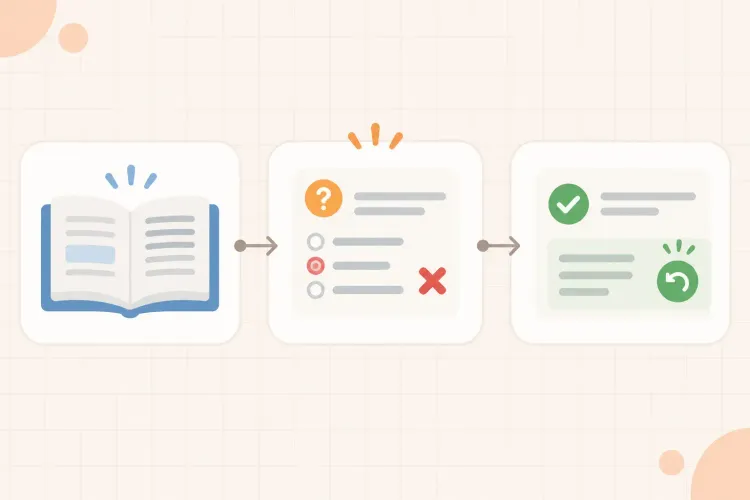

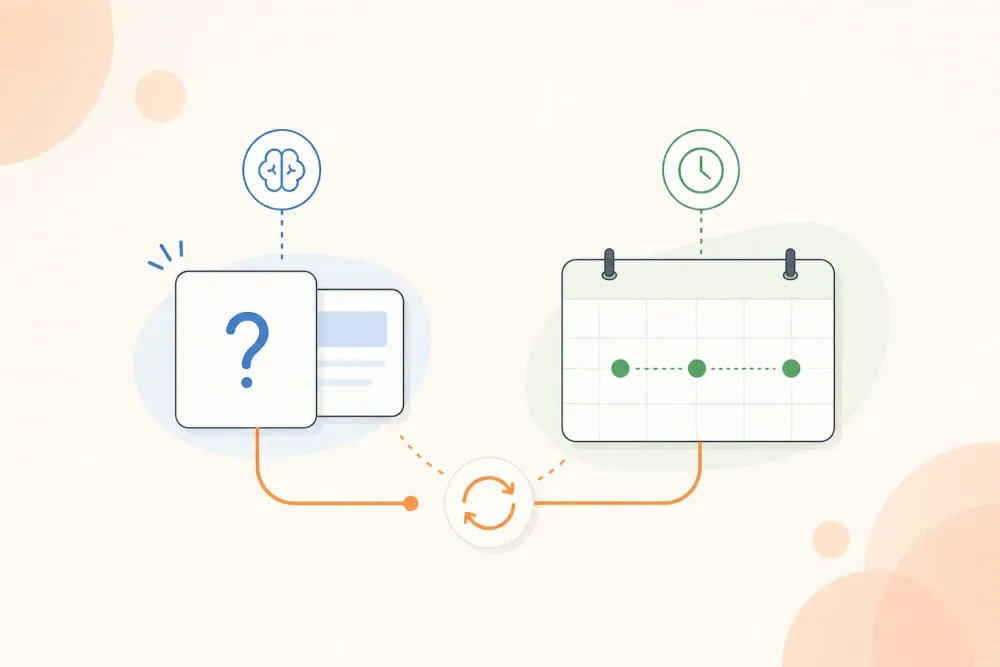
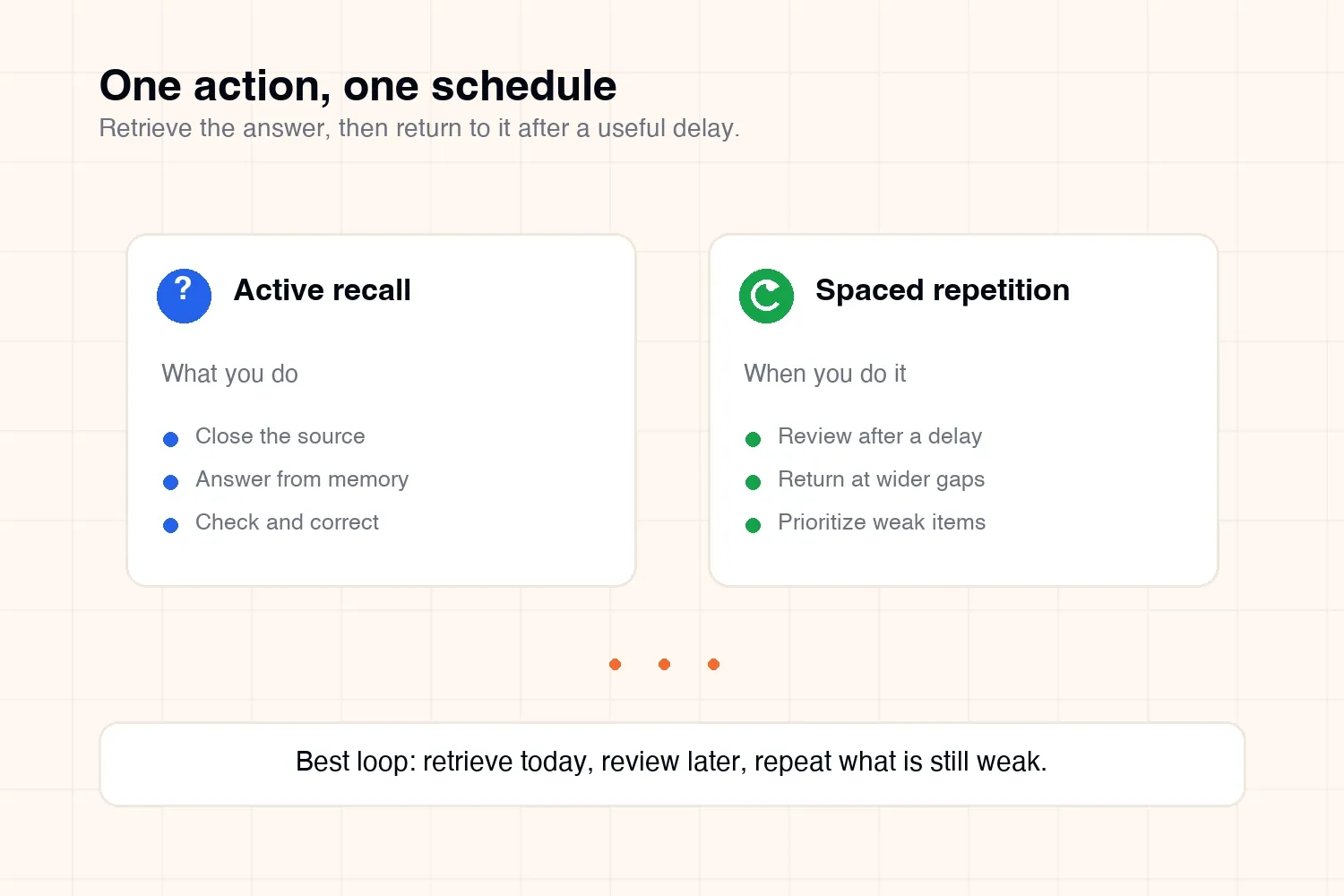
Spaced repetition and active recall are often presented as competing study methods. They are not. Active recall describes what you do when you study: close the source and retrieve an answer. Spaced repetition describes when you do it: return to that question after a delay instead of reviewing everything in one sitting.
That distinction matters because a perfect schedule cannot rescue passive review, and the memory from one recall attempt may fade if you never return to it. For long-term learning, use active recall inside a spaced schedule: retrieve, check, wait, and retrieve again.
Spaced repetition vs active recall in one sentence
Active recall is how you study; spaced repetition is when you study it again.
| Question | Active recall | Spaced repetition |
|---|---|---|
| What does it control? | The action during review | The timing between reviews |
| What does it look like? | Answering a question before checking | Repeating that question across days or weeks |
| Main risk if used alone | You may not return to the material | You may reread on a schedule without retrieving |
| Best use | Test understanding now | Keep useful knowledge accessible later |
The two ideas overlap when you use flashcards, practice questions, or short-answer prompts on a schedule. A flashcard session uses active recall when you attempt the answer before revealing it. The review dates are spaced repetition.
What is active recall?
Active recall, also called retrieval practice, means trying to bring information to mind before looking at the answer. The medium is secondary: a flashcard, blank page, worked problem, or explanation can all work if you must produce the answer before seeing support. For a deeper guide to the retrieval side of studying, learn how to use active recall to remember more.
For example, instead of rereading a page about cellular respiration, close the page and answer: `What is the role of the electron transport chain?` Then compare your answer with the source and correct what is missing. The effort of producing the answer is the important part; the format can vary.
Retrieval practice is useful because it shows what you can produce without support. Recognition is weaker evidence. A sentence may look familiar when you see it in your notes even though you could not explain it in an exam.
What is spaced repetition?
Spaced repetition means revisiting material across separate sessions instead of repeating it all at once. The delay gives you a chance to forget some of the material, so the next attempt requires real retrieval rather than immediate repetition.
The tool is secondary. A calendar, notebook, or flashcard app can all work if it brings the same question back after a delay. What matters is that the next review is triggered by time and performance, not by whatever page you happen to reread next.
A useful starting pattern is:
- Today: learn the idea, then answer a few questions with the source closed.
- Tomorrow: bring back anything you missed or only partly explained.
- Three or four days later: mix those questions with newer material instead of reviewing one topic in isolation.
- The following week: test the weak topics again with a changed example or question order.
The exact gaps should depend on your deadline and the difficulty of the material. A topic you can explain easily may need less frequent review than one you repeatedly miss. The University of California San Diego describes spaced practice as distributing study across days or weeks rather than massing it before an exam. Read the spaced-practice guidance for a calendar-based example.
Why they work better together
Active recall is the effortful act of retrieving an answer; spacing determines when that act happens again. Each time you retrieve a concept after a delay, you learn whether it is still accessible.
Together, they turn mistakes into scheduling data. Several reliable answers justify a longer gap. A repeated miss calls for a nearer review, a smaller prompt, or a clearer explanation before the question returns again.
Research explains why the two ideas should be separated. In a study by Roediger and Karpicke, rereading produced higher immediate confidence, while practice testing led to stronger retention after a delay. In practical terms, active recall tells you whether you can retrieve the answer now; spacing tests whether it survives until later. Read the testing-effect study.
This is why a spaced-repetition deck should not become a queue of cards that you flip through passively. The schedule is only helpful if each review includes an honest attempt before you reveal the answer.
How to combine active recall and spaced repetition
Use this five-step loop for a chapter, lecture, PDF, or set of notes:
- Choose one decision-sized topic. Start with a lecture section or learning objective that can be tested in a few questions.
- Write prompts that expose understanding. Ask for an explanation, comparison, calculation, or new example rather than a phrase copied from the source.
- Retrieve with the source closed. Answer in writing or out loud before looking at the notes.
- Classify the result. Mark the answer as solid, partial, or missed; then keep only the correction that would prevent the same mistake.
- Let the result set the delay. Bring partial or missed answers back tomorrow, and move solid answers to a longer gap.
The distinction is especially useful when you start with a lecture or PDF. Turn the important ideas into questions, answer them without looking back, check the gaps, and schedule the questions you missed for another attempt. The source gives you the material; retrieval and timing do the learning work.
A worked example: biology over one week
Suppose you are studying membrane transport. On Monday, create six questions from the lecture: define diffusion, compare passive and active transport, explain the sodium-potassium pump, and apply the ideas to three short scenarios.
Answer the questions with the lecture closed. You remember diffusion and passive transport, but you confuse the direction of the pump. Check the diagram, write a short correction, and schedule that question for Tuesday. Leave the questions you answered confidently until Thursday.
On Thursday, answer all six again in a mixed order. The pump question is now correct, but one application scenario is weak, so that question returns on Friday. On the following Monday, use a new scenario rather than repeating the same wording. You are practicing the concept, not memorizing the shape of one card.
The active-recall part is each attempt to retrieve and explain the answer. The spaced-repetition part is the Monday, Tuesday, Thursday, Friday, and following-Monday timing.
Active recall without spaced repetition
Active recall still helps when an exam is tomorrow or you only need to prepare for a short-term task. In that case, use it to triage: close the source, answer the questions most likely to matter, and spend the remaining time repairing the gaps that appear.
The limitation is that one session does not give you much evidence about long-term recall. You may perform well immediately after learning and still struggle a week later. When the knowledge needs to last, add another retrieval session after a delay.
For the science behind testing yourself rather than rereading, see the practice-testing explanation. The key difference here is timing: when those retrieval attempts happen.
Spaced repetition without active recall
A spaced schedule is better than cramming, but spacing passive rereading is not the same as spaced retrieval. If you only highlight or reread when the calendar tells you to, you may build familiarity without checking whether you can produce the answer.
A card that repeatedly fails is often a prompt problem, not a sign that more rereading is needed. Break it into a smaller question, review the explanation, and attempt the new version after a short delay. The goal is an honest but manageable retrieval attempt.
How often should you use spaced repetition?
There is no single schedule that fits every subject or deadline. Start with a review soon after learning, then widen the gap when you can retrieve the idea reliably. Bring a question back sooner when the answer is missing, mixed up with a similar idea, or too brittle to transfer to a new example.
Let performance guide timing rather than chasing a fixed number of days. With several weeks before an exam, give weak questions the next-day slot and move reliable ones to later in the week. With only one day left, stop trying to build a full spacing pattern: use active recall immediately, repair the highest-value gaps, and treat the result as short-term preparation.
If you need help placing those sessions around real assignments and deadlines, use a revision timetable to reserve review windows without turning the schedule into another source of stress.
The simplest way to remember the difference
Ask two questions:
- What happens during review? Retrieve the answer before checking.
- When should review happen again? Return after a delay, with weak items coming back sooner.
Active recall is the effortful action. Spaced repetition is the distribution of that action across time. Use both when you want knowledge that remains available beyond the moment it feels familiar.