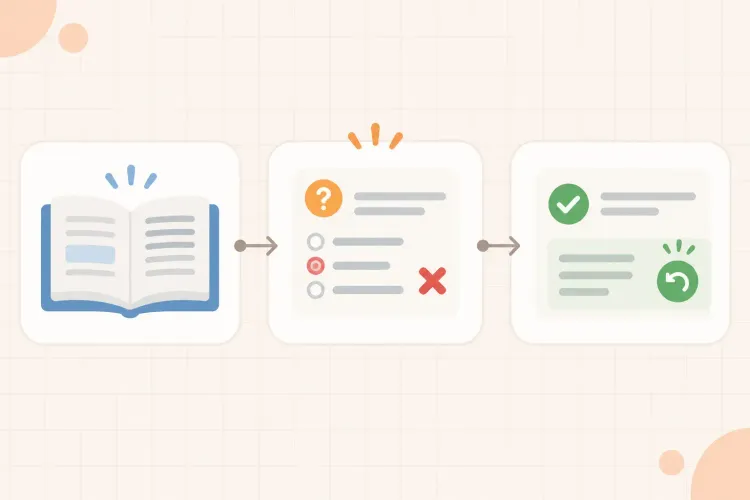


A case-study exam question gives you a situation, a set of facts, or a short data-rich scenario and asks you to use course knowledge in that context. It is not mainly a memory test. You need to notice what matters, connect it to the right concept, and explain why that concept leads to a sensible conclusion.
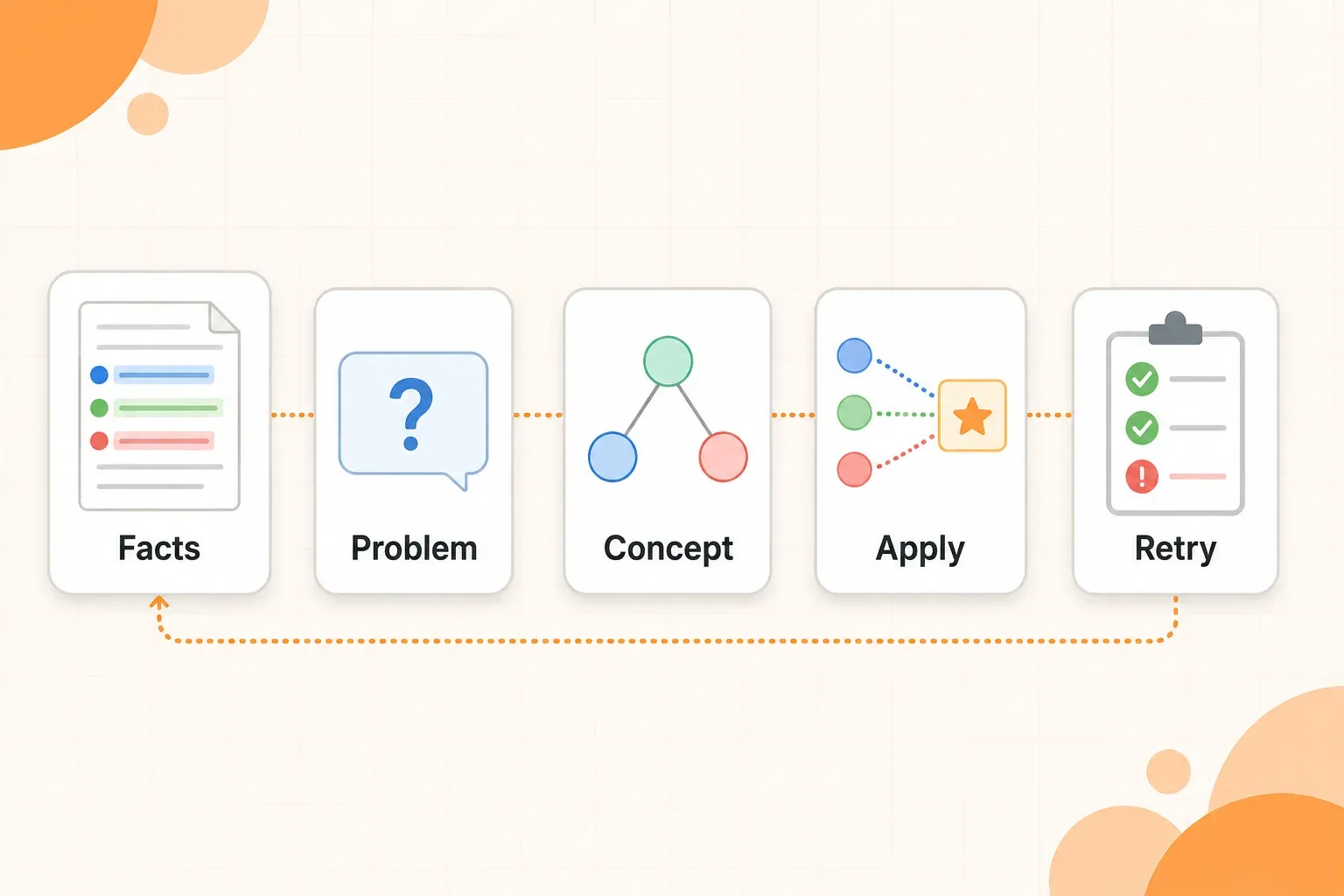
The most reliable way to prepare is to practise the whole chain: facts -> problem -> concept -> application -> conclusion. Learn the underlying material first, then work through unfamiliar cases so you are practising judgment rather than memorising a model answer.
This guide is about studying for case-based exam questions. It does not cover writing a long case-study report for an assignment, and it is not a replacement for your subject's own exam instructions or marking criteria.
What case-study exams are testing
Case-study questions vary by subject, but they usually ask you to do more than recall a definition. You may need to:
- identify the issue or decision hidden in a long scenario
- select a relevant theory, rule, model, or process
- connect specific facts to that concept
- compare possible explanations or actions
- make a conclusion that fits the evidence and the question
That is why rereading a collection of completed cases can feel productive while leaving you unprepared. You recognise the company, patient, dispute, or situation, but recognition does not guarantee that you can decide what matters in a new case.
The exact balance depends on the assessment. Some exams use short case-based questions with several linked parts. Others give you a longer scenario and ask for analysis, calculation, advice, or a recommendation. Check the official assessment outline before you build your study plan. Monash's guide to approaching case studies is useful here because it separates analytical cases from problem-solving cases.
Build a case-study knowledge base
Do not begin by collecting full answers. Build three smaller resources that you can use across different cases.
1. A concept and framework map
List the theories, rules, models, processes, and calculations that the course expects you to use. For each one, record:
- what problem it helps you analyze
- the signals that make it relevant
- the facts you would need to apply it
- its main limitation or alternative
For example, a business student might list SWOT, break-even analysis, stakeholder analysis, and the marketing mix. A law student might list the elements of a claim, relevant tests, and possible defenses. A health student might map symptoms, risk factors, mechanisms, and treatment considerations.
The purpose is not to create a second textbook. It is to make the choice between concepts visible.
2. An evidence bank
Keep examples, figures, definitions, regulations, and course-specific evidence in a form you can retrieve quickly. Add a note explaining what each item shows and when it would not apply.
An evidence bank is more useful than a list of quotations because case questions usually reward a connection between evidence and the facts in front of you. If you use an example from a lecture or reading, write the underlying point beside it rather than storing the example alone.
3. A case pattern log
After each practice case, record the type of decision it required, the clue you missed, and the concept that eventually helped. Over time, the log becomes a map of recurring case signals.
| Resource | Record this | Why it helps |
|---|---|---|
| Concept map | Problem, signals, application, limitation | Makes method selection faster |
| Evidence bank | Fact, meaning, and conditions | Stops examples from becoming decoration |
| Case pattern log | Missed clue and correct concept | Shows what to practise next |
Use the fact-to-analysis method
When you study a case, move through the same sequence each time. The sequence gives you structure without forcing every subject into the same answer format.
Step 1: Read the question before the case
Start with the actual requirement. Look for the task, the subject of the answer, the time period, the decision-maker, and any limits on what you should discuss. Mark the command word if there is one, but focus on the job it sets rather than memorising a definition.
Do not read the case as if every sentence deserves equal attention. The question tells you what kind of evidence to look for.
Step 2: Reduce the case to relevant facts
On your first pass, write only facts that could change the answer. Separate them into three groups:
- Situation: What is happening and who is involved?
- Evidence: Which facts, figures, symptoms, rules, or events support an interpretation?
- Constraint: What limits the available options or changes the likely outcome?
This prevents a common mistake: copying the case into your answer without explaining why its details matter.
Step 3: Name the central problem
Put the case into one sentence. For your notes, write: “The central issue is whether [decision or problem], given [most important evidence] and [main constraint].”
The sentence is for your planning, not necessarily for the final answer. If you cannot name the problem, you may be selecting concepts too early or treating every detail as equally important.
For example, “the company has falling sales” is only a symptom. “The company must decide whether falling sales come mainly from price, positioning, distribution, or a change in customer demand” is a problem that can guide analysis.
Step 4: Choose the concept that fits
Now compare the problem with your concept map. Ask:
- Which concept explains the decision in this case?
- What evidence would I expect to see if it applies?
- What nearby concept could be confused with it?
Do not choose a framework because it is the one you revised most recently. Choose it because it explains the facts and helps you answer the question.
Step 5: Apply the concept to the facts
Application is the part that turns a general explanation into case analysis. Use a simple chain:
- State the relevant concept or rule.
- Point to the specific fact that activates it.
- Explain what the fact means in this situation.
- Show the likely consequence or implication.
The answer should make clear why the concept matters here. A named framework without a connection to the case is description, not analysis.
Step 6: Compare and conclude
If the question asks for a recommendation or judgment, compare the strongest options against the case's constraints. A useful conclusion does not repeat every point. It identifies the best-supported option, explains why it fits the situation, and states what condition could change the recommendation.
For a short question, this may take two or three sentences. For a longer response, it may become a paragraph with evidence and a limitation. Let the marks, time, and wording guide the depth.
Practice cases without memorizing model answers
Completed answers are useful for checking your reasoning, but they are poor material for memorisation when the case can change. Use them in three passes.
Pass 1: Diagnose before looking at the answer
Read the question and case, then write:
- the central problem
- two or three relevant facts
- the concept or framework you would use
- your provisional conclusion
Only then compare your plan with the model answer. This shows whether your difficulty was finding the issue, choosing the concept, applying it, or reaching a conclusion.
Pass 2: Change one condition
Alter a meaningful fact. Change the budget, the legal duty, the patient's risk factor, the market condition, or the available evidence. Then ask what part of your analysis changes first.
This is more valuable than rereading the same case because it tests whether you understand the relationship between the facts and the conclusion.
Pass 3: Use an unfamiliar case
Finish with a case you have not seen before. It can be shorter than a full mock. Your aim is to recognise the problem and choose a defensible approach without relying on the memory of a previous answer.
If your notes are in a PDF or lecture document, you can turn a selected section into practice questions. Keep the questions tied to the source, then reshape broad recall prompts into case-based tasks such as “Which fact changes the recommendation, and why?”
Rehearse the decisions under time pressure
Once you can work through a case without help, add the conditions that make the exam difficult. Start by reading the requirements and checking the marks before you read every detail. An answer worth more marks usually needs more developed application than a short definition, but that does not mean every fact belongs in the answer.
Set a time limit for planning and answering. Leave enough time to identify the issue, connect the strongest evidence to the relevant concept, and write a conclusion. If the case contains incomplete or conflicting information, do not invent certainty. State what the evidence supports, name the limitation, and explain what additional fact would change your view.
After the attempt, ask whether the time problem came from reading too slowly, planning too broadly, or writing details that did not answer the requirement. Practise that specific decision in the next short case instead of simply trying to work faster.
A worked example: one case, two different analyses
Imagine a business case about a small retailer whose sales have fallen after a competitor opened nearby. The case mentions lower prices from the competitor, weaker foot traffic, a loyal customer segment, and limited cash for a store redesign.
A weak study response might memorise: “Use SWOT. Strengths are loyalty, weaknesses are cash, opportunities are online sales, and threats are competition.” That list is not wrong, but it does not decide what the retailer should do.
A fact-to-analysis response would be more selective:
- Problem: The retailer needs to protect sales without spending money it does not have.
- Relevant facts: It has a loyal customer segment, lower foot traffic, and a nearby lower-price competitor.
- Concept choice: Customer positioning and competitor analysis are more relevant to the immediate decision than a complete list of internal and external factors.
- Application: Competing only on price may be unrealistic because cash is limited. A clearer service or product-positioning response could protect the loyal segment, but it must address why foot traffic has fallen.
- Conclusion: The first action should test a focused positioning and retention offer before a costly redesign. The recommendation would change if the case showed that loyal customers were also moving to the competitor because of price.
The point is not that one framework is always correct. The point is that the answer begins with the case's decision and uses concepts to explain it.
Adapt the method to your subject
The fact-to-analysis sequence stays stable, but the evidence and conclusion look different by subject.
Business and economics
Look for market conditions, costs, incentives, stakeholders, constraints, and measurable trends. Make the recommendation conditional when the data is incomplete. A case may support a likely action without proving that it will succeed.
Health and clinical subjects
Separate symptoms, risk factors, mechanisms, evidence, and safety constraints. Explain why a finding changes the differential diagnosis or management choice. Do not treat a memorised list as a diagnosis without applying it to the case details.
Law
Identify the legal issue, the relevant rule or test, the facts that satisfy or challenge each element, and the uncertainty. Avoid writing every rule you know. Use the facts to show which rule matters and where the argument may fail.
Social sciences
Connect the scenario to a theory, study, concept, or process. Explain what the concept helps you see, then acknowledge evidence that limits the interpretation. A named theory is useful only when it changes how you understand the case.
Use feedback to repair the right problem
When a case answer goes wrong, do not simply reread the model answer. Classify the error first.
| Error | What it usually means | Next practice |
|---|---|---|
| You copied details without using them | You did not connect evidence to the task | Write a fact-meaning-consequence chain |
| You chose an unrelated framework | The case signals are not yet clear | Compare two nearby concepts using short cases |
| You knew the concept but ignored a constraint | Application was too general | Add a “what changes the answer?” line |
| Your analysis was sound but the conclusion was vague | You did not weigh the options | Write a conditional recommendation |
| You ran out of time | Planning was too broad | Practise short issue-and-application outlines |
If an answer key or mark scheme is available, use it to see whether the missing piece was evidence, application, or judgment. This guide on using a mark scheme to improve an exam answer shows how to turn that diagnosis into a retry. The useful question is not only “What did the model answer say?” It is “Which part of my reasoning prevented me from earning this mark?”
How to review a case before the exam
In the final stage, stop collecting new model answers and test the decisions you need to make quickly. For each major topic, choose one familiar case and one unfamiliar case. On the familiar case, check whether you can explain the framework without copying the response. On the unfamiliar case, check whether you can identify the problem and select a method under time pressure.
Create a short checklist for each practice attempt:
- Did I answer the actual requirement?
- Did I select facts that change the analysis?
- Did I name the concept or rule that fits?
- Did I apply it to the case rather than describe it generally?
- Did I address the main constraint or alternative?
- Is my conclusion supported and appropriately qualified?
When the question's command word is unclear, read what “explain,” “compare,” and “evaluate” require in an exam. Use that distinction to identify the answer task, then keep the case-specific analysis in this workflow. If the case requires a longer written argument, the same evidence-to-conclusion process can support your essay-exam preparation without requiring you to memorise a complete response.
Common mistakes when studying case studies
Memorizing a complete case
You may remember the sequence of one answer without understanding how the reasoning would change in a new situation. Memorise concepts, signals, and relationships instead.
Using every detail
Long cases contain context that may not affect the question. Select facts by their impact on the decision, not by how prominently they appear.
Naming frameworks without applying them
A framework is not analysis until it changes how you interpret the case. Always connect it to a fact and a consequence.
Forcing the same structure onto every subject
A legal problem, clinical scenario, and business recommendation do not use identical evidence or conclusions. Keep the reasoning sequence, but follow the conventions and assessment criteria of your subject.
Treating uncertainty as a failure
Some cases are designed to contain incomplete or conflicting information. State what the evidence supports, name the limitation, and explain what additional fact would change your view.
Writing the answer you expected
The case may resemble a practice question while asking something different. Read the requirement again before you commit to a framework or recommendation.
The method in one sentence
Prepare by learning the concepts, signals, and evidence that your subject uses. Then practise unfamiliar cases by moving from relevant facts to the central problem, the fitting concept, a case-specific analysis, and a qualified conclusion.
The goal is not to memorise what happened in one case. It is to recognise what matters when the next case changes. Close the source, name the problem, apply the right idea to the evidence, and explain why your conclusion follows.