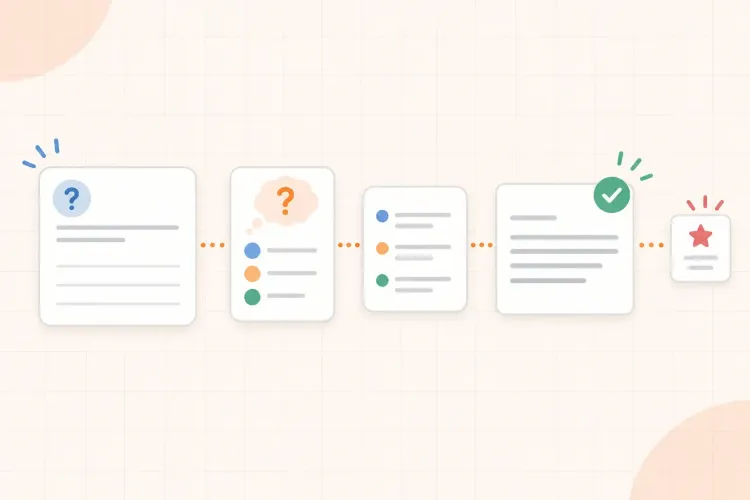


Essay exams reward more than remembering facts. You need enough knowledge to answer the question, a clear position, relevant evidence, and a structure you can build under time pressure. The most useful preparation moves from broad course themes to flexible arguments, then from plans to timed writing.
To study for an essay exam, first confirm how the assessment is marked. Then map the course into themes, build a compact evidence bank, turn likely themes into questions, practice thesis and paragraph plans, and write at least one response under realistic conditions. Review each attempt by asking whether it answered the exact prompt, supported its claims, and used time well.
How to study for an essay exam
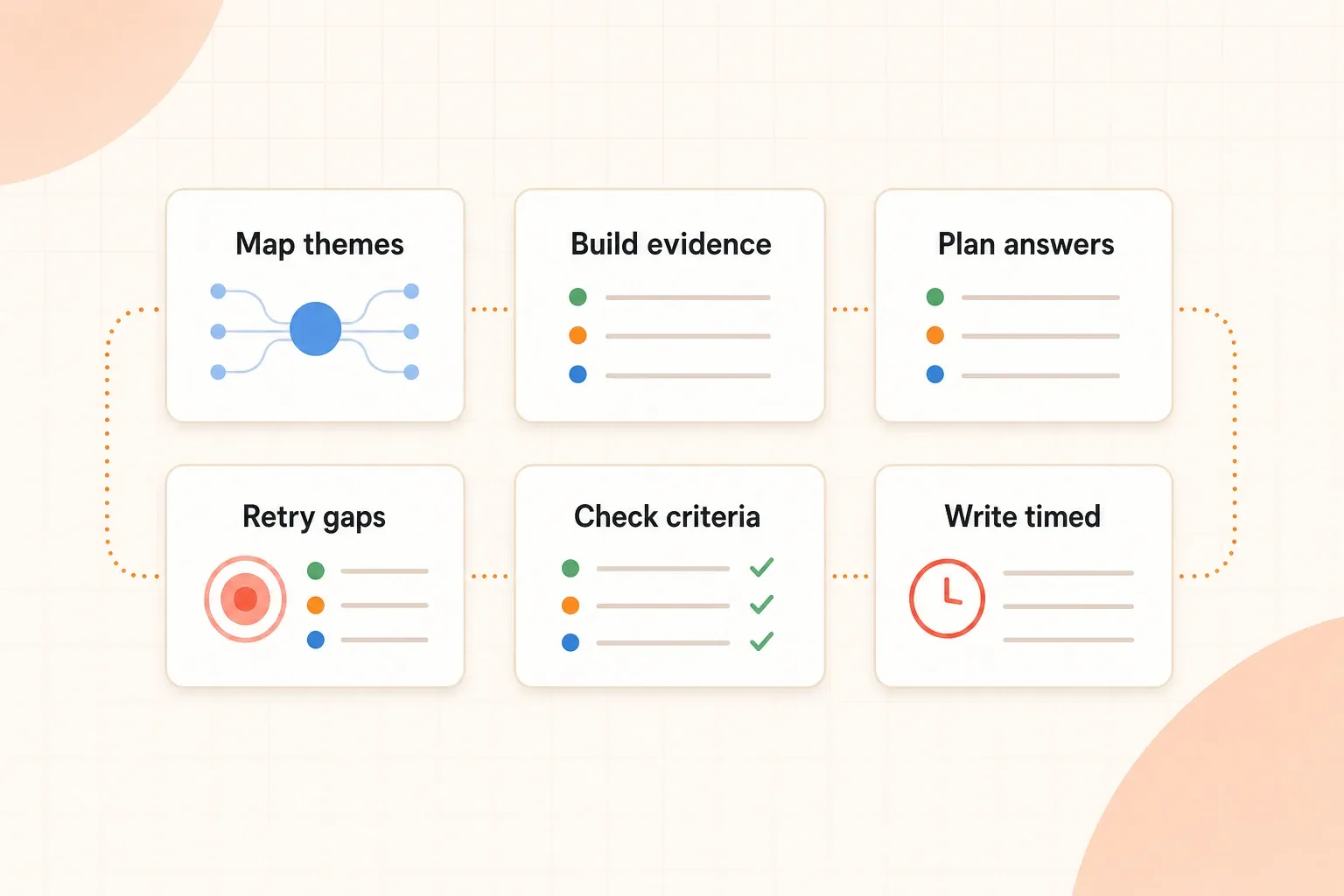
Use this sequence to turn course material into timed answers:
- Understand the assessment. Check the number of essays, time limit, question style, permitted materials, and marking criteria.
- Map the main themes. Group lectures, readings, and notes into ideas that can be compared, explained, or debated rather than memorizing chapter order.
- Build an evidence bank. For each theme, collect a few precise examples, studies, quotations, cases, or data points and write what each one proves.
- Practice flexible arguments. Turn themes into possible prompts, draft direct theses, and link each claim to evidence and explanation.
- Write under time limits. Start with short plans, then complete full responses with time reserved for checking.
- Review the reasoning. Mark missing knowledge, weak links, irrelevant evidence, and time problems. Use those findings to choose the next practice task.
This is different from memorizing finished essays. A finished essay can prepare you for one wording; a theme map and evidence bank can help you adapt when the exam asks a new question.
Start with the exam format, not the textbook
Before reviewing content, find out what the exam actually asks you to do. Look at the syllabus, assessment brief, instructor guidance, sample questions, and any available marking criteria. Note:
- whether questions are broad essays, source analyses, compare-and-contrast responses, or problem-based arguments;
- how many responses you must write and how long you have for each one;
- whether you need named readings, quotations, research findings, cases, formulas, or data;
- whether marks reward factual accuracy, analysis, use of evidence, structure, or all four;
- whether the questions are drawn from known themes or are completely unseen.
This matters because the same material can require different preparation. A literature exam may expect close reference to a text. A history exam may reward chronology, causation, and competing interpretations. A sociology exam may require theories and research evidence. Study the kind of answer you will have to produce, not just the material you will have to recognize.
Trent University's essay-exam study guide reinforces this assessment-first approach and recommends building a study guide around the course's key themes and analytical tools.
Turn the course into a theme map
Do not keep your revision organized only by lecture or chapter. Essay questions usually ask you to connect ideas across the course, so create a map that shows the relationships you may need to explain.
For each major theme, record:
- the central claim or problem;
- the concepts, theories, or events connected to it;
- two or three contrasts, causes, consequences, or interpretations;
- the evidence that supports each connection;
- one uncertainty or limitation you still need to resolve.
For example, a history course on industrialization might be organized around causes, working conditions, state responses, and long-term consequences. A question may connect all four. If your notes remain separated by week, you may remember the content but miss the relationship the prompt is testing.
Keep the map compact. Its job is to show where an argument can go, not to become another set of complete lecture notes.
Build an evidence bank that explains itself
An evidence bank is more useful than a list of names and dates because it tells you how each detail supports an argument. Use a small table like this:
| Theme | Evidence | What it helps you argue | Limitation or connection |
|---|---|---|---|
| Factory reform | A reported change in working-hour regulation | Reform followed public concern and political pressure | Compare legal change with conditions that remained unchanged |
| Industrial migration | Census or demographic pattern | Industrialization changed where and how people lived | Avoid treating migration as a single-cause process |
| Worker organization | A strike, union demand, or contemporary account | Workers acted collectively rather than only reacting individually | Distinguish short-term demands from long-term outcomes |
For science or social-science essays, replace events with studies, mechanisms, data, or theoretical examples. For literature, record the scene, quotation, image, or formal feature and the interpretation it can support.
Limit the bank to evidence you can explain accurately. Five well-understood examples are more useful than twenty details you can name but cannot connect to the question. For each item, practice completing the sentence: “This matters because…”
Practice questions before you practice essays
A list of topics is not yet an essay practice set. Convert each theme into prompts that require a decision:
- Cause: Which factor best explains the change, and why?
- Comparison: In what way were these two ideas or cases similar, and where did they diverge?
- Evaluation: How convincing is this interpretation, given the evidence?
- Change over time: What changed, what persisted, and what caused the difference?
- Application: How would this theory explain an unfamiliar case?
Write prompts that vary the wording and the angle. If you only practice a question that closely matches your notes, you may learn to reproduce a prepared paragraph instead of adapting your reasoning.
Before opening your notes, write a one- or two-sentence answer to each prompt. Mark whether the difficulty was missing knowledge, choosing a position, selecting evidence, or explaining the connection. That diagnosis tells you what to practice next.
Prepare for unseen essay questions
When the wording is unknown, do not try to predict one perfect essay. Practice adapting the same theme and evidence to different tasks:
- Read the prompt once for its topic, then again for its task and limits.
- Write a provisional position in one sentence, even if you expect to refine it.
- Choose two or three claims that answer that exact question rather than reciting the whole theme.
- Select the evidence that best supports those claims, then note one qualification or alternative view.
Repeat the drill with several prompts on the same topic. If your answer changes completely each time, the theme map may be too vague. If it never changes, you may be forcing a memorized essay onto questions that require a different emphasis.
Write thesis and paragraph plans first
Full essays take time, so begin by practicing the decisions that control the whole response. For each prompt, write:
- Your direct answer. State the position you would defend, not just the topic you would discuss.
- Your main claims. Choose two or three reasons that prove the answer.
- Evidence for each claim. Select the example, study, quotation, or data point that does the most work.
- The explanation. Write how the evidence supports the claim and how the claim answers the prompt.
- A qualification. Note a limit, counterargument, alternative interpretation, or condition that makes the answer more precise.
A useful plan is not a pile of keywords. It is a route from the prompt to the conclusion. If you cannot explain why a piece of evidence belongs under a claim, the problem is not yet solved.
Move from plans to timed writing
Once you can produce a coherent plan, write under conditions that resemble the assessment. Start with one response rather than simulating an entire exam. Use the same question style as the exam, close the source, and set a time limit that includes planning and checking.
Divide the time into three jobs:
- Plan: identify the task, choose a position, and order the claims;
- Write: develop each claim with evidence and explanation;
- Check: confirm that every part of the prompt is answered and remove irrelevant material.
Do not spend the whole session polishing the introduction. In an essay exam, a clear plan and developed body paragraphs usually matter more than an elegant opening sentence. Your practice should reveal whether you run out of time because you write slowly, over-plan, search for perfect evidence, or lose the argument halfway through.
UNSW's guidance on building an essay-exam argument is useful for checking whether your timed response has a clear answer, structure, and supporting evidence.
Review a practice essay by cause, not by feeling
After writing, do not simply decide that the essay “felt weak.” Review it in passes:
- Prompt fit: Underline the words in the question that define the task. Did your thesis and conclusion answer those words directly?
- Argument: Write the main claim of each paragraph in the margin. Do the claims build one answer, or do they become separate mini-essays?
- Evidence: Circle each example or source. Is it accurate, relevant, and followed by an explanation of its significance?
- Connections: Mark where the reasoning jumps from evidence to conclusion without showing the link.
- Time: Record when the plan ended, when the final paragraph began, and whether checking time remained.
Classify the result before choosing your next task:
- Knowledge gap: You could not recall the relevant concept, example, or relationship.
- Selection gap: You knew several details but chose evidence that did not answer the prompt.
- Reasoning gap: The evidence was relevant, but you did not explain what it showed.
- Structure gap: The answer had useful ideas but no clear order or controlling thesis.
- Execution gap: Your plan was sound, but time pressure left the response incomplete or unclear.
Repair the smallest important gap. If the problem is evidence selection, do not reread the whole course. Write three new prompts and choose evidence for each. If the problem is reasoning, practice expanding “This shows…” into a full explanation. If the problem is timing, write a shorter response with the same plan and a stricter writing limit.
If you also complete a full practice exam, use this guide to turn the result into the next study action. For the essay itself, keep the review focused on prompt fit, argument, evidence, explanation, and time.
A worked example: preparing for a history essay exam
Imagine that Maya has a history exam with two unseen essays. The course covers industrialization, political reform, and worker movements. Her first plan is to reread every lecture in order and memorize a paragraph for each topic.
She changes the workflow:
- She checks the sample questions and sees that the exam asks for causes, comparisons, and evaluations.
- She makes a theme map linking industrial growth to migration, working conditions, reform, and collective action.
- She builds an evidence bank with six examples, each paired with what it proves and what it cannot prove.
- She writes eight prompts with different verbs and creates a thesis plus three claims for each.
- She completes two timed essays, then discovers that her evidence is accurate but her explanations stop after naming the example.
- Her next practice block requires one extra sentence after every example: what does this evidence show about the argument, and why does that matter for the question?
She has not memorized two finished essays. She has prepared a set of arguments that can be reshaped when the wording changes.
Use AI without outsourcing the argument
An AI tool can help you turn your notes into possible essay prompts, identify themes that need comparison, or challenge a draft with follow-up questions. It should not choose your position, invent evidence, or write a polished answer that you never reconstruct yourself.
Use a source-grounded workflow:
- Give the tool the relevant lecture notes, readings, or study guide.
- Ask for several prompts with different command words.
- Answer one prompt without looking at the generated suggestions.
- Ask for questions about missing evidence, weak reasoning, or unsupported assumptions.
- Check every factual correction against the original course source.
The useful output is not a finished essay. It is a better question, a clearer gap, or another opportunity to retrieve and defend your own answer.
Common mistakes when studying for an essay exam
Memorizing complete essays
A memorized response is fragile when the prompt changes. Memorize relationships, evidence, and possible claims, then practice adapting them.
Collecting evidence without interpretation
Names, dates, and quotations do not make an argument by themselves. Write what each item proves and what qualification it needs.
Writing only full essays
Full responses are important, but plans and paragraph drills let you practice more decisions in less time. Alternate short planning with occasional full timed attempts.
Ignoring the question's instruction
“Explain,” “compare,” and “evaluate” require different kinds of answers. Read the task before selecting your evidence, and do not let a familiar topic decide the response for you.
Rereading instead of producing
Familiarity can make your notes feel mastered. Close the source, write a thesis or plan, and use the gaps in that attempt to choose the next review.
A final checklist
Before the exam, you should be able to:
- explain the major themes without following your lecture order;
- produce relevant evidence and state what it proves;
- write a direct thesis for an unfamiliar prompt;
- create a paragraph plan with claims, evidence, and explanation;
- complete at least one response within the real time limit;
- name the main gap in your last attempt and the practice that will repair it.
Essay-exam preparation works when knowledge becomes usable reasoning. Map the themes, connect evidence to claims, practice adapting to the prompt, write under time pressure, and review what caused each weakness rather than rereading everything again.