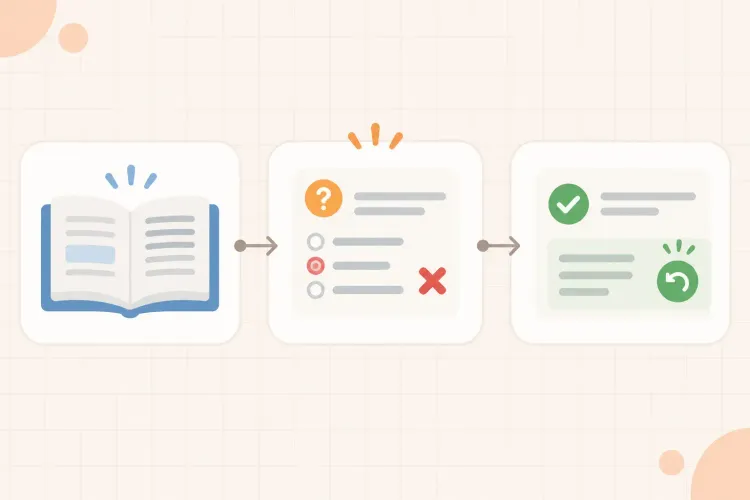

Finishing a practice test gives you a score, but the score is not the study plan. The useful information is in the questions behind it: what you could retrieve, what you guessed, what you misunderstood, and what you could not finish in time.
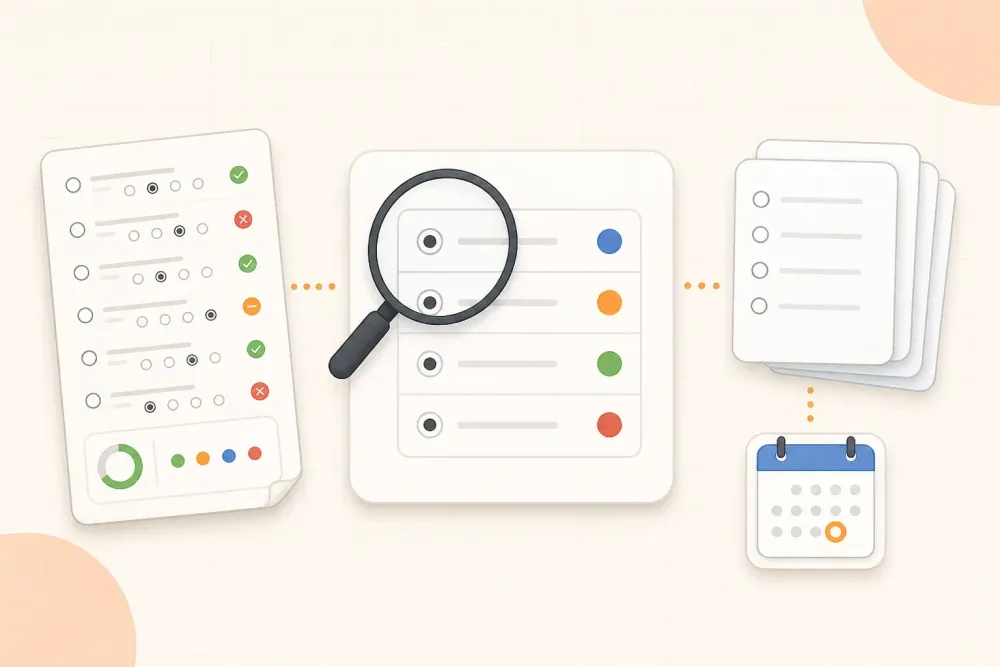
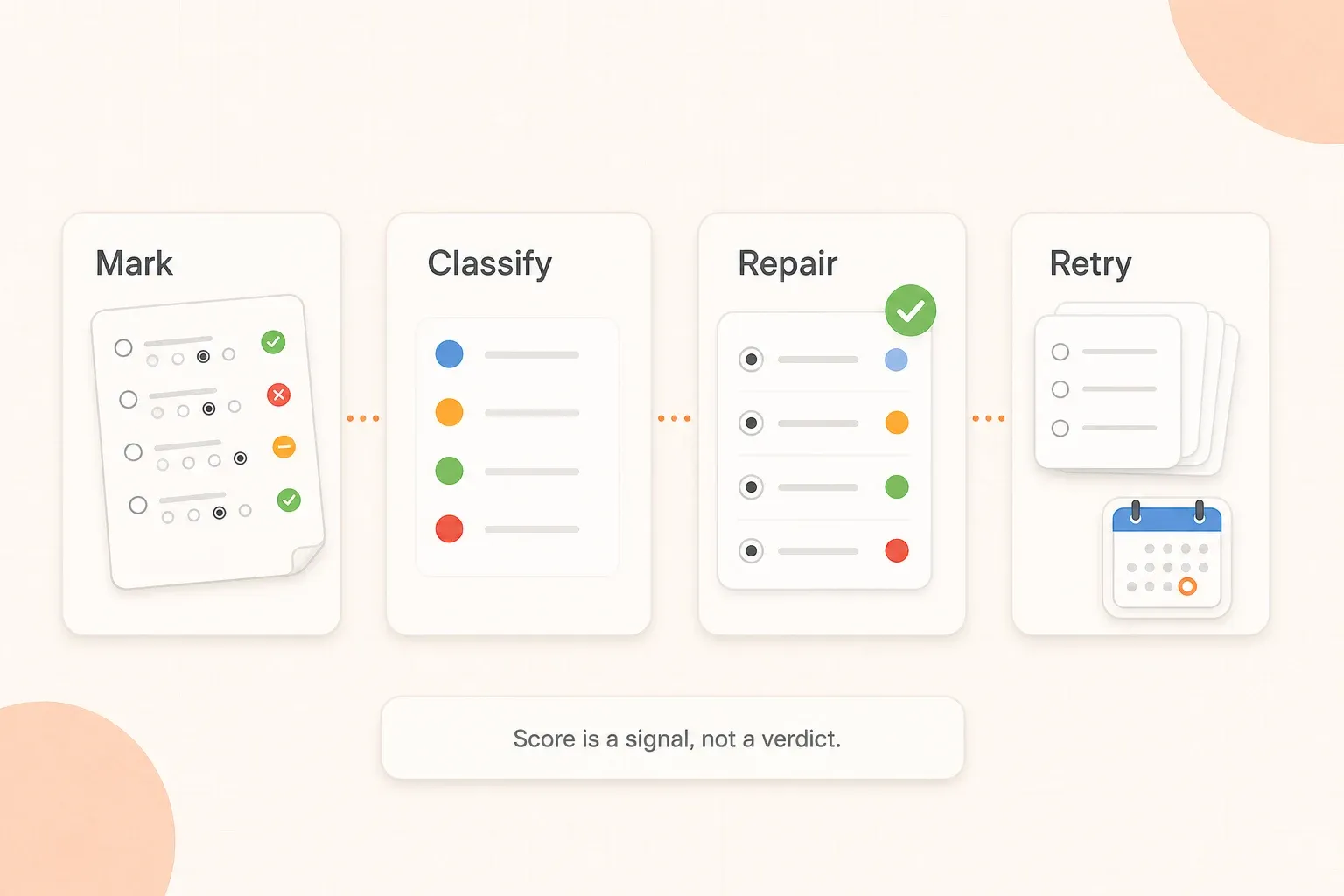
The best way to review a practice test is to turn each lost or uncertain mark into a reason and a next action. Mark the paper, classify the problem, repair the exact gap, and retry a similar question later. This makes one completed test useful for more than a single score report.
How to review a practice test
Use this sequence after a practice test:
- Record the conditions and score before checking the answers.
- Mark every question, including correct guesses and answers you were unsure about.
- Classify why each mark was lost or uncertain.
- Correct the reasoning, not only the final answer.
- Build a small retry set from the patterns you found.
- Retest after a gap and use the result to choose your next study block.
The order matters. If you read the answer immediately, the explanation can feel familiar without showing whether you could have produced it yourself. If you only write down the question number, you know what went wrong but not what to do next.
Mark the test before you study the answers
Use two passes. The first pass preserves what happened during the attempt; the second uses the answer key to explain it. This prevents a familiar explanation from replacing your own reasoning.
For the first pass, start with the test as you actually completed it. Write down the score, the time used, and any conditions that affected the attempt. For example, note whether you worked under the real time limit, used notes, paused between sections, or checked a formula halfway through. Mark questions you guessed on, felt unsure about, or spent unusually long answering before looking at the answers.
For the second pass, mark the test with the answer key or mark scheme. Use more than two labels:
- Correct and confident: you could explain the answer without help.
- Correct but uncertain: you chose the right answer, but it may not be reliable yet.
- Wrong: your answer does not match the required answer or reasoning.
- Blank or incomplete: you could not produce a usable answer.
- Slow: you eventually got it right, but the time cost would matter in the real exam.
Correct guesses deserve review because the result can hide an unstable memory. A question that felt like a coin toss is not equivalent to a question you could answer and explain cleanly.
If the test uses partial marks, record where the answer stopped earning credit. A nearly correct calculation, an explanation missing one condition, and a completely wrong method need different repairs.
Classify why each mark was lost
For every wrong, blank, slow, or uncertain question, ask why the answer was lost, delayed, or unreliable. Keep the categories practical enough to change your next study action.
| Problem type | What it looks like | Next action |
|---|---|---|
| Knowledge gap | You do not know the fact, definition, rule, or step required. | Learn the missing idea, then answer a new question without the source. |
| Retrieval failure | You studied the idea but could not bring it to mind. | Practise recalling it from a cue, then revisit it after a delay. |
| Reasoning or application error | You knew the ingredients but chose the wrong method or connection. | Explain the decision, then solve a changed version. |
| Misread or interpretation error | You missed a condition, command word, unit, or exception. | Annotate the question and practise reading for the limiting detail. |
| Process or careless error | The method was sound but an arithmetic, transcription, or checking step failed. | Add one deliberate check to the solving routine. |
| Timing problem | You knew enough to answer but ran out of time or spent too long. | Practise the same question type with a pacing rule. |
Do not put every miss in a box called "careless." That label can be accurate, but it is not a repair plan. If you repeatedly lose marks through the same supposedly small mistake, treat it as a process problem that needs a specific check.
Correct the reasoning, not only the final answer
Looking at the correct answer is not the same as understanding it. For each reviewed question, write a short correction that answers four questions:
- What answer or approach did you try?
- What was the first point where the reasoning went off track?
- What feature of the question should have guided the answer?
- What will you do differently next time?
For a definition question, the correction might be a more precise distinction between two terms. For a calculation, it might identify the wrong variable or a missing unit. For an essay or extended response, it might identify the missing claim, evidence, link, or condition instead of simply copying a model paragraph.
Try to explain the correction before reading a long solution. A set of exam-analysis prompts from Princeton follows the same useful direction: examine the kind of mistake and the approach that would have prevented it, not only whether the final answer was right.
A good correction is short enough to use later. It might say, "The rate formula was used before identifying the interval," or "The process was named, but the answer did not explain why the condition changes the outcome." That sentence is more useful than a page of copied explanation.
Build a small retry set from the errors
After reviewing the whole paper, look for repeated causes. Do not automatically make one flashcard for every wrong question. Instead, group questions that require the same repair.
For example, three biology questions may look different but all reveal the same problem: you can recall the terms in the pathway, but you cannot explain what changes when one condition is removed. That pattern calls for a short explanation task and a changed scenario, not three copies of the original question.
Your retry set can include:
- one question that checks the missing fact or rule;
- one question that uses the idea in a different context;
- one question that resembles the original exam format;
- one question aimed at the reading, timing, or checking habit that caused the error.
Keep the set small. The purpose is to test whether the repair worked, not to recreate the entire practice test. If the same topic keeps producing errors, you can identify the weak topic behind the pattern instead of rereading the whole syllabus.
Example: turning a 40-mark test into a one-hour review
Imagine Maya finishes a 40-mark biology practice test with 32 marks. The score looks reassuring, but her review shows eight lost marks:
- three marks came from confusing two mechanisms;
- two came from missing a condition in the question;
- two came from setting up a calculation incorrectly;
- one came from running out of time on the final question.
She should not spend the next hour rereading every biology chapter. She can use the evidence to make a narrower plan:
- Spend 15 minutes rebuilding the distinction between the two mechanisms from memory.
- Answer two changed questions that ask when each mechanism applies.
- Work through one new calculation and add a unit check to the method.
- Do three short questions with the relevant condition underlined before answering.
- Finish with one timed extended-response question so the timing problem is tested separately.
The next test should show whether these repairs changed her performance. If the same mechanism error returns, the gap is not closed yet. If the mechanism is correct but the answer is still slow, the next action is different: practise selecting and applying the method under a limit.
Decide what the next study block should be
Use the review to choose one or two actions, not to create an intimidating list of every weakness in the course. Prioritize an error when it is recurring, important for the exam, and realistic to repair before the next attempt.
A useful decision rule is:
- One isolated knowledge gap: repair it briefly and test it again.
- Several questions with the same concept gap: schedule a focused teaching and retrieval block.
- Several misread or careless errors: practise the checking routine on fresh questions.
- Several slow but correct answers: practise the question type with a time target.
- Many errors across one topic: add that topic to the next revision session and test it before taking another full paper.
If you are planning several study blocks, add the repair work to a realistic revision timetable rather than leaving it as an open task. The review is only useful when its next action reaches your calendar or your next study session.
Common practice-test review mistakes
Reviewing only the questions you got wrong
Include guesses, slow correct answers, and answers you could not explain. These are warning signals that a score alone will not show.
Recording only the topic
An entry such as "cell respiration" does not explain what needs to change. Record the topic, the failure mode, and the repair: for example, "could recall the stages but could not explain what changes when oxygen is unavailable; answer a changed scenario from memory."
Copying the solution
Copying creates a neat record but does not prove that you can reproduce the method. Close the solution and explain or redo the question from memory before moving on.
Making an error log that is too large to use
An error log should help you choose the next action. Keep the cause, the repair, and the retest question. Delete or compress details that do not change what you will do next.
Taking another full test without repairing anything
A second test can measure progress, but it is not a repair by itself. If you repeat the same process without targeted work, a similar score will tell you little about why the pattern persists.
When to take the practice test again
Do not retake the same paper immediately just to see a higher score. You may remember the answer pattern instead of demonstrating the skill. First complete the smallest repair that addresses the recurring error, then use new or changed questions to check transfer.
Retake selected questions after a delay. Return to the original question only when you want to check whether the reasoning is now reliable. For a larger exam, use another equivalent section or paper for the next full attempt so the result reflects more than memory of the first test.
The method of testing yourself instead of rereading works best when the answer is followed by feedback. The completed test gives you evidence; the correction explains it; the retry shows whether the next study action changed anything.
The goal of review is a better next attempt
A practice-test score is a snapshot. The review turns that snapshot into a set of decisions: which idea needs teaching, which skill needs retrieval, which habit needs checking, and which question type needs more timed practice.
Mark the paper honestly, classify the cause, repair the first point of failure, and retry a changed question later. When the next study block comes from evidence instead of anxiety, one practice test can make the following attempt more precise and more useful.