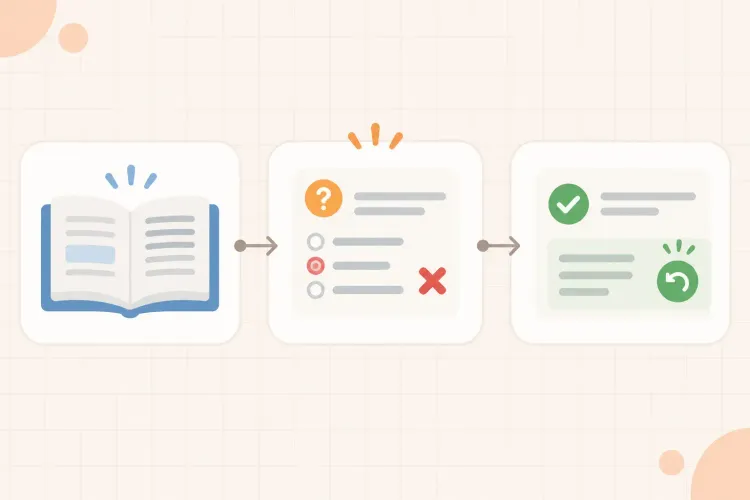

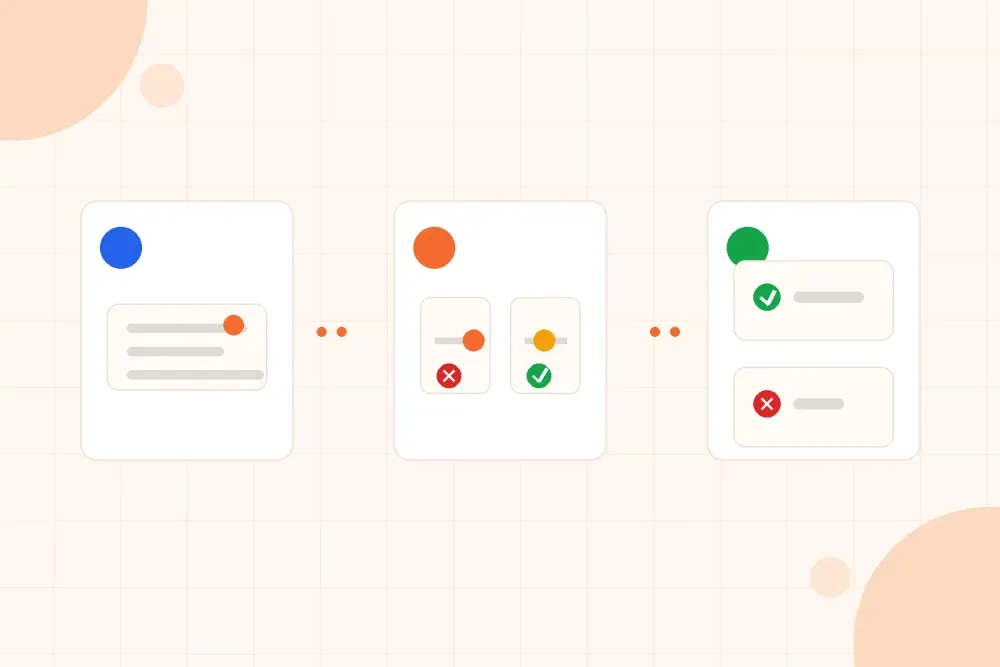
The topics that deserve your next hour are not always the ones you feel least comfortable with. A familiar chapter can hide a high-confidence mistake, while a difficult topic may simply need one more clear explanation. To find weak spots before an exam, test yourself first, record both your answer and your confidence, then use the mismatch to choose what to review.
This turns exam preparation into a diagnosis instead of a full reread. A weak spot is not simply a topic you dislike or find difficult. It is a specific point where your recall, explanation, or application breaks down. You need a short list of ideas you cannot yet retrieve, explain, or apply reliably. A practice-testing cycle can expose those gaps.
How to find weak spots before an exam
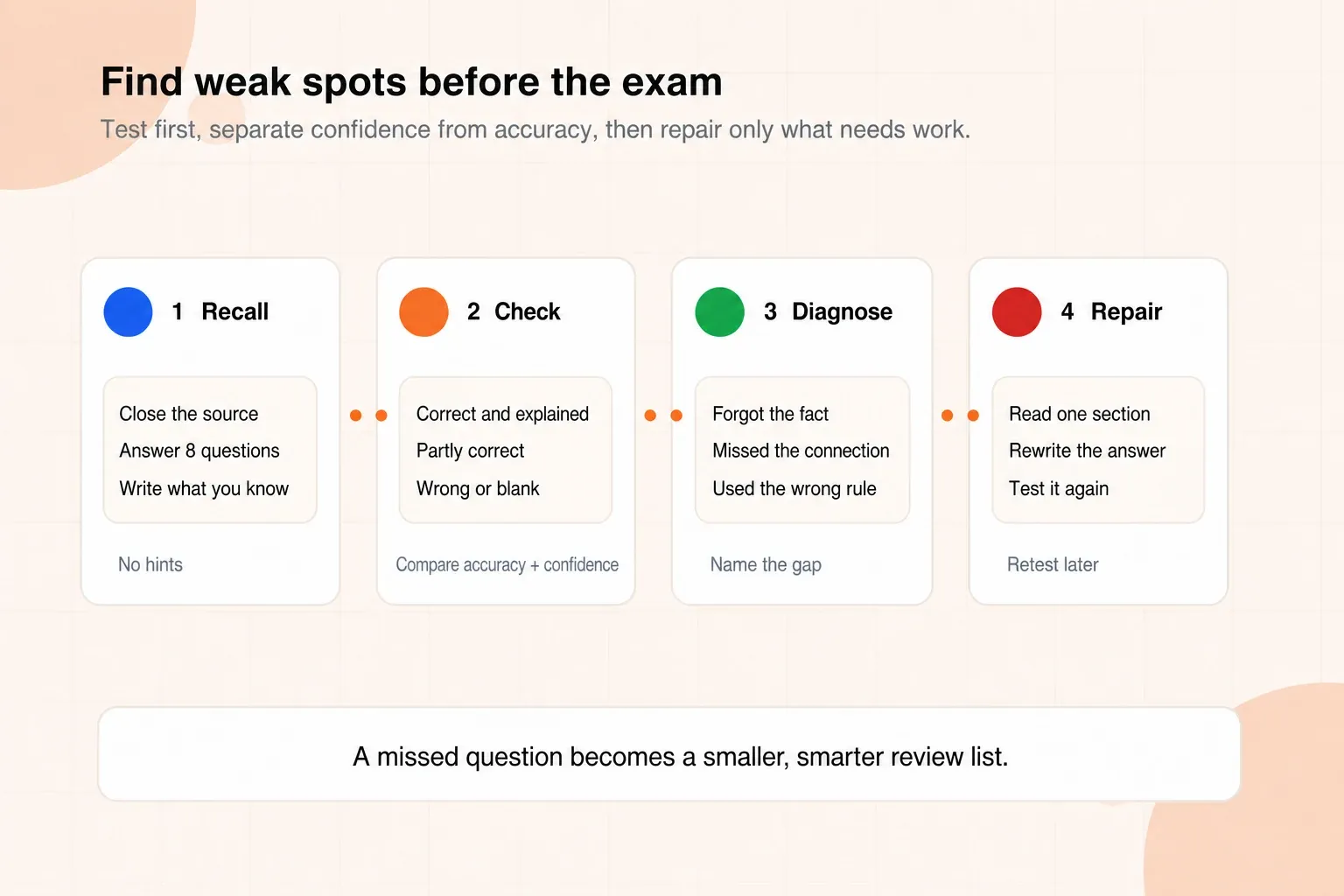
Use this sequence for a chapter, lecture, PDF, or set of notes:
- Close the source. Answer a small set of questions without looking back.
- Record confidence. Before checking, mark how certain you are from 1 to 5.
- Check the answer. Compare your response with the source, not with how familiar the topic feels.
- Name the gap. Decide whether you forgot a fact, confused two ideas, missed a relationship, or used the wrong method.
- Choose one repair path. Reread the relevant section, explain it in your own words, and write a narrower question.
The important order is test, check, diagnose, repair. If you review everything before testing, recognition makes it difficult to see which topics you can actually produce from memory.
Test before you decide what to review
Start with questions that cover the main ideas, not with the pages you happen to have open. Use a mixture of definitions, explanations, comparisons, applications, and sequences. For one lecture, eight to twelve focused questions are enough for a first scan.
Write or collect the questions before you begin. Then answer with the lecture, PDF, or textbook closed. A correct answer should include the relationship that makes the idea useful, not just a familiar keyword.
For example, instead of asking whether you recognize the term "opportunity cost," ask: "What is the opportunity cost of choosing one study plan over another?" The second question shows whether you can use the idea, not merely recognize its definition.
Separate confidence from accuracy
Confidence is useful only when you compare it with what you actually answered. Use a simple two-part record:
| Answer | Confidence before checking | What it means |
|---|---|---|
| Correct | High | Likely stable; keep monitoring |
| Correct | Low | Correct but fragile; revisit soon |
| Wrong or incomplete | High | High-priority blind spot |
| Wrong or incomplete | Low | Known gap; repair it directly |
The most dangerous row is a confident mistake. It feels finished, so it is easy to skip during review. A low-confidence correct answer matters too: you may have reached the right result by guessing or by recalling a partial cue, and that knowledge may not hold under exam pressure.
Research on practice testing has repeatedly found that testing can improve later retention, but it also shows why feedback and repeated retrieval matter. A missed answer is not the end of the process; it is information about what to do next. See this research on repeated retrieval and feedback for the underlying evidence.
Diagnose the kind of weak spot
A wrong answer does not always call for more reading. First identify the failure mode:
- Forgotten fact: You cannot recall a term, date, definition, formula, or label.
- Confused pair: You know both ideas but switch their roles, conditions, or consequences.
- Broken explanation: You can name the steps but cannot say how one causes the next.
- Transfer gap: You can repeat the example but cannot apply the rule to a changed situation.
- Process error: You understand the concept but choose the wrong sequence, formula, unit, or decision rule.
- Question problem: The prompt was too broad, ambiguous, or missing a condition.
The label changes the repair. A forgotten fact may need a short cue or flashcard. A transfer gap needs a new example. A broken explanation needs a cause-and-effect answer. If the question itself is vague, rewrite it before deciding that the topic is weak.
Turn each miss into one repair task
Avoid responding to every miss with "reread the chapter." That creates more exposure without giving the gap a clear target. Match the repair to the diagnosis:
- Forgotten fact: Find the exact source sentence, hide it, and recall the fact twice.
- Confused pair: Make a two-column contrast and answer what changes between them.
- Broken explanation: Write the chain using because, therefore, and so that.
- Transfer gap: Create a new condition and predict what changes.
- Process error: Work one similar problem slowly, naming the decision at each step.
- Question problem: Narrow the prompt until you can describe what a complete answer must contain.
After the repair, retest later with a fresh question rather than copying the answer you just read. The goal is not to feel familiar with the correction; it is to produce the corrected idea without the original cue.
Build a weak-topic list that stays small
A useful weak-topic list is not a copy of your syllabus. It is a short action list. For each missed question, record:
- The concept or source section
- The type of gap
- The corrected answer in one or two sentences
- A new question for the next attempt
- When you will test it again
Use priority rather than panic. Start with high-confidence errors, foundational ideas that support several later topics, and concepts likely to appear in the exam's main question types. Leave minor details for later unless your instructor has emphasized them.
How to prioritize weak topics when time is limited
If you cannot repair every gap, give each one three quick ratings from 1 to 3:
- Exam relevance: How likely is this idea to appear, based on objectives, repeated emphasis, examples, or past questions?
- Foundation value: How many later topics depend on understanding it?
- Repairability: Can a focused explanation and a few practice questions improve it soon?
Start with gaps that score highly across all three. For example, a missed definition might score 3 for relevance, 1 for foundation value, and 3 for repairability, while a confusing multi-step process might score 3, 3, and 2. Repair the process first because it affects more later questions, even though the definition may be quicker to fix. If two topics tie, choose the one you got wrong with high confidence first. This keeps your review list connected to likely exam value and available time instead of letting anxiety choose the order.
For a long PDF, you can generate practice questions from it. Use the answers and confidence marks to decide which sections deserve review; the generated questions are only a starting set.
Example: find the weak spots in one biology lecture
Imagine you are reviewing a biology lecture on cellular respiration. You answer ten questions with the source closed:
- You correctly define glycolysis with confidence 3/5.
- You correctly explain that ATP synthase uses a proton gradient with confidence 2/5.
- You confidently say fermentation produces oxygen. The answer is wrong.
- You correctly list the stages of the electron transport chain but cannot explain why oxygen is needed at the end.
- You solve an ATP-yield question with confidence 4/5 but use the wrong condition for anaerobic respiration.
Your next review should not start with the first page of the lecture. It should start with three targeted repairs: correct the fermentation misconception, explain oxygen's role in the electron transport chain, and redo the ATP-yield problem under the anaerobic condition. The low-confidence correct answer about ATP synthase can come next because it is fragile but not yet a demonstrated error.
Write a new question for each repair:
- Why does fermentation regenerate NAD+ when oxygen is unavailable?
- What happens to the electron transport chain when oxygen cannot accept electrons?
- How does ATP production change when the cell relies on anaerobic pathways?
This list is more useful than a vague instruction to "review cellular respiration." Each item names the weak relationship, the repair, and the next retrieval attempt.
Use a short pre-exam diagnosis session
A 30-minute session is enough to produce a realistic review list:
- Choose one source for 3 minutes. Pick the lecture, chapter, or PDF most relevant to the next exam.
- Answer eight to twelve questions for 10 minutes. Keep the source closed and write short answers.
- Mark confidence for 2 minutes. Do it before checking the answers.
- Check and classify for 5 minutes. Label errors as facts, confusion, explanation, transfer, process, or question problems.
- Repair the highest-priority gaps for 7 minutes. Read only the relevant source sections and rewrite the answers.
- Schedule the retest for 3 minutes. Put the new questions into your next review session.
If you are building a longer plan, place the retest after a gap rather than immediately repeating the same answer. A revision timetable can help you distribute weak topics across the remaining study days instead of cramming them into one final reread.
When should you stop reviewing a weak spot?
Stop treating a topic as urgent when you can answer a focused question correctly, explain why the answer is correct, and repeat that success on a later attempt. One correct answer immediately after rereading is not enough; it may only show that the source is still fresh.
You do not need perfect confidence before moving on. You need evidence that the answer is becoming accurate and retrievable. Keep a topic on the list if you can only recognize the explanation, if your confidence is much higher than your accuracy, or if you fail when the question changes its condition.
For the broader principle behind retrieving information before checking it, see the active-recall guide. This article's narrower rule is simple: do not ask what feels difficult; ask what you can answer, how certain you were, and what the miss tells you to repair next.
Weak spots become manageable when they stop being a feeling and become a short list of testable gaps. Close the source, answer a question, mark your confidence, diagnose the failure, repair one point, and retest later. That sequence gives you a reason for every item on the review list.