
A lab exam tests more than whether you remember the names of equipment or the order of a procedure. You may need to set up an investigation, choose a measurement, identify a source of error, interpret an unexpected result, or explain why a safety step matters. That combination makes practical exams feel different from ordinary revision.
The most reliable preparation is to practise the decisions the practical requires. Learn what each step is trying to achieve, predict what you should observe, record results with units and appropriate precision, and explain what the evidence supports. Then repeat the weakest part with a changed condition instead of rereading the whole method.
What a lab exam usually tests
The exact format varies by course, but a lab or practical exam usually combines several jobs:
- perform or sequence a procedure
- identify equipment, samples, structures, or visible changes
- choose or carry out a measurement
- record observations and data clearly
- calculate or interpret a result
- explain what the evidence supports
- identify a limitation, improvement, or safety decision
Some courses use timed stations. Others give you one investigation and assess the setup, measurements, analysis, and explanation together. Check your course outline, practical handbook, or past assessment before you practise so you spend time on the actions you will actually be marked on.
How to prepare for a lab exam: the core sequence
Use this sequence for each practical or experiment on your course:
- Reconstruct the purpose. State the question, variables, and expected relationship before looking at the detailed method.
- Explain the procedure. Know what each major step controls, measures, or prevents.
- Predict the observation. Describe what should change, appear, separate, reach a maximum, or stay constant.
- Record the evidence. Practise tables, units, significant figures, annotations, and short observations.
- Explain the result. Connect the evidence to the scientific idea without claiming more than the data show.
- Check the method. Identify one limitation, source of error, improvement, or safety decision.
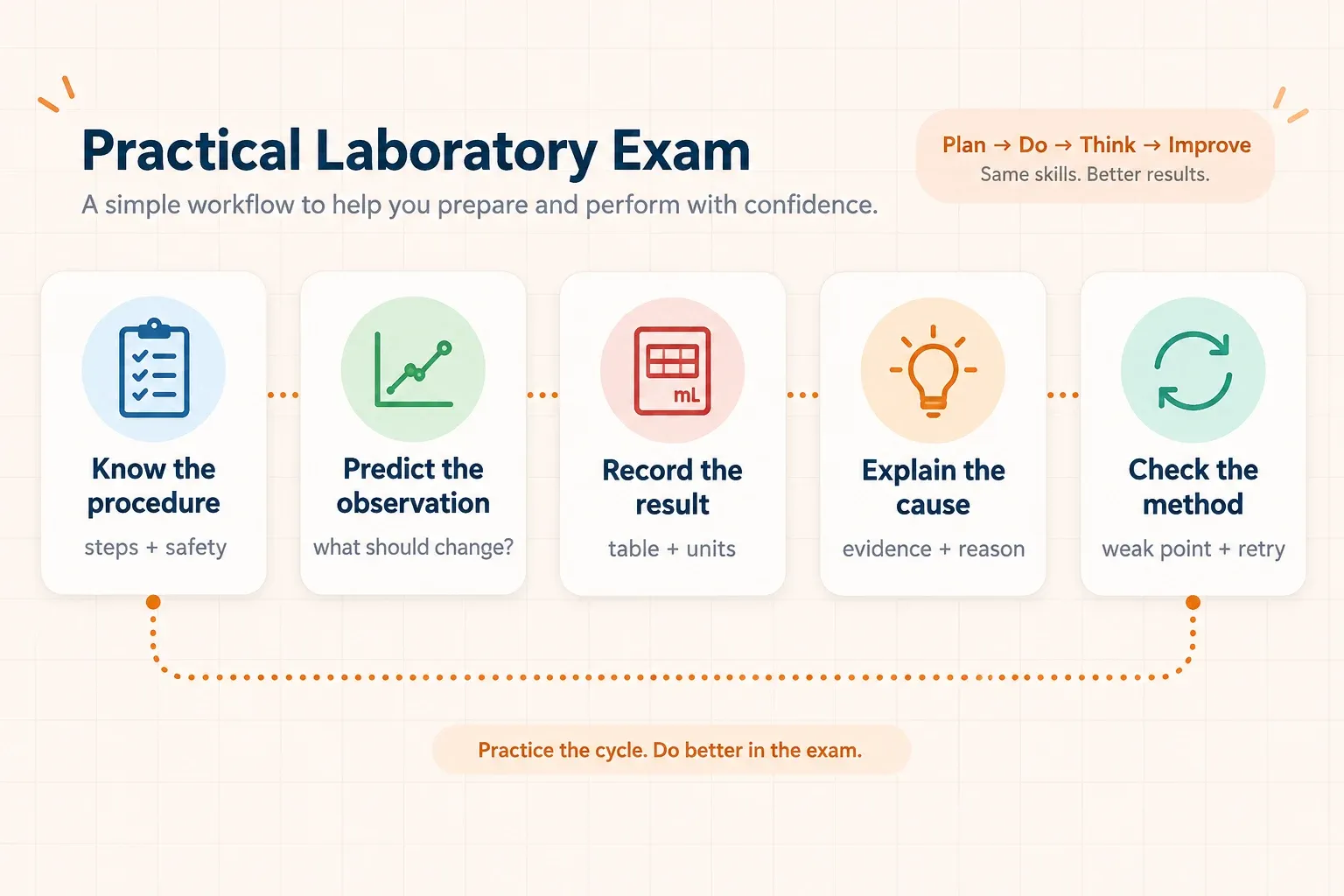
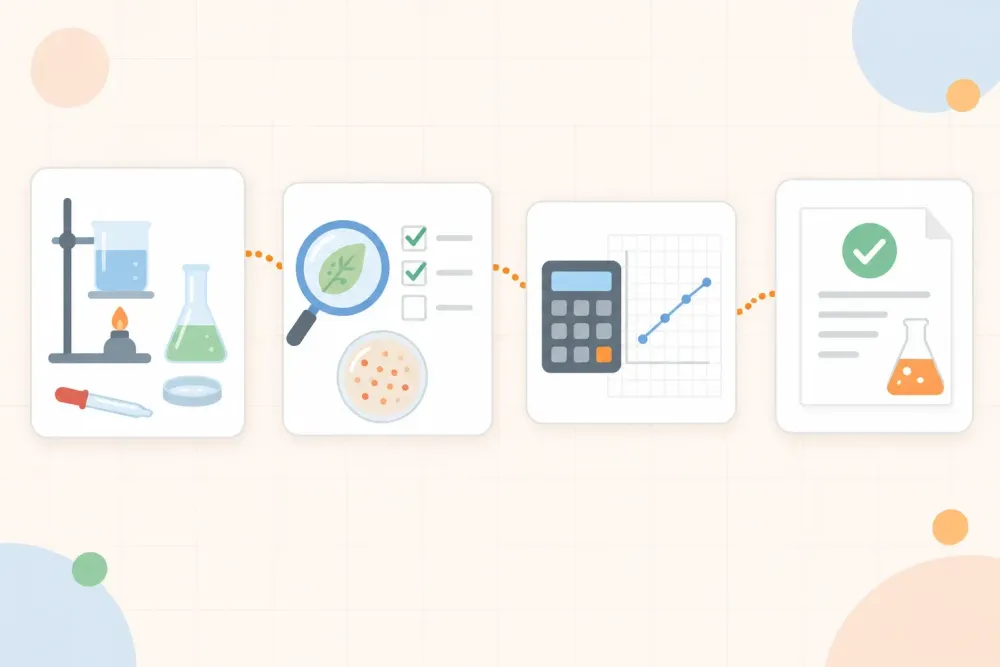
This sequence stops practical revision from becoming a list of apparatus and disconnected instructions. A strong performance shows that you understand what the practical is doing and can use that understanding when the question changes.
Start with the question, variables, and expected pattern
Before memorising the steps, write a one-sentence description of the investigation. Include the independent variable, the dependent variable, and the main control variables. Then predict the broad pattern you expect.
For example, a practical might investigate how temperature affects the rate of an enzyme-controlled reaction. The temperature is changed, the reaction rate is measured, and factors such as volumes, concentrations, and timing should be controlled. Your prediction should go beyond “the rate changes”: it should explain why the rate may rise and why it may fall if the enzyme loses its functional shape.
Use this quick check:
- What question is the practical answering?
- Which variable is deliberately changed?
- What is measured or observed?
- Which conditions must stay the same?
- What pattern would support the prediction?
- What result would make you reconsider the explanation?
If you cannot answer these questions, the method will feel like a script. If you can answer them, each step has a reason you can recover under pressure.
Learn what each step is doing
Do not revise a procedure as one long paragraph. Break it into decisions and purposes. For every important step, ask what it changes, measures, controls, or prevents.
| Procedure detail | Question to ask |
|---|---|
| Add a measured volume | Why must the volume be measured rather than estimated? |
| Rinse or clean equipment | What contamination or dilution would this prevent? |
| Wait for a colour change | What does the endpoint tell you? |
| Repeat a measurement | What does repetition help you judge? |
| Keep a condition constant | How would changing it affect the result? |
This is also where you should learn the safety reasoning. Follow your course instructions and local laboratory rules, but be able to explain the purpose of relevant protective equipment, handling steps, waste procedures, and responses to spills or breakages. A safety answer is more useful when it names the hazard and the control rather than simply saying “be careful.”
Practise observations before you see the result
Lab questions often ask what you would expect to observe, not only what happened in a demonstration. Close the notes and predict the visible or measurable change before checking the answer.
Make predictions specific enough to test. Instead of “the reaction changes,” write “the time taken decreases as the reactant concentration rises, while the other conditions remain constant.” For a separation, identify which component should move farther and why. For a biological sample, state what feature should become more or less visible and what that indicates.
Then change one condition and predict again:
- What if the temperature is higher?
- What if the sample is more dilute?
- What if the reaction is stopped earlier?
- What if one control is missing?
- What if the result is the opposite of the prediction?
These changed-condition prompts are more valuable than copying a familiar observation because they test whether you understand the mechanism behind it.
Record data as if someone else must check it
A practical answer can lose clarity even when the underlying idea is correct. Practise recording data in a way that makes the evidence easy to inspect.
Check the details that are often rushed:
- Put the variable and unit in the table heading where appropriate.
- Use consistent decimal places or precision when the instrument requires it.
- Record raw observations before converting or interpreting them.
- Label axes, include units, and choose a scale that uses the graph space well.
- Show the formula, substitution, and unit for a calculation.
- Keep enough intermediate values to make an error traceable.
- Distinguish an observation from an explanation.
A useful practice habit is to give your table or graph to someone else and ask whether they can tell what was measured, under which condition, and with what result. If they have to ask, the presentation needs another pass.
Explain results without overstating the evidence
A good practical explanation connects three things: the result, the scientific reason, and the limit of the evidence. Use a simple structure:
- State the pattern or result.
- Identify the principle or mechanism that explains it.
- Refer to the data or observation that supports the explanation.
- Add a condition, uncertainty, or limitation when it matters.
For example: “The reaction was faster at the higher concentration because more reactant particles were available for successful collisions in the same time. This is supported by the shorter time recorded for the endpoint. The result would be less reliable if the volumes or temperature were not kept consistent.”
Avoid explanations that merely repeat the result. “The solution changed colour because it changed colour” adds no mechanism. Also avoid claiming certainty when the experiment only shows an association or when the data are too limited to separate two explanations.
Practise calculations and equipment choices separately
Practical exams often combine physical work with a calculation or a choice about measurement. Do not wait until the end of revision to practise these details.
Make short practice sets for:
- choosing the most suitable instrument for a measurement
- reading a scale or meniscus correctly
- converting units
- calculating a rate, concentration, percentage change, uncertainty, or mean
- deciding whether a repeat is an outlier or a useful check
- explaining why greater resolution or more repeats would improve the quality and reliability of the evidence
Keep the practical context attached to the calculation. A correct number is not enough if you cannot state what it represents, whether the unit is appropriate, or whether the size is plausible. After solving, ask: “What should this value tell me about the experiment?”
Turn your practical notes into closed-source questions
Your lab manual, slides, and write-ups can become a compact practice set. Write questions that require you to reconstruct decisions rather than recognise a familiar page.
Useful prompts include:
- What is the purpose of this practical?
- Which variable is changed, and which is measured?
- Why is this control necessary?
- What should you observe at this step?
- What would a result in the opposite direction suggest?
- Which measurement needs the most care?
- What should the data table or graph look like?
- What calculation turns the raw data into the required result?
- What is one realistic source of error?
- What improvement would reduce it?
- What safety decision protects the person, sample, or equipment?
Answer with the source closed, then reopen it to check the exact step, condition, unit, or explanation you missed. For a dense practical PDF, you can turn the document into closed-source practice questions, but verify every generated question against your course method and safety instructions.
Run a practical under exam conditions
For each major practical, practise at least once without the notes and prompts that make the task easier. Set a time limit, hide the method, and work from the question or objective. If your assessment uses stations, divide the practice into short checkpoints and move on when the time ends. This exposes hesitation in setup, measurement, or explanation before the exam. If you cannot perform the physical setup at home, simulate the decisions on paper using a blank procedure, diagram, data table, or unfamiliar result.
Use a simple marking grid:
| Area | Can you do it without notes? | Evidence to check |
|---|---|---|
| Purpose and variables | Yes / partly / no | Question, controls, prediction |
| Procedure | Yes / partly / no | Order, reasons, safety |
| Observation | Yes / partly / no | Expected pattern and changed condition |
| Data handling | Yes / partly / no | Table, graph, units, calculation |
| Explanation | Yes / partly / no | Mechanism, evidence, limitation |
| Evaluation | Yes / partly / no | Error, improvement, reliability |
Do not turn the grid into a vague confidence rating. Write the exact failure. “You do not know how to choose the scale” gives you a useful next task. “You feel bad at graphs” does not.
Repair the weak point with a changed version
Once you find a gap, make the next attempt slightly different. If you forgot why a control was needed, remove or alter that control and predict the consequence. If you confused two pieces of equipment, compare the measurements they are designed to make. If you lost marks on evaluation, use a new result and write one limitation plus one improvement.
This is where practical preparation becomes more than memorising the official method. You are learning to respond when the sample, numbers, order, or observation is unfamiliar. Keep a short error log with three columns: what you did, why it was wrong or incomplete, and what you will look for next time.
Common mistakes in lab-exam preparation
Memorising the method without the purpose
Knowing the order of steps helps, but it does not prepare you for a question that changes a condition or asks for a reason. Attach a purpose to every major step.
Treating observations as guaranteed
Real results vary. Learn the expected pattern, then practise explaining what a weaker, stronger, delayed, or opposite result might mean.
Writing conclusions before checking the data
Start with the values or visible pattern. Then decide what they support. Do not force the result to match your prediction.
Ignoring units, precision, and scale
A calculation or graph can look complete while still being impossible to interpret. Make units, labels, and precision part of every practice attempt.
Giving generic errors and improvements
“Human error” is rarely enough. Name the step that could vary, the direction of the effect if possible, and the change that would reduce it.
Repeating the practical only when it feels comfortable
A familiar repetition can build fluency, but changed conditions reveal whether you understand the method. Add one variation after each successful attempt.
A focused lab-exam revision session
Choose one practical and work through this session:
- Spend 5 minutes writing the purpose, variables, prediction, and safety points from memory.
- Spend 10 minutes reconstructing the procedure and adding a reason beside each major step.
- Spend 10 minutes answering observation, data, calculation, and evaluation questions with the source closed.
- Spend 5 minutes checking the method and marking the exact gap.
- Spend 10 minutes completing a changed version that tests that gap.
The time split is adjustable. The important part is the order: reconstruct, attempt, check, and retry. Reading the method again can be useful after the attempt, but it should not replace the attempt.
How to know you are ready for a lab exam
You are closer to ready when you can:
- explain the purpose and variables without opening the notes
- describe the reason for the main procedure steps
- predict an observation and explain a changed condition
- choose or justify a measurement
- record data with clear units, labels, and appropriate precision
- complete the relevant calculation and interpret its value
- connect a conclusion to evidence rather than repeating the prediction
- name a realistic limitation and a matching improvement
- explain relevant safety decisions
- recover when the result is unexpected.
If one of these is missing, keep the weakness specific and practise that decision again. You do not need to restart every practical from the beginning.
A lab exam rewards understanding that can survive a changed setup. Learn the purpose, reconstruct the method, predict what should happen, record the evidence, explain the result, and retry the weakest decision.
Once you have the method and practice questions, you can organise your practical notes, calculations, and review in one study session. Close the method, make the decision, check the evidence, and know exactly what to practise next.