
Short-answer exams sit between simple recall and full essays. You may need to define a term, explain a process, compare two ideas, interpret data, or apply a rule in only a few lines. Knowing the topic is not enough if your answer is too vague, too long, or aimed at the wrong command word.
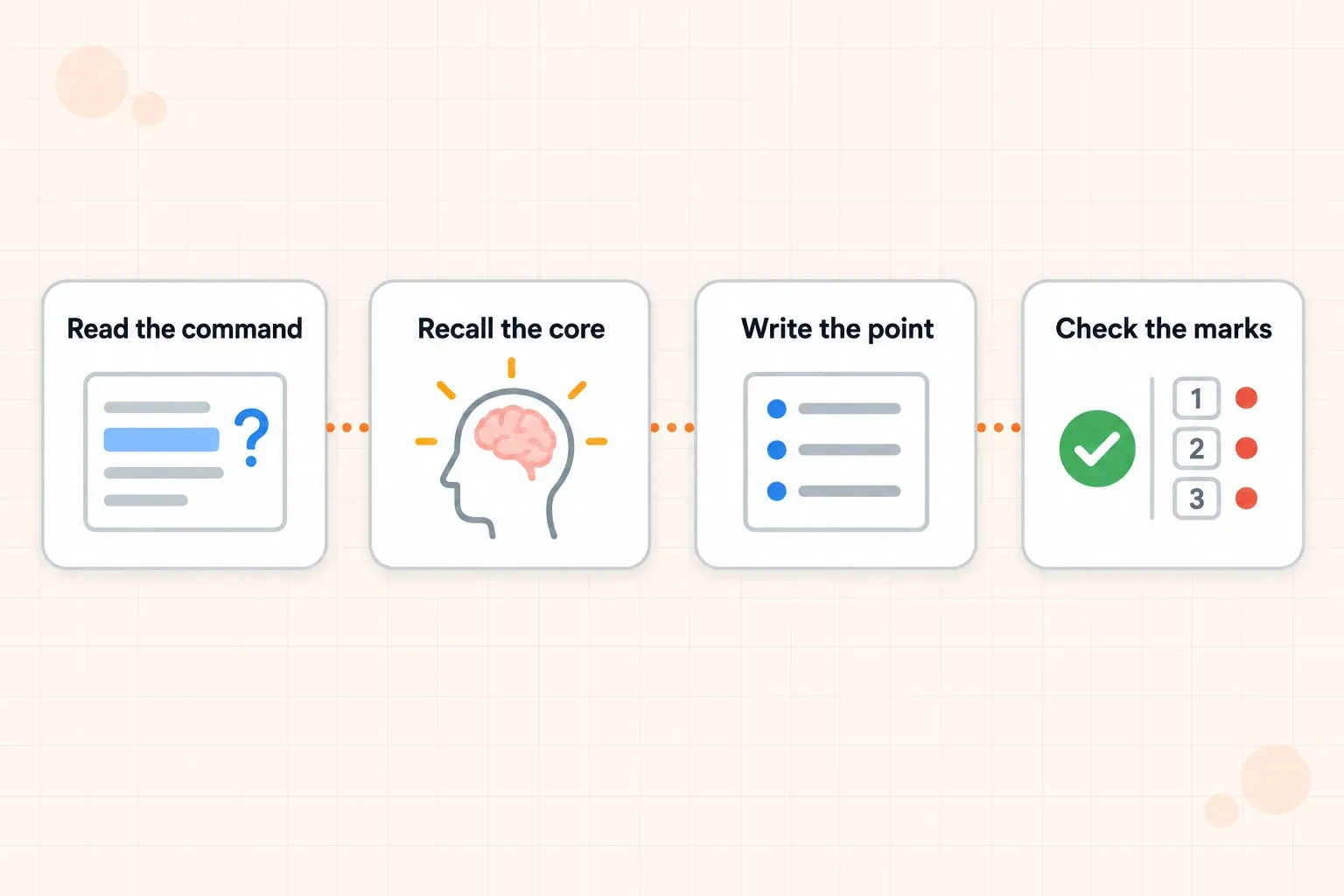
The most useful preparation is to practise producing answers under the same constraints as the exam. Read what the question asks, recall the relevant idea, write the smallest complete answer, and check which part would earn credit. This article shows how to build that habit without turning every response into an essay.
How to study for a short-answer exam
Treat each revision block as a small answer-building loop: choose a topic, write a question, answer it with the notes closed, then compare the response with the marks. Repeat with different command words so you practise both the knowledge and the response the exam requires.
What makes short-answer exams different
A short-answer question gives you less room to hide uncertainty. In an essay, you may develop context and qualify an argument over several paragraphs. In a short response, the marker needs to see the required idea, relationship, evidence, or calculation quickly.
| The question asks you to… | Your answer usually needs to… |
|---|---|
| Define | State the meaning accurately and directly |
| Describe | Identify the relevant features or steps |
| Explain | Give the reason, mechanism, or relationship |
| Compare | Address both things using a shared basis |
| Calculate | Show the method, working, and appropriate result |
| Evaluate | Make a judgement supported by relevant evidence |
| Apply | Use the idea in the specific situation given |
The answer length should follow the task and the marks, not the amount of information you happen to remember. A two-mark explanation does not need every fact from the chapter. It needs the two useful points that answer the question.
Build a topic map from the exam questions
Do not revise short-answer exams by rereading the syllabus as one large block. Break each topic into the kinds of responses you may need to produce.
For each topic, list a few prompts under these headings:
- Core terms: What must be defined accurately?
- Processes: What steps or mechanisms must be described?
- Relationships: What causes, contrasts, or dependencies must be explained?
- Evidence: Which examples, studies, data, or quotations could support an answer?
- Applications: Where might the idea appear in a new context?
- Calculations: Which quantities, units, formulas, or assumptions must be handled?
This creates a response map rather than a pile of notes. It also shows where your preparation is uneven. You may know the definitions but have no practice explaining a relationship or interpreting a result.
Practise the command word first
Many weak answers contain relevant knowledge but do not perform the task in the question. Before writing, underline the command word and translate it into an action.
For example, describe asks what happens, while explain asks why or how it happens. Compare needs a relationship between two things, not two separate descriptions. Evaluate needs a supported judgement, not a list of advantages and disadvantages with no conclusion. If command words still feel interchangeable, check what each one asks you to do before you practise.
Then write one answer to the same topic using two different command words. For example:
- Describe how a feedback loop works: state the sequence.
- Explain how the loop changes the system: connect each step to its effect.
- Apply the idea to a new case: identify where the same mechanism appears.
This exercise separates knowing the content from knowing what the question wants you to do with it.
Write the smallest complete answer
A complete short answer is not the shortest possible answer. It is the shortest answer that contains the parts needed for credit.
Use a simple structure:
- Answer the question directly. Start with the term, judgement, result, or relationship the question asks for.
- Add the necessary reason or evidence. Explain the mechanism, show the relevant working, or support the claim.
- Stop when the task is complete. Do not add unrelated facts that create new opportunities for confusion.
For an explain question, this might be “The rate increases because more particles have enough energy to overcome the activation barrier.” The second clause does the work. A definition alone would not answer the reason the question asks for.
Match detail to the marks
Marks are not a perfect formula, but they give you a useful limit. Before practising, look at how many marks the question offers and ask what separate credit-worthy points could fit in that space. The University of Waterloo makes the same practical point: answer length should follow relevance, depth, and the marks available.
A one-mark definition may need one precise statement. A four-mark explanation may need a sequence of linked points. A calculation may need the formula, substitution, working, and unit. Do not pad a short answer with background that the question did not request. Instead, make each sentence earn its place.
When reviewing practice answers, compare them with a mark scheme to see what the examiner actually rewards. Look for the missing idea or condition, then apply it to a fresh question rather than copying the model answer word for word.
Practise from memory, then check the response
Reading model answers can show you what a complete response looks like, but it does not prove that you can produce one. Cover the answer, write your response, and compare the reasoning with the key.
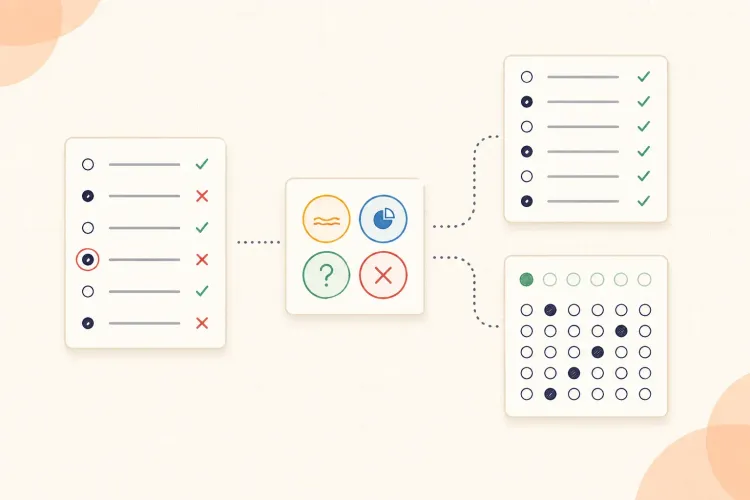
For each attempt, mark one of these outcomes:
- Complete: The answer contains the required idea and does the requested task.
- Partly complete: The main idea is present, but a link, condition, example, or unit is missing.
- Misread: The response answers a different command word or ignores part of the question.
- Uncertain: The answer is plausible, but you cannot explain why it is correct.
Writing from memory before checking is a form of practice testing. You can use practice testing to measure what you can produce, then review the gap instead of mistaking recognition for recall. This is more useful than recording only right or wrong. A partly complete explanation needs a different repair from a misread command word.
Turn model answers into new prompts
Do not let the mark scheme become another text to memorise. Use it to create a second question that checks whether you understand the required point.
If the scheme rewards “explains that increasing temperature raises the rate because more particles exceed the activation energy,” ask:
- What would happen if temperature decreased?
- Which part of the explanation describes the cause?
- How would the answer change if the question asked you to compare two reactions?
These variations stop you from memorising the wording of one response. They also expose whether you can transfer the idea when the question changes.
Prepare for different short-answer formats
Short-answer exams can look different across subjects. Practise the form that matches your course instead of treating every response as a paragraph.
| Format | What to practise | Common failure |
|---|---|---|
| Definition | Precision and essential qualifiers | Giving an example instead of the meaning |
| Explanation | Linked cause-and-effect steps | Listing facts without showing the connection |
| Data response | Selecting evidence and interpreting it | Describing the data without answering the question |
| Calculation | Formula, working, unit, and sensible rounding | Writing only the final number |
| Comparison | A shared basis for both items | Writing two separate mini-answers |
| Application | Selecting the relevant principle in context | Repeating the general rule without using the case |
Mix these formats in practice. If every question is a definition, you may feel prepared while avoiding the harder work of explaining, interpreting, and applying.
Build a short-answer practice set
For one topic, create six questions:
- one definition
- one describe question
- one explain question
- one application question
- one data, comparison, or calculation question
- one question that combines two ideas
When your course provides them, start with official past papers. Otherwise, use teacher-written questions or prompts built from your own course material. Answer them with the notes closed. Give yourself a rough time limit based on the paper's total time and marks, then mark the first missing requirement in each response. If you need a larger set of varied prompts, you can create practice questions from your notes or lecture material, but check every generated question against the source before studying from it.
Review answers by failure type
After a practice set, do not reread the whole topic automatically. Sort the errors:
- Content gap: You could not recall the relevant idea. Relearn it, then answer a fresh question.
- Command-word gap: You knew the content but performed the wrong task. Rewrite the prompt in plain language and try again.
- Completeness gap: You gave the main point but missed a condition, link, or unit. Add that requirement to a new prompt.
- Application gap: You knew the rule but did not use the information in the question. Practise a changed case.
- Expression gap: The idea was present but too vague to earn clear credit. Rewrite it with the precise term or relationship.
This keeps review proportional. A content gap may need explanation. An expression gap may need only one sharper rewrite.
What to do in the exam
Use the first reading of the paper to identify the task, not to draft a perfect answer in your head. For each short question:
- Circle the command word.
- Note the topic and the specific situation.
- Estimate the answer size and time from the marks, space, and paper timing.
- Write the direct answer before adding support.
- Check that every part of the question has been addressed.
If you get stuck, write the relevant principle or definition and connect it to the information given. A precise partial answer is more useful than leaving the page blank while waiting for a perfect sentence. Return later if the question depends on a fact you have not yet recalled.
A final check for short answers
Before moving on, scan for four things:
- Task: Did the response do what the command word asks?
- Context: Did it use the specific situation or data in the question?
- Credit: Did it include the term, relationship, evidence, calculation, or condition the marks require?
- Finish: Did it stop once the answer was complete?
Short-answer preparation works when the response is practised as carefully as the content. Read the task, retrieve the relevant idea, write clearly, and use the missing point to shape the next question.