

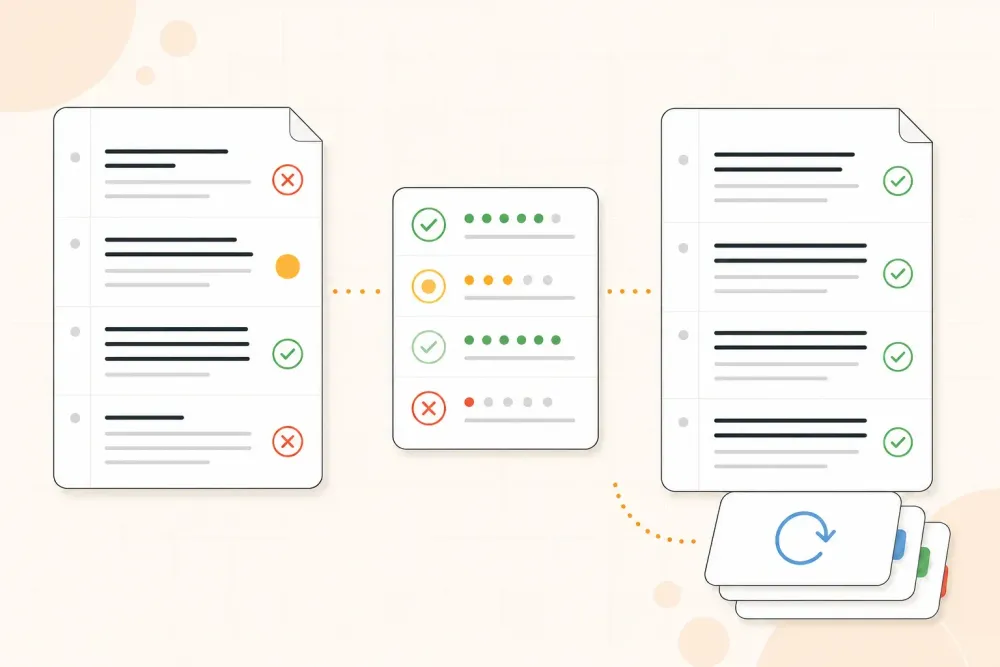
Mark schemes are more useful than a final score on its own. They show what an examiner can credit, where your answer stopped earning marks, and what to change before you attempt a similar question again. The key is to use the scheme after you have answered, not as a script to copy.
If you are reviewing a past paper, use the mark scheme to turn each lost mark into a specific action: add the missing condition, show the next calculation step, use the data in the question, or develop the explanation. This guide shows you how to read a mark scheme, diagnose lost marks, and practise the exact answer behaviour your exam rewards.
How to use a mark scheme to improve exam answers
Use this loop for a question set or a complete paper:
- Choose the official mark scheme for the same exam board, subject, paper, and series.
- Answer the questions without opening the scheme.
- Mark each response against the credit points, working marks, or level descriptors.
- Record why each mark was lost, not only the score.
- Rewrite the smallest part of the answer that would earn the missing mark.
- Retry a similar question later without looking at your correction.
The score tells you where you are. The mark scheme tells you what to do next. Use it as feedback for your next attempt, not as a final judgment of your ability.
Find the right mark scheme first
Mark schemes are specific to an exam board, qualification, paper, and exam series. Before you start, check the paper code or title against the scheme. A similar-looking paper from another board may use different command words, mark allocations, accepted answers, or level descriptors.
Use the official source when one is available. For example, AQA’s guide to how mark schemes work distinguishes points-based schemes from level-of-response schemes. That distinction matters: a short factual question is usually marked differently from an essay where the quality and development of the response determine the level.
Keep the question paper and mark scheme together. If the scheme refers to a diagram, data table, formula, or earlier part of the question, you need the full question in front of you to understand why the mark is available.
Answer before you look at the scheme
Do not read the mark scheme first and then reproduce its wording. That tests recognition, not whether you can construct the answer under exam conditions.
Instead, hide the scheme and attempt the question. Write enough to expose your reasoning, even if you are unsure. For a calculation, show the formula and substitutions. For a science explanation, include the chain of cause and effect. For an essay, make the claim, evidence, and explanation visible.
Then mark the response in a different colour. The separation helps you see what was available from memory and what only became obvious after checking.
Read the scheme as a list of decisions
A mark scheme is not always a model answer. It is a guide to the conditions under which marks can be awarded. Read each line by asking what the examiner needed to see.
| What the scheme shows | What to ask about your answer |
|---|---|
| A required point | Did your answer state the idea clearly enough to earn it? |
| An accepted alternative | Did you use different wording that still means the same thing? |
| A condition or qualification | Did you include when, why, or under what condition it applies? |
| A method or working mark | Did you show the step, even if the final answer went wrong? |
| A level descriptor | Did your answer develop and connect ideas, or only list them? |
| A rejected answer or common error | Did you make a predictable mistake that needs a separate practice question? |
This turns marking into diagnosis. You are not hunting for a phrase to copy; you are identifying the type of thinking the question required.
Learn the notation without treating it as a code to memorise
Some schemes use short labels for different kinds of credit. In a maths or science scheme, for example, you may see a method mark beside an accuracy mark, or a note that an error can be carried forward. Other boards use different labels, so read the scheme's key before you apply them.
The useful question is not “What does every abbreviation stand for?” It is “What evidence did this label tell the examiner to look for?” A method mark usually points to a valid process, while an accuracy mark depends on the result or the correct use of that process. An error-carried-forward note may allow later working to earn credit even though an earlier value was wrong. Record the practical lesson beside your answer, such as “show the substitution before rounding” or “keep using the corrected value consistently.”
Do not assume that a label has the same meaning in every subject or exam board. The scheme's instructions and definitions take priority over a memorised list.
Compare the reasoning, not only the keywords
Finding one matching keyword is not enough. A response can contain the right term and still miss the mark because it does not answer the command word, use the supplied data, or explain the relationship between ideas.
For every missed mark, ask four questions:
- What did the question ask you to do?
- What part of your answer was creditworthy?
- What exact element was missing or incorrect?
- What will you do differently in the next question?
For example, a biology answer might name the electron transport chain but fail to explain that oxygen acts as the final electron acceptor. The repair is not simply to “memorise more biology.” It is to include oxygen's role in the chain of consequences when the question asks what happens without it.
Classify why each mark was lost
Use a small set of error categories so your review does not become a pile of vague corrections:
- Knowledge: you did not know the fact, definition, formula, or process.
- Application: you knew the concept but did not connect it to the scenario, data, or source.
- Command word: you described when the question asked you to explain, compare, evaluate, or justify.
- Development: you made a point but did not support, link, or extend it.
- Method: your approach or working was incomplete even if the final answer was close.
- Accuracy: a unit, sign, value, spelling, or final calculation cost the mark.
- Reading: you answered a nearby question instead of the one that was asked.
The category determines the next action. Review a definition for a knowledge gap, practise a new context for an application gap, and answer a new question using the same command word when the problem was how you responded. Do not respond to every error by rereading the textbook.
Rewrite the smallest part that earns the mark
A full rewrite can feel productive while hiding the real problem. First identify the smallest change that would make the answer more creditworthy.
- Add the missing condition to a definition.
- Insert the data value and explain what it shows.
- Show the next line of working.
- Replace description with a cause-and-effect explanation.
- Add evidence and explain how it supports the claim.
- State a judgement and support it when the question asks you to evaluate.
Write the correction beside the original answer, then close the scheme. Your correction should explain the change in your own words rather than reproduce a full answer you could not create independently.
Use level descriptors without trying to memorise them
Extended-response schemes often describe levels rather than award one mark for each sentence. They may refer to the accuracy, relevance, development, evidence, structure, or judgement in the response.
Use the descriptors as a checklist for answer quality:
- What makes an answer move beyond a list of points?
- How much explanation or evidence is expected?
- Does the highest level require a supported judgement?
- Are there subject-specific assessment objectives to address?
Then practise writing a response that satisfies those conditions. Do not memorise the descriptor as a paragraph. Translate it into a visible action, such as “compare both factors and reach a supported conclusion” or “use the data, then explain the pattern.”
Use the mark scheme with examiner reports and examples
The mark scheme tells you what can earn credit. An examiner report or official example can add context about why answers succeeded or failed, especially for essays and questions with several valid approaches.
Use those materials after your first marking pass. Look for recurring issues: answers that were too general, explanations that stopped too soon, calculations without working, or conclusions that did not follow from the evidence. Add only the pattern that applies to your work to your error log.
Do not treat an exemplar as the only possible answer. A mark scheme may accept alternative wording or a different valid method. The goal is to understand the requirements, not to produce one memorised paragraph.
Example: improve a six-mark biology answer
Suppose the question asks you to explain what happens to aerobic respiration when oxygen is unavailable. Your first answer mentions that the electron transport chain stops and ATP production falls, but it does not explain why the chain stops or what happens to NADH.
After checking the scheme, classify the problem as an incomplete chain of explanation. Your repair note might be:
> Oxygen is the final electron acceptor. Without it, electrons cannot pass through the chain, the proton gradient is not maintained, and NADH cannot be reoxidised efficiently. Fermentation can regenerate NAD+ so glycolysis can continue temporarily.
Now close the scheme and answer a changed question: “Why does the lack of oxygen affect both oxidative phosphorylation and the supply of NAD+?” If you can explain the connection without copying, you have turned the correction into something you can use.
Build a retry set from your corrections
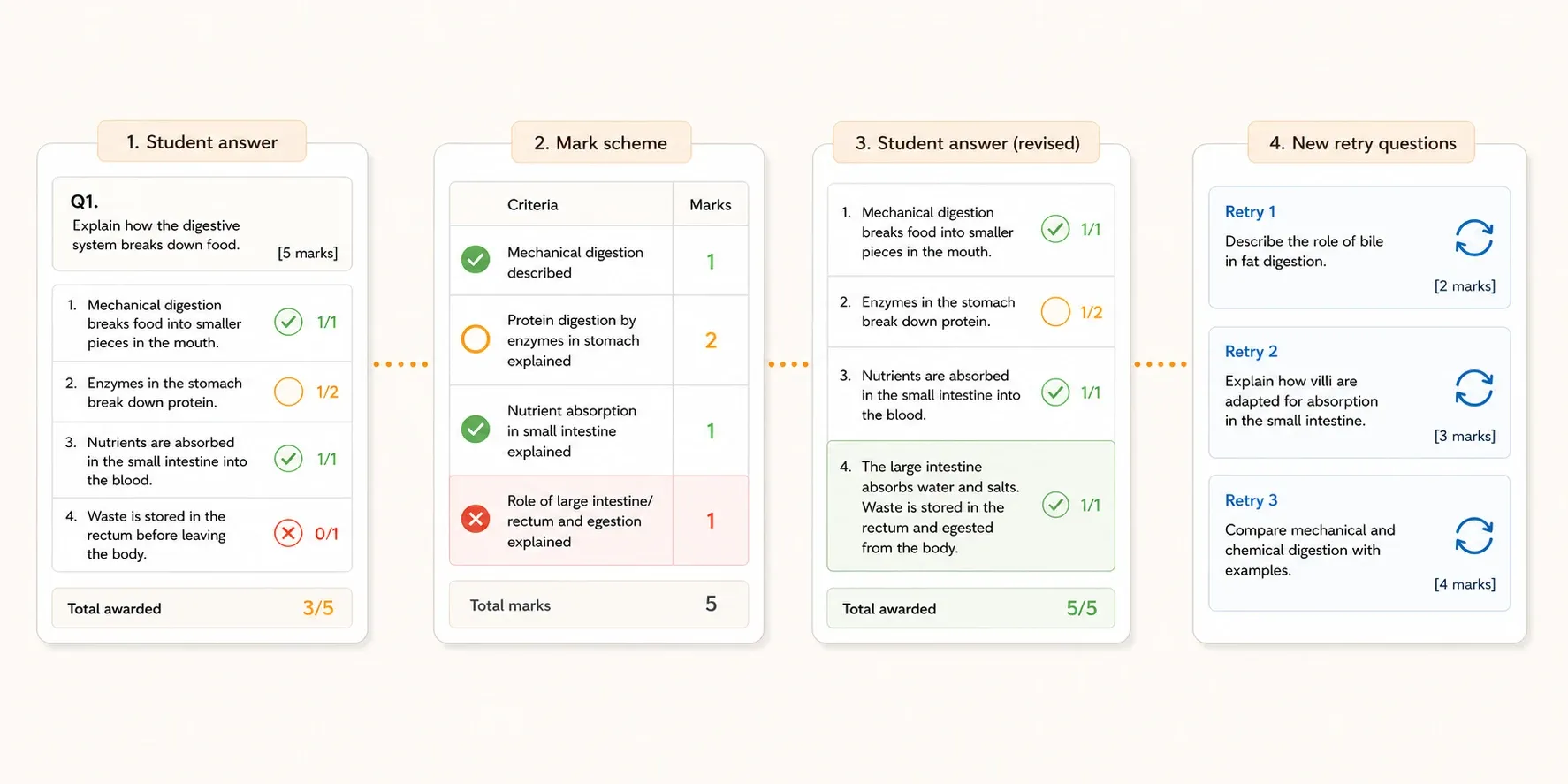
Do not leave the mark scheme review at the score or rewritten answer. Choose a few questions that test the same failure in a new context.
For example:
- missed a method mark: retry a problem that changes the numbers but keeps the method;
- missed application: answer a question using a different case study or data table;
- missed development: write another short paragraph with a claim, evidence, and explanation;
- missed a command word: answer the same topic using “compare,” “explain,” and “evaluate.”
Once you have classified the errors, review the completed practice test and turn its corrections into a targeted retry set rather than rereading the whole paper. Review those retry questions later, without the mark scheme open, and check whether the same error returns.
A mark-scheme review routine you can use today
For one completed question set:
- Put the question paper, your answer, and the matching official scheme together.
- Mark the response without changing it first.
- Write one reason beside every lost or uncertain mark.
- Rewrite only the missing step, condition, application, or development.
- Choose two changed questions that test the same weakness.
- Schedule the retry while the error is still specific.
If your review produces only a score, it is incomplete. Finish with a short list of what to practise next and the answer behaviour you want to see.
What not to do with a mark scheme
Avoid these habits:
- applying the scheme to a different exam board, paper, or series;
- awarding yourself a mark because an answer sounds familiar without checking the credit point;
- treating every keyword as mandatory when the scheme accepts equivalent wording;
- ignoring working marks because the final answer is wrong;
- rewriting every answer instead of repairing the specific error;
- stopping at the score without scheduling a targeted retry.
The mark scheme is useful when it changes what you do next. It is not a second textbook or a list of phrases to memorise.
The goal is better answers, not perfect scores
A mark scheme gives you a shared standard for checking your answer, but it cannot replace thinking through the question. Attempt first, identify the missing requirement, repair one part, and test that repair in a new context.
Use the score to locate the problem, the scheme to name it, and the retry to find out whether you fixed it. That is how a completed paper becomes feedback you can act on.