


Chemistry exams are difficult when you prepare every topic in the same way. Memorising definitions will not teach you how to choose an equation, and completing calculation drills will not automatically help you explain a reaction. A better approach is to separate the work into three parts, then connect them with targeted practice: understand the concept, identify the problem type, and explain what the result means.
This guide shows how to study for a chemistry exam using that structure. You will build a map of the syllabus, turn reactions and definitions into recall prompts, practise calculations by decision rather than pattern matching, and use mistakes to choose your next review task.
Start by sorting the chemistry you need to know
Before rereading notes, turn the syllabus, revision guide, or lecture slides into a short list of testable areas. Give each area one of three labels: concept, calculation, or reaction. Some topics will have more than one label, but the first label tells you what kind of work to start with.
- Concepts: definitions, models, trends, conditions, and explanations such as why atomic radius changes across a period.
- Calculations: quantities, units, equations, graphs, and multi-step problems such as finding concentration from titration data.
- Reactions: reactants, products, conditions, observations, mechanisms, and the reason a reaction follows a particular pathway.
Then mark each item as secure, uncertain, or missing. Do not use confidence alone. A topic is secure only if you can answer a question about it without looking, use the relevant representation correctly, and spot a common error. This gives you a more useful starting list than highlighting every page in your notes.
Build understanding before memorising details
For each concept, write a small explanation that answers four questions: What is it? What causes it? What does it predict? When does the rule stop applying? The final question matters because exam questions often change a condition to see whether you understand the model rather than remember a sentence.
For example, do not leave electronegativity as a definition to memorise. Add the trend across the periodic table, the effect on bond polarity, and the fact that the trend is a useful generalisation rather than an explanation for every individual bonding situation. That extra connection gives you several ways to retrieve the idea.
Close the source and explain the concept aloud or in writing. If your explanation contains a vague phrase such as it gets stronger or the particles react faster, return to the source and replace it with the mechanism, variable, or condition that makes the claim precise.
Learn equations as decisions, not just formulas
A formula is useful only when you know when to use it and how to check the result. For every important equation, make a four-part note: what the equation describes, what each symbol represents, what units are required, and what kind of question usually signals that equation.
- Name the quantity the question is asking for.
- List the values you know and convert units before substituting.
- Choose the equation that connects those values to the unknown.
- Check the unit, sign, scale, and chemical meaning of the answer.
Practise the decision step separately from the arithmetic. Take a mixed set of questions and, before solving, write only the likely quantity, equation, and reason for your choice. Then solve the problem. This stops you from recognising a familiar layout and applying the last formula you used.
When a chemistry calculation feels like a formula hunt, the same classify-before-solving habit described in this math exam problem-solving guide can help. The subject changes, but the decision to identify the problem structure before calculating is the same.
Turn reactions into connected recall prompts
Reaction revision becomes fragile when you memorise an isolated equation with no conditions or explanation. Build a small prompt set around each reaction instead. Ask what reacts, what forms, which conditions are required, what you would observe, and why the reaction is useful.
- Recall the balanced equation or the key transformation.
- State the conditions, catalyst, solvent, or temperature if they matter.
- Explain the mechanism or driving idea at the level your course expects.
- Predict what changes if one reactant, condition, or product is changed.
One reaction can therefore produce several useful cards or questions without becoming a list of disconnected facts.
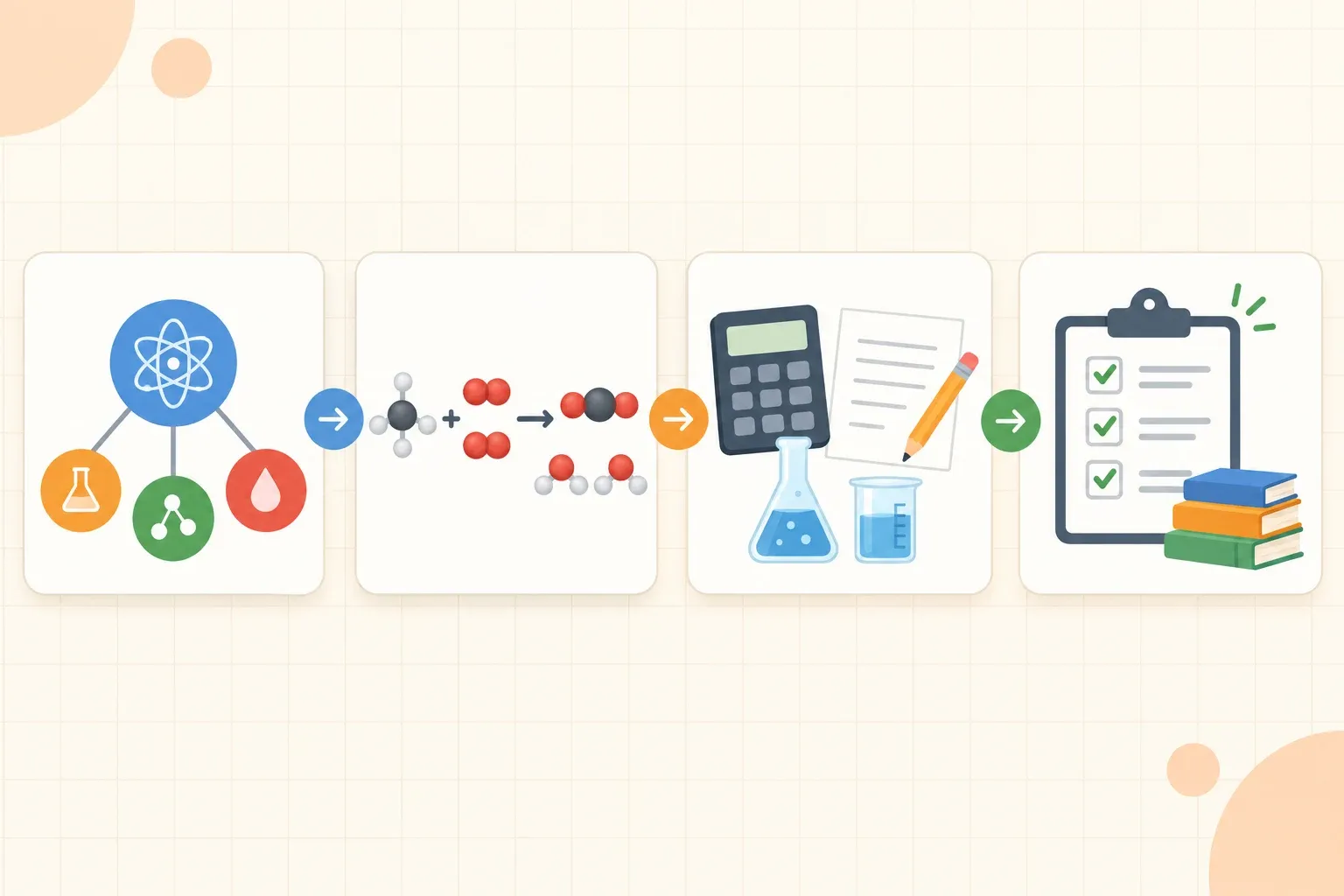
Keep each answer short enough to check, but include the condition or reason that prevents a lucky guess.
Use mixed practice to connect the three parts
Once you have reviewed concepts, equations, and reactions separately, mix them. An exam rarely tells you which section of your notes to use. Your practice should sometimes require you to decide whether a question needs a definition, a model, a calculation, a reaction pathway, or more than one of these.
A useful sequence is one concept explanation, one calculation, and one reaction question from the same topic.
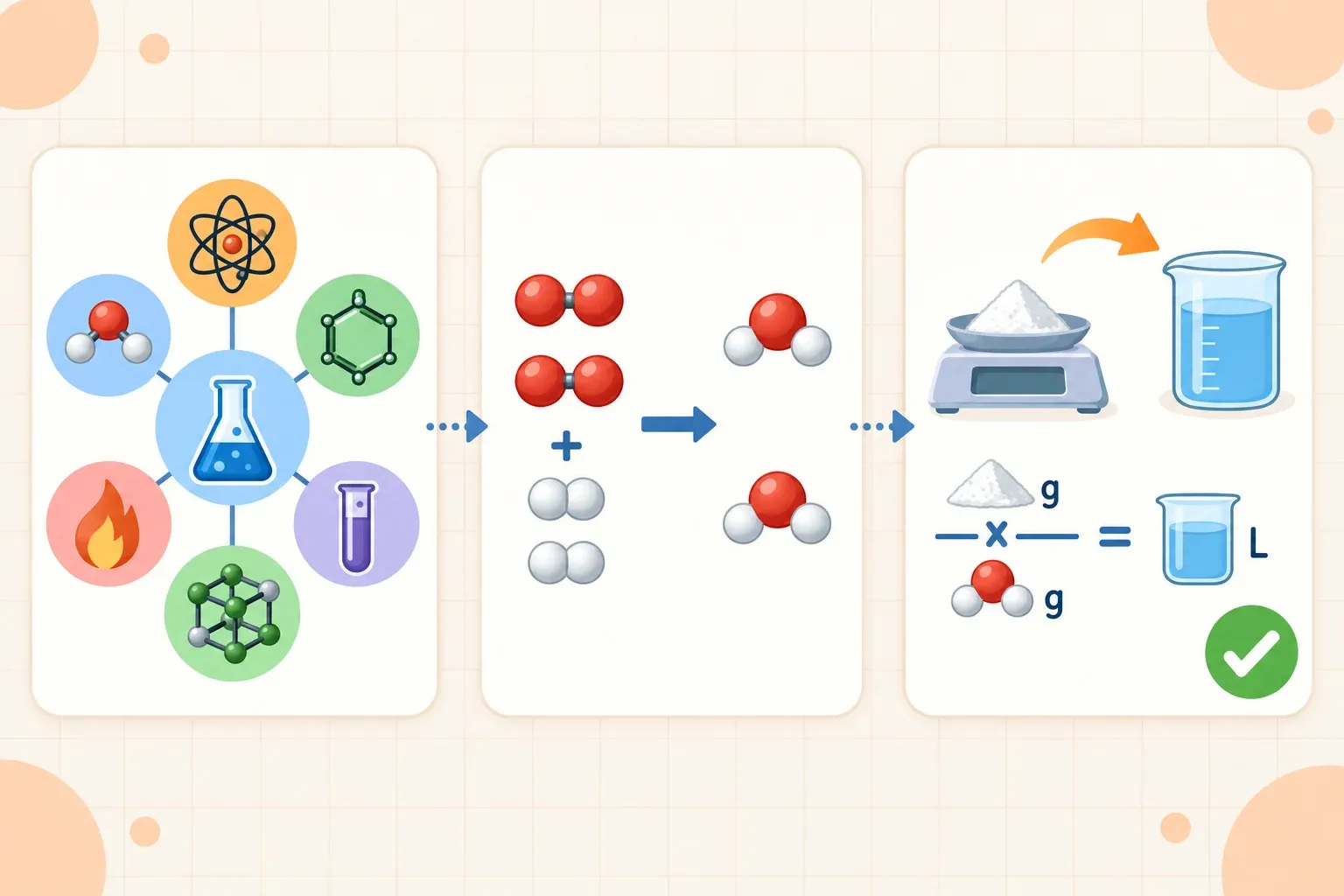
For an acids topic, you might explain strong versus weak acids, calculate a concentration from data, and predict how a condition affects an equilibrium. The questions share a topic but demand different actions, which is closer to the decisions you make in an exam.
If answering questions feels less fluent than rereading, read the guide to practice testing for the learning reason behind that difficulty. In this chemistry workflow, the moment you struggle tells you which concept, decision, or condition needs a closer look. The Learning Scientists describe the same distinction in their overview of retrieval practice.
Match practice to the exam you will actually sit
Chemistry courses do not all assess the same balance of calculations, explanations, reactions, and practical work. Before choosing questions, check the syllabus, learning outcomes, lecture objectives, assigned problem sets, lab write-ups, and any past papers you have. They show the notation, command words, level of detail, significant figures, and question formats your instructor expects.
If you have already solved a question, change one part before trying it again: alter the values, ask for a different unknown, remove a familiar cue, or change a reaction condition. This creates a new decision without sending you into a completely unfamiliar topic. Stanford chemistry study advice makes the same practical point: regular problem solving, careful explanations, and attention to laboratory and course materials should work together. See Stanford chemistry study tips for a useful checklist of those course-specific habits.
Do not skip practical and laboratory material
If your exam includes practical questions, treat lab notes as part of the examinable material rather than a separate task. For each experiment, recall the aim, the variables, the essential steps, the expected observation, the data or graph, and one reason the result could be less reliable. Then connect the observation to the chemistry behind it.
You do not need to memorise every sentence in a lab report. You do need to explain what was measured, why the method was suitable, and how a change in procedure would affect the result. If practical work is not part of your exam, keep this section brief and put that time into the concepts and problem types your assessment actually uses.
Keep a chemistry-specific error log
After each practice set, record the first point where your answer stopped being reliable. Do not write only “got it wrong.” Classify the error so that your next action is obvious.
- Recall error: you could not state the definition, trend, equation, or condition.
- Selection error: you knew the tools but chose the wrong equation or reaction.
- Execution error: the method was right but a unit, sign, balance, or arithmetic step failed.
- Explanation error: the result was plausible but you could not justify it with the relevant chemical idea.
Repair one category at a time. A recall error may need a short prompt set. A selection error needs mixed questions with the equation hidden. An execution error needs a slower worked example followed by a similar problem. An explanation error needs you to write the reason before checking the mark scheme.
If you are unsure which topics deserve the next session, use the answers you miss to choose the next topic rather than reviewing the whole course again.
How to study for a chemistry exam: a practical sequence
For each topic, use this sequence:
- Map the topic into concepts, calculations, and reactions.
- Close your notes and explain the central ideas from memory.
- Practise choosing equations and setting up calculations before solving them.
- Recall reactions with their conditions, observations, and reasons.
- Finish with a mixed set and log the first point of failure.
- Repair only the errors that appeared, then retry a changed version of the question.
If your chemistry material is spread across PDFs, lecture slides, and problem sheets, you can generate practice questions from a PDF and answer them without looking at the source. This works best when the questions stay tied to the original material, especially when a condition, diagram, or equation matters.
What to do the day before the chemistry exam
Do not try to reread every chapter from the beginning. Use your error log and topic map to choose a small final set: a few concepts you cannot explain, calculations where equation choice is still slow, and reactions whose conditions or products are easy to confuse. Answer those questions from memory, check the source, and stop when your accuracy begins to fall.
The goal is not to make every topic feel equally familiar. It is to know what you can explain, what you can calculate, which reactions you can reconstruct, and which gaps still need attention. In chemistry, that clarity is more useful than another full pass through the notes.
Close the source, choose the chemistry task, solve or explain it, check the reason, and let the mistake decide what you study next.