

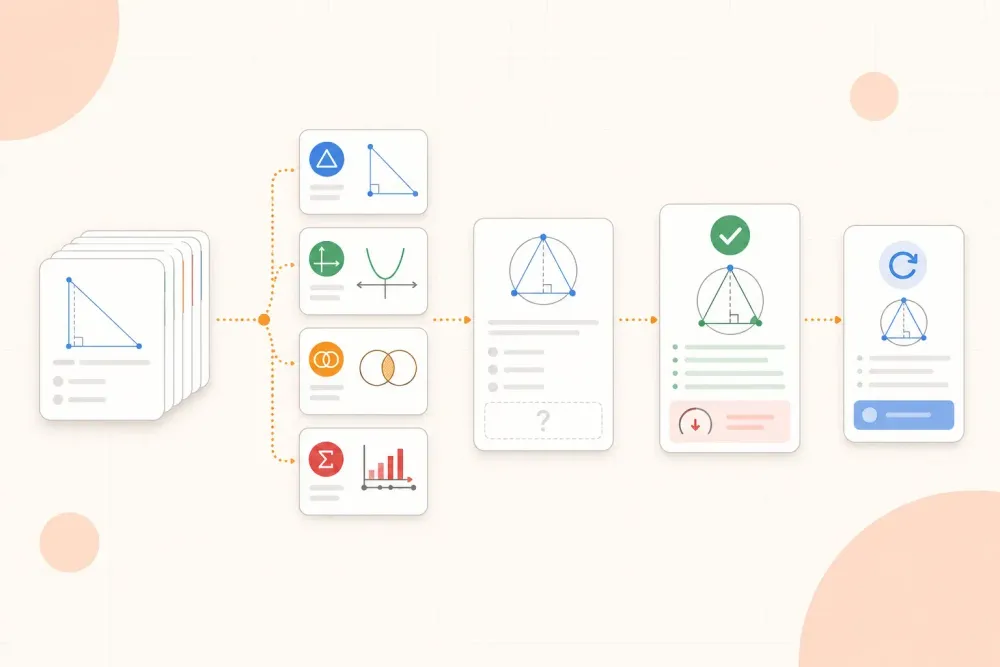
Studying for a math exam is not mainly a reading task. Whether the course is algebra, calculus, statistics, or another problem-based subject, you need to recognize what a question is asking, choose a method, carry it out, notice when the result does not make sense, and try again on a similar but unfamiliar problem.
For this reason, the most useful routine is a problem-solving loop: map the problem types, attempt questions without help, diagnose the exact failure, repair the smallest missing skill, and retry in a mixed set. This approach gives each practice problem a purpose instead of turning revision into a long stack of exercises.
How to study for a math exam: a problem-solving system
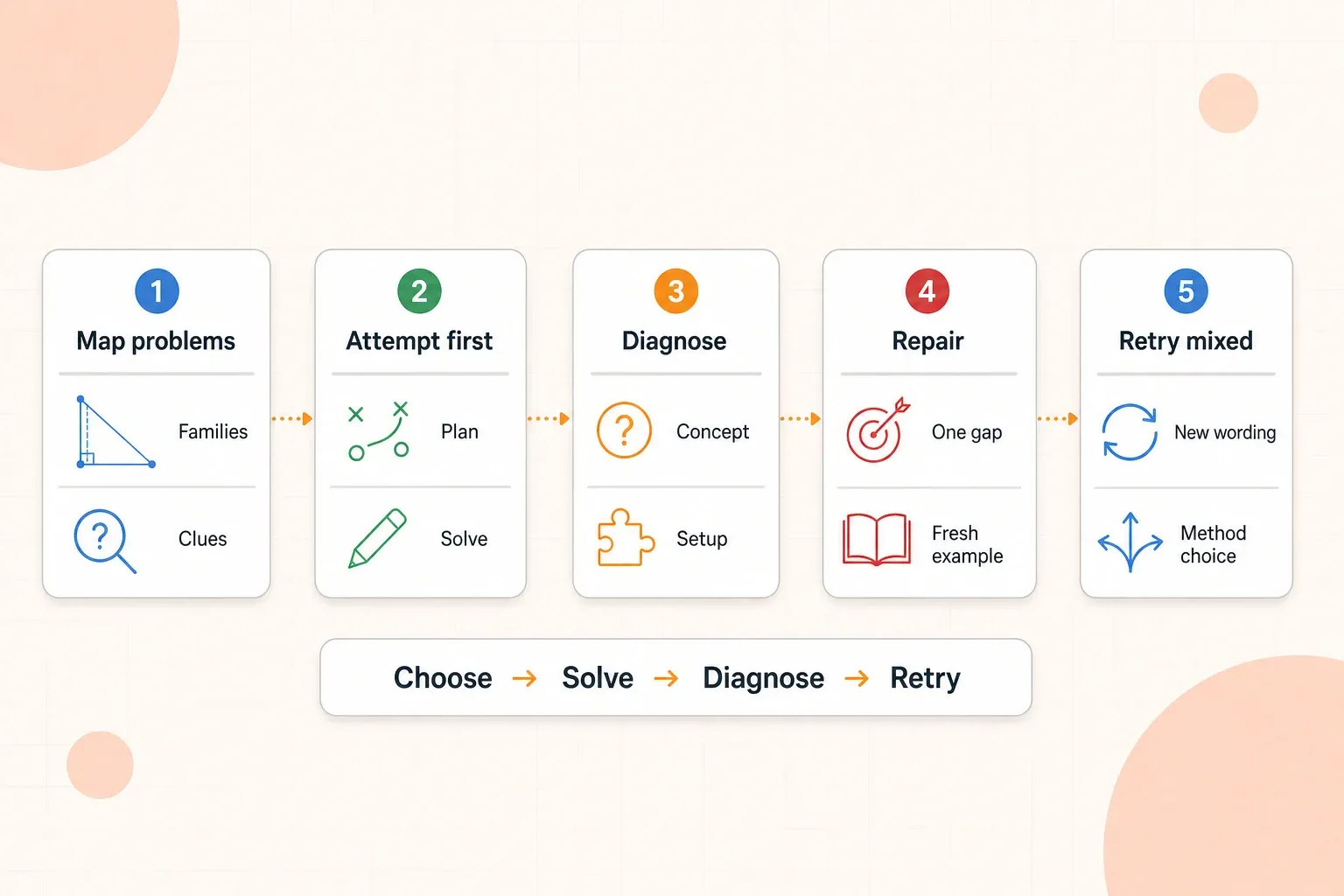
Use this sequence whenever you prepare a topic or a group of related topics:
- Map the problem families. Identify the kinds of questions the exam can ask and the clues that distinguish them.
- Attempt before checking. Work without notes or worked solutions long enough to reveal your actual approach.
- Diagnose the failure. Decide whether the problem was the concept, method choice, setup, algebra, arithmetic, interpretation, or time.
- Repair one gap. Review only the explanation or skill connected to that failure.
- Retry a variation. Solve a new problem that uses the same idea in a different form.
- Mix your practice. Choose the method before you know which chapter the question came from.
This is different from completing every exercise in order. It trains the decisions that make exam questions difficult: recognizing the structure, selecting a path, and checking whether the result is reasonable.
Start by mapping problem families, not chapters
A syllabus or textbook is usually organized for teaching, not for showing you which decisions an exam will require. A single chapter may contain several problem families, while the same family may appear across different chapters.
Build a short map from your lecture notes, assignments, review sheet, and practice exam. For each family, record:
- what the problem is asking you to find or prove;
- the clues that suggest this family;
- the main method or representation it usually needs;
- one representative problem to attempt without help;
- one likely failure point to watch for.
For example, a calculus map might separate derivative rules, tangent-line questions, optimization, and accumulation problems. The categories are not just topics to memorize. They are different decisions: differentiate directly, interpret a rate, build an objective and constraint, or connect a rate to a total.
Do not make the map exhaustive. If two exercises require the same recognition and method choice, keep them in one family and choose the clearer representative.
Attempt problems before looking at the method
Worked examples are useful for learning a method, but they cannot tell you whether you can recognize and use that method independently. Start each practice problem with your notes and examples closed. Write down what is known, what is being asked, and what you think the first step should be.
Set a stop point before you begin. For a standard practice problem, spend about five minutes trying to identify the family, make a plan, and write the first step. If there is still no progress, take one targeted hint rather than reading the full solution.
If the first attempt stalls, do not immediately copy the solution. Use a small hint ladder:
- Restate the question in your own words.
- List the known quantities, constraints, units, or conditions.
- Name two possible methods and explain which one seems more appropriate.
- Complete only the next step, then continue without looking again.
- Read the full solution only after you have identified where your plan stopped working.
University math-study guidance makes the same practical point: attempt practice questions without notes first, then use your materials to repair the specific gap rather than treating the solution as a script to memorize. For a concise explanation of this answer-first approach, see UC Davis's advice on attempting practice questions without notes.
The goal is not to struggle indefinitely. It is to expose your first approach clearly enough to show whether you lacked a fact, chose the wrong method, or made an execution error.
Diagnose the kind of mistake you made
"The answer is wrong" is not yet useful feedback. Classify the failure before you open the answer:
| Failure type | What to ask | Best next action |
|---|---|---|
| Concept | Which idea or definition was misunderstood? | Review the concept, then explain it in a new example. |
| Method choice | What clue should have pointed to another method? | Compare two problem families and name the deciding clue. |
| Setup | Were the words, diagram, or conditions translated correctly? | Rebuild the representation before calculating. |
| Execution | Where did the algebra, arithmetic, or sign error begin? | Redo the first incorrect line without copying the solution. |
| Interpretation | Does the result answer the question and fit the units or constraints? | Check the result against an estimate, graph, or boundary case. |
| Timing | Was too much time spent on one step? | Practice a shorter set with a deliberate time checkpoint. |
Keep a compact error log with the problem, failure type, first wrong step, and next variation to try. The point is not to collect mistakes; it is to make the next practice decision obvious.
If confidence is high but accuracy is low, or if easy-looking questions take too long, use this workflow for prioritizing weak spots. For math, add the method-choice clue and the first wrong line so the diagnosis remains specific to problem solving.
Repair the smallest missing skill
Once you know the failure type, avoid restarting the entire chapter. Repair the smallest part that blocked the solution:
- missing definition: write the definition and use it in one fresh example;
- wrong method: compare the correct method with the tempting alternative;
- weak setup: redraw the diagram or translate the words into variables;
- algebra error: isolate the exact transformation that failed;
- interpretation error: check units, sign, scale, endpoints, or the meaning of the result.
Then solve a nearby problem with the source closed. If you only reread the explanation, you may recognize it without being able to produce the next step. A repair is complete when you can use the idea again, not when the worked solution looks familiar.
Move from similar exercises to mixed practice
Start with a small group of related problems while you are learning a method. Then mix that group with problems from other families. In a real exam, the heading will not tell you which procedure to use, so practice must eventually include that recognition decision.
For a mixed set, choose problems that vary at least one feature:
- the wording or representation;
- the numbers and units;
- the method that looks tempting but does not fit;
- the number of steps;
- the context in which the same idea is used.
Before calculating, write the problem family and the reason you chose it. If you cannot name either one, the missing skill may be recognition rather than calculation.
Problem-solving guidance from Oregon State University also recommends practicing the types of questions an exam will ask, working beyond assigned exercises, and analyzing the process after solving. Its problem-solving exam guide gives a useful checklist for turning a list of exercises into deliberate practice.
Use worked solutions without memorizing them
A worked solution should explain a decision, not replace one. When you check an answer, cover the next step and ask what you would do. Then compare your step with the solution and write down the reason for any difference.
Pay attention to transitions such as:
- why a variable was introduced;
- why one equation was rearranged before substitution;
- why a diagram or graph was used;
- why a method was rejected;
- how the final result was checked.
After reading the solution, close it and reproduce the path from the original problem. Then change one condition and solve the variation. If you can repeat the exact numbers but cannot adapt the method, you learned the example rather than the problem family.
Build an exam-style practice session
An exam-style practice session should include both recognition and execution. A useful session has:
- A short warm-up from a problem family you recently repaired.
- A mixed set where the method is not identified in advance.
- One unfamiliar or multi-step problem.
- A check using your error log, not just the answer key.
- One retry scheduled after a gap.
For the timed portion, match the exam's question format, calculator rules, working expectations, and approximate pace. Do not turn every practice session into a full mock exam; use timed work to test decision-making and pacing after you have learned the underlying methods.
When you finish a full practice paper, do not stop at the score. Follow this practice-test review workflow to preserve your reasoning, classify lost marks, correct the first point of failure, and build targeted retries.
Space retries to test transfer
An immediate retry checks whether the repair made sense. A later retry checks whether the method is still available when the example is no longer fresh. For an important error, use three passes:
- Solve a nearby example in the same session while the repair is clear.
- Solve a mixed version later without labeling the problem family.
- Attempt a timed variation before the exam, with a different wording or tempting method.
If the same failure returns, do not simply add more exercises. Reclassify the error: the missing skill may be recognition, setup, or interpretation rather than the procedure itself.
Example: preparing for a calculus optimization exam
Imagine you can differentiate familiar functions but lose marks on optimization questions. Completing more derivative drills would make you feel busy without addressing the real problem.
Use the problem-solving system instead:
- Map the family: recognize that optimization questions require an objective, a constraint, a variable choice, and a check of critical points or endpoints.
- Attempt a question with the textbook closed. Write what quantity must be maximized or minimized and what information connects the variables.
- Diagnose the failure. If the derivative was correct but the objective function was never built, classify the issue as setup rather than calculus execution.
- Repair the setup by working through one example that translates the wording into variables and a single-variable function.
- Retry a variation with different dimensions or a different quantity to optimize.
- Mix it with derivative, graph interpretation, and rate problems so you must recognize the family before choosing the method.
The important gain is not simply getting one optimization answer. It is learning to notice the signal that calls for an optimization model, then checking whether the resulting value makes sense.
How to organize practice as the exam approaches
Do not build your plan around the number of pages or exercises you hope to finish. Build it around outputs:
- a completed problem-family map;
- a short error log with recurring failure types;
- repaired examples that you can solve without notes;
- mixed sets that test method choice;
- timed practice followed by targeted retries.
Use those outputs to decide what happens next. With several days available, alternate new problem families with older mixed sets and scheduled retries. If the exam is close, prioritize representative problems and unresolved errors rather than starting every chapter again.
When several gaps compete for attention, rank them using three signals: how likely the problem family is to appear, how often the error has repeated, and how much of the solution the error blocks. This keeps practice focused on high-impact weaknesses rather than the topics that feel easiest to review.
Once you know which problem families and retries matter, turn them into a revision timetable built around your available study time. Keep solving and retrying visible in the plan, rather than filling it with reading blocks.
What to do the day before the exam
The day before is for confirming readiness, not for trying to absorb an entirely new course. Complete a short mixed set, review the error log, retry one or two high-value problems, and check any permitted formula or reference sheet.
Stop when additional work is producing careless errors rather than useful information. A final late-night chapter reread cannot replace the ability to select and execute a method with the source closed.
The most effective math revision is not about completing the most exercises. It is a loop that shows you what you cannot yet recognize or produce, repairs that exact gap, and tests whether the repair transfers to a new problem.