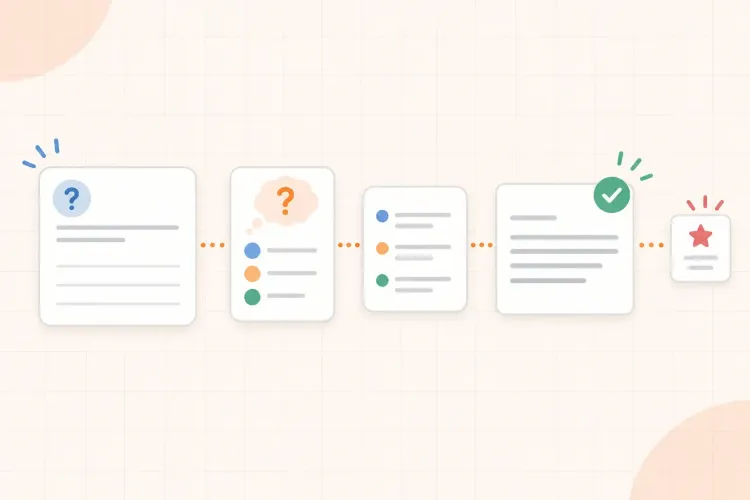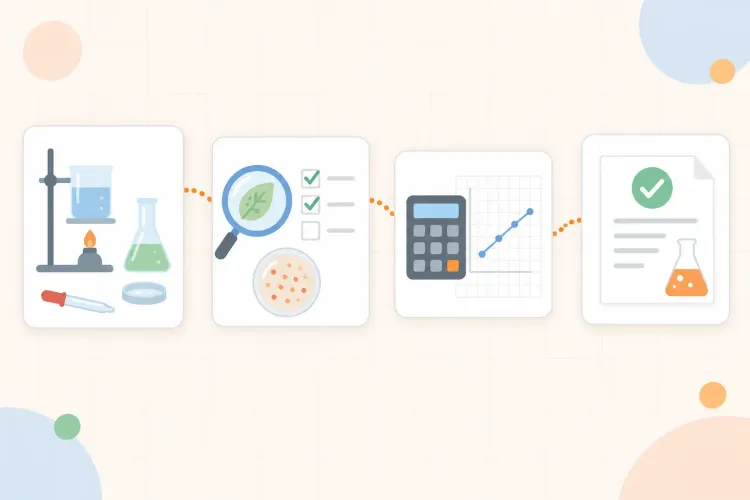


Past papers are most useful when you do more than complete them and look at the score. Use the right paper for your course, choose a practice mode that matches how close the exam is, mark each answer against the scheme, and turn lost marks into the next study task.
The goal is not to prove that you already know everything. It is to see how real questions expose gaps in knowledge, reasoning, timing, or answer technique. A useful past-paper session ends with a short repair list, not just a percentage.
How to use past papers effectively
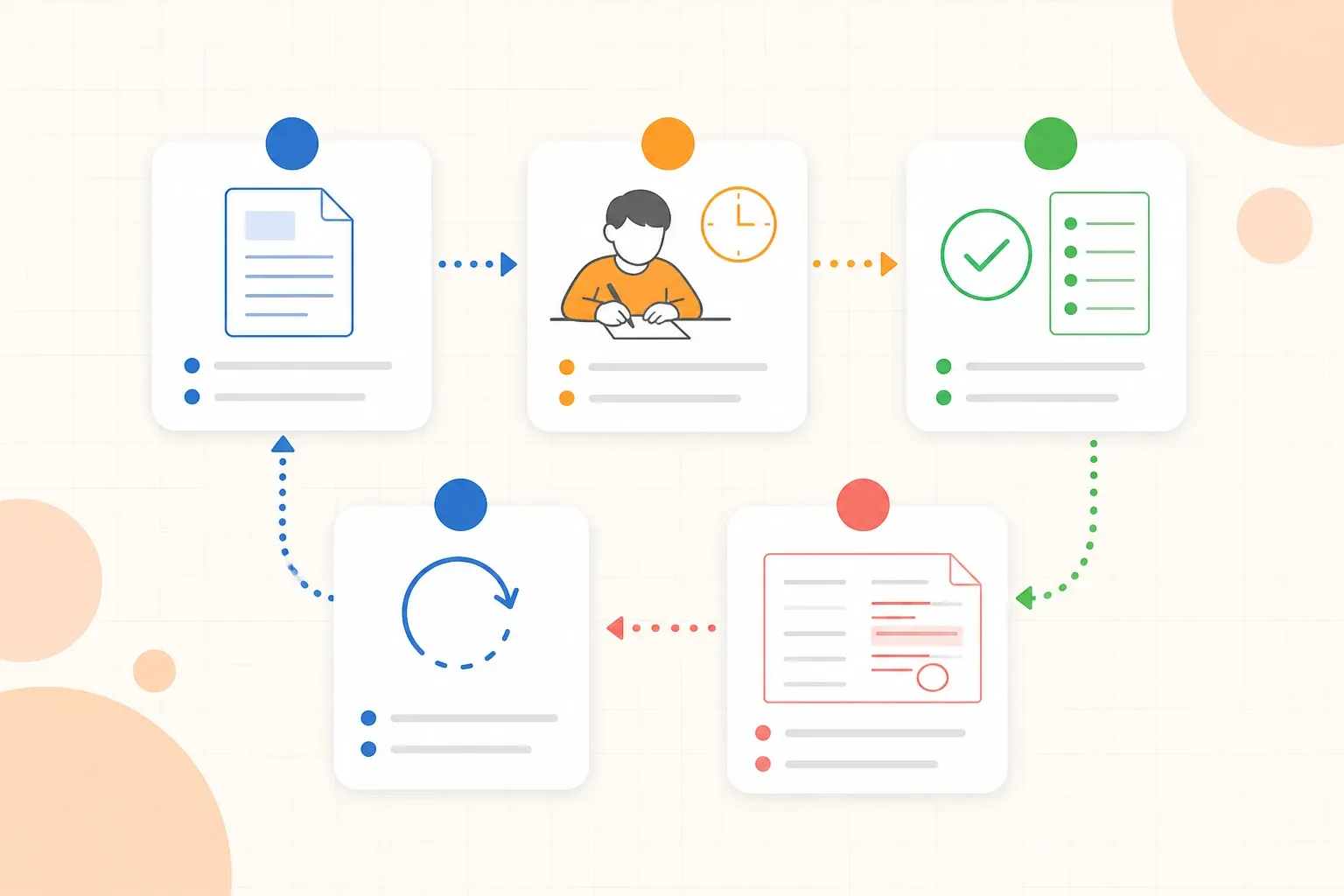
Use this sequence for each paper or selected question set:
- Choose a relevant paper. Match the subject, course, exam format, and current specification as closely as possible.
- Pick the right practice mode. Start with selected questions, then move to timed sections and full papers as the exam approaches.
- Attempt before checking. Keep notes, answer keys, and worked solutions out of reach while you answer.
- Mark for more than the total. Record which marks were lost and why they were lost.
- Repair the cause. Review only the relevant idea, method, or answer structure.
- Retry later. Use a fresh question or a changed version of the original task to check whether the repair holds.
This is a complete workflow, not a score-chasing exercise. If you want the broader reason that answering before rereading helps, read why practice testing beats rereading. This article keeps the focus narrower: how to make a past paper produce useful next steps.
Choose a past paper that matches your exam
The closer the paper is to your actual assessment, the more informative its score and mistakes will be. Before you start, check the subject and course or module, the exam board or department format, the current specification or syllabus, the question types and mark allocations, and whether a mark scheme or model answer is available.
An old paper can still help you practise a concept or question type, but treat it carefully if the syllabus, terminology, or marking rules have changed. Do not let an outdated paper become a list of topics you assume will appear on the current exam.
If you have several papers, keep the newest and closest matches for later full simulations. Use older or less similar papers earlier for topic practice, when the point is to build understanding rather than predict the exact exam. Avoid repeating one paper until the answers feel familiar; once you remember the questions, switch to a fresh paper or write a changed version that tests the same skill.
Use the right practice mode
You do not need to complete every past paper under full exam conditions. That is useful later, but inefficient when you are still learning the material. Use three modes:
| Mode | When to use it | What to do |
|---|---|---|
| Topic practice | Early in revision | Select questions on one topic and review the method after each attempt. |
| Timed section | During revision | Complete a group of questions under a time limit, then mark the section. |
| Full simulation | Closer to the exam | Complete the paper in one sitting with the permitted materials, timing, and answer format. |
Topic practice helps you learn what the questions are asking. Timed sections add pacing without making one mistake consume an entire afternoon. Full simulations show whether you can combine knowledge, timing, and concentration across the whole paper.
A practical rule is to move toward exam conditions as the exam gets closer, not to use maximum pressure from the first session. Choose the mode that matches the decision you need to make: learn a topic, measure pacing, or simulate the exam.
Attempt the paper before looking at help
For a diagnostic session, keep the source material, mark scheme, and worked answers closed. Read the full question first, identify the command word, and write the best answer you can. If you are stuck, record the question and move on rather than turning the session into an open-book search.
You can use a small confidence mark beside each answer: high, medium, or low. This adds useful information to the score. A wrong answer you felt certain about may deserve earlier attention than a question you left blank because you already know it is difficult.
Do not spend ten minutes trying to rescue one question during a timed paper. Mark it, continue, and return if time allows. The result should show both what you know and where the time limit changes your performance.
Mark every lost mark by its cause
A total score tells you how much was missed. The marking process should tell you what to do next. Classify each lost mark as a knowledge gap, reasoning gap, application gap, answer-technique gap, or timing and carelessness problem.
| Lost mark | What it usually means | Next action |
|---|---|---|
| Knowledge gap | You did not know or recall the relevant fact or concept. | Review the exact section and answer a focused question from memory. |
| Reasoning gap | You knew the ingredients but could not connect them. | Write the relationship step by step and explain why each step follows. |
| Application gap | You knew the rule but could not use it in this situation. | Try a changed example and identify what stays the same. |
| Answer-technique gap | The idea was present but the response missed the command word, evidence, structure, or detail. | Rewrite the answer against the mark scheme. |
| Timing or carelessness | You ran out of time, misread the prompt, or made an avoidable slip. | Practise the question type with a checkpoint or checking routine. |
This distinction prevents the common response of rereading everything after a disappointing score. A knowledge gap, a weak explanation, and a timing problem may all look like a wrong answer, but they need different repairs.
Use the mark scheme without memorizing it
A mark scheme is not only an answer key. It shows what the examiner was looking for and how much detail the question rewards. When you check an answer, ask:
- Which part of the answer earned a mark?
- Which required idea, step, comparison, or piece of evidence was missing?
- Did the response answer the command word, or did it give a nearby fact?
- Was the answer clear enough to be marked without the examiner guessing what it meant?
For longer responses, compare the structure of your answer with the scheme or model answer. Do not copy the wording and call that improvement. Close the scheme, rewrite the answer in your own words, and check whether the required elements are still there. This guide to using practice exams and marking schemes follows the same loop: attempt, mark, identify lost marks, and focus the next study session.
Research on retrieval practice supports the value of trying to produce an answer before checking it, but it does not mean every past paper should be treated as a high-pressure final rehearsal. The benefit depends on using feedback and choosing a practice format that matches the purpose of the session. A systematic review of classroom retrieval practice found benefits across different ages, subjects, test formats, and feedback timings, while also noting limits in the research base.
Example: turn one paper into a better study plan
Imagine a student completes a 40-mark biology paper and scores 26. The score is useful, but it is not the study plan. After marking, the student sees:
- 5 marks lost because two processes were confused
- 4 marks lost on a data-interpretation question
- 3 marks lost because a longer answer named facts but did not explain the relationship
- 2 marks lost through timing at the end
The next session should not be a full reread of biology. It could include a two-column contrast for the confused processes, two new data questions, one rewritten explanation checked against the scheme, and a short timed section. The student then retries similar questions two days later. The lost marks have become four specific tasks instead of one discouraging percentage.
Build an error log and retry set
After marking, keep a small error log rather than a list of scores. For each important mistake, record the question or topic, the cause of the lost mark, the corrected idea or answer element, a new question that tests the same skill in a different way, and when you will attempt it again.
Keep the retry set smaller than the original paper. Its purpose is to check whether the repair worked, not to recreate the whole exam immediately. For a more detailed diagnosis of the gaps revealed by your answers, use the weak-spot review process.
For a longer revision plan, spread the repair tasks across the days before the next full paper. Use a revision timetable to place retry questions after a gap, rather than doing the paper, reading the answers, and forgetting the mistakes by the next morning.
When a past paper is not the right first step
Past papers are not a substitute for learning the material from scratch. If you cannot recognize the main concepts, do not understand the notation, or have no idea how to begin most questions, start with a short source review and a few guided examples. Then use selected past-paper questions to check your understanding.
They are also not a perfect prediction of the next exam. A paper can show recurring question types and expected answer quality, but it cannot guarantee which topics will appear. Use it to practise the skill and expose gaps, not to memorize a list of likely questions.
How often should you use past papers?
Use selected questions as you finish learning each topic, timed sections during the middle of revision, and full papers once you can attempt most of the content without constant guidance. After a full paper, leave time for marking and repair before scheduling the next simulation.
More papers are not automatically better. One carefully marked paper that changes your next study session is more valuable than three papers whose answers you never analyze.
Past papers work best when they change what you do next. Choose a paper that matches the exam, attempt it in the right mode, mark the cause of every important lost mark, repair one skill at a time, and retry after a gap. The score is only the starting point; the useful result is knowing exactly what to practise next.