

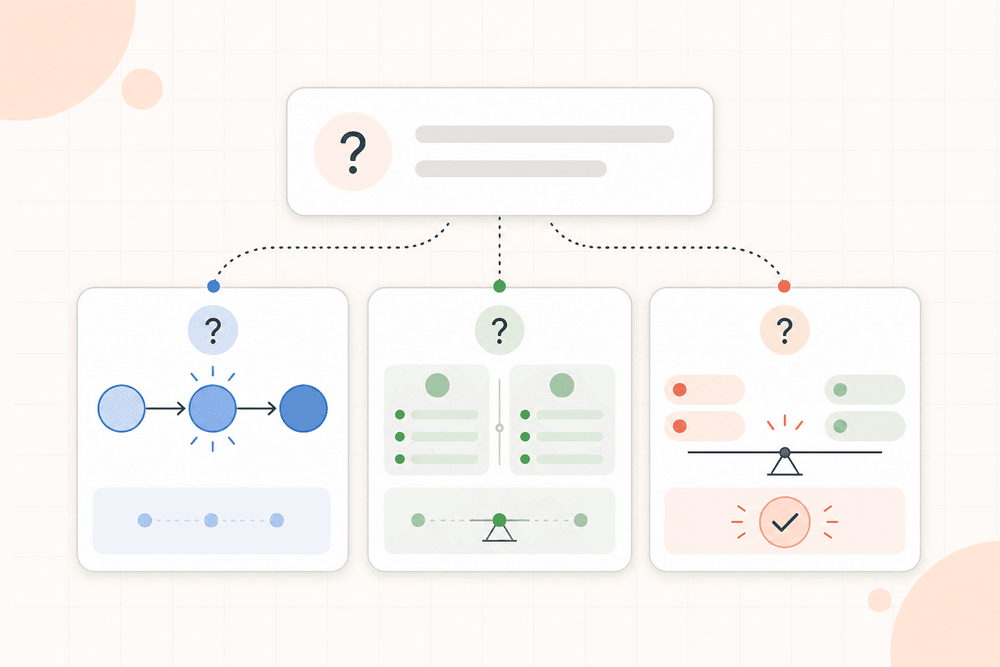
Exam questions often contain two different kinds of information: the topic tells you what to discuss, while the command word tells you what to do with it. If you know the topic but miss the instruction, you can write a knowledgeable answer that still answers the wrong question.
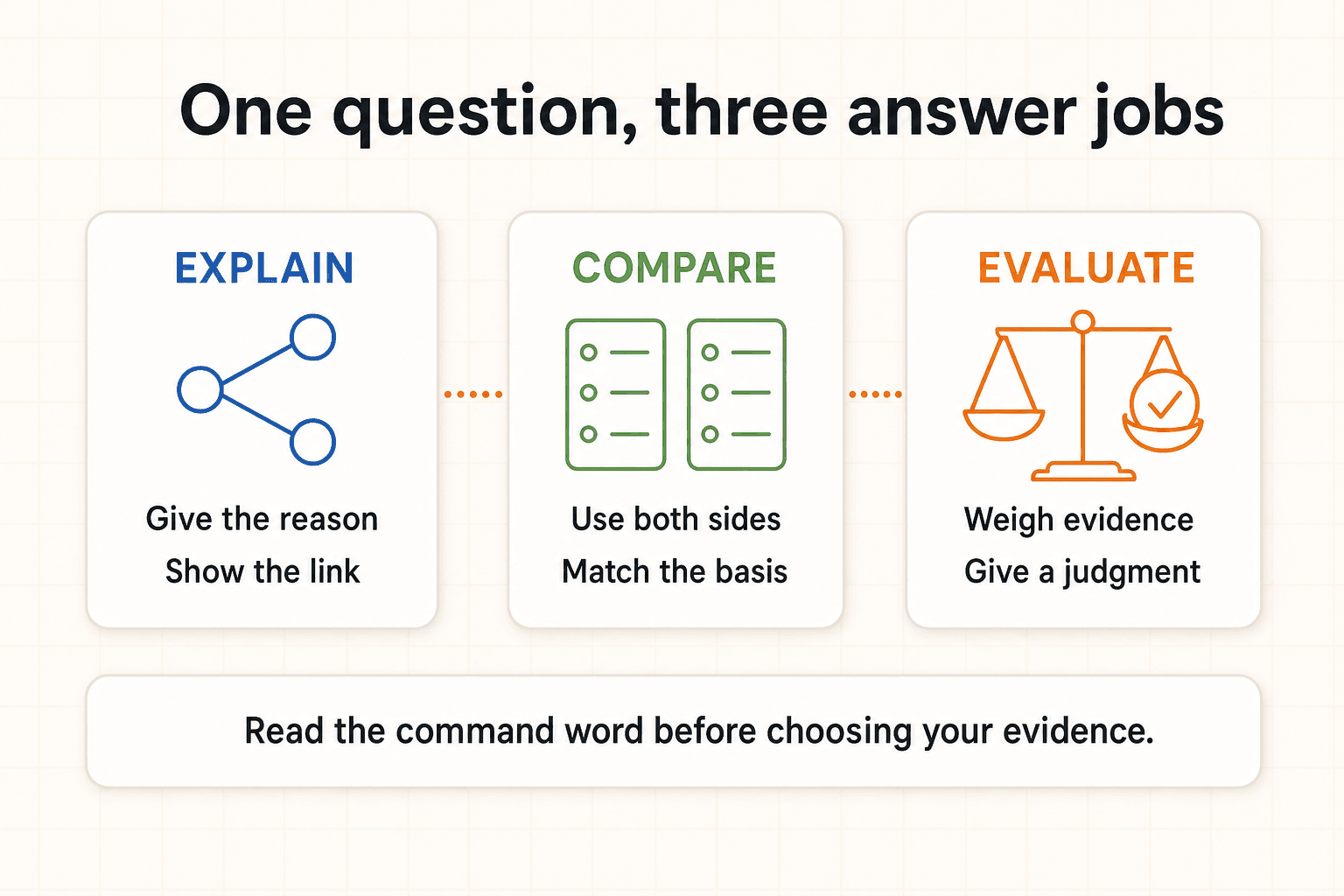
“Explain,” “compare,” and “evaluate” are not interchangeable requests. Explain asks you to make a reason or relationship clear. Compare asks you to examine two or more things using the same basis. Evaluate asks you to weigh evidence and reach a supported judgment. The wording may vary by subject or exam board, so always check your course guidance. These distinctions are a useful starting point.
What do explain, compare, and evaluate mean in exams?
Read the command word before you start choosing facts. It determines the job your evidence must perform:
| Command word | Main job | What the answer must show |
|---|---|---|
| Explain | Make a reason, process, or relationship clear | How or why something happens, supported by relevant evidence |
| Compare | Set two or more things against the same criteria | Similarities, differences, and the basis of the comparison |
| Evaluate | Weigh the quality, importance, or validity of something | Evidence on more than one side, followed by a reasoned judgment |
The topic can stay the same while the answer changes. For example, a biology question about exercise could ask you to explain how oxygen reaches working muscles, compare aerobic and anaerobic respiration, or evaluate the claim that exercise intensity is the main factor affecting recovery. Each question needs a different answer structure.
How to answer an explain question
An explain question asks you to make the logic visible. You need more than a definition or a list of facts. Show the chain that connects a cause to an effect, a mechanism to an outcome, or a decision to its consequence.
A useful structure
- State the point. Answer the question directly in the first sentence.
- Give the relevant detail. Use the concept, process, event, or evidence that supports the point.
- Show the link. Explain why that detail leads to the outcome or proves the relationship.
- Return to the question. Make the significance of the explanation explicit.
Suppose the question is: Explain why a lack of oxygen reduces aerobic ATP production.
A weak answer might say that oxygen is needed for respiration and ATP production decreases. That identifies the topic, but it leaves the mechanism implicit.
A stronger answer would connect the stages: oxygen acts as the final electron acceptor in the electron transport chain; without it, electron transfer backs up, the proton gradient is not maintained, and oxidative phosphorylation slows or stops. The answer then explains the consequence rather than simply naming it.
What an explain question does not require
You do not automatically need to:
- argue that one factor is more important than another;
- describe every detail you remember about the topic;
- present two opposing interpretations;
- add a conclusion that weighs competing evidence.
Those tasks may appear in the question, but they are not created by the word “explain” alone. Keep asking: Have you shown why or how?
How to answer a compare question
A compare question asks you to examine at least two things in relation to each other. Listing everything you know about A and then everything you know about B is not automatically comparison. Your answer needs to apply the same basis to both.
Choose the basis before the evidence
Before writing, decide what dimensions make the comparison useful. Depending on the subject, these might be:
- purpose or function;
- causes or mechanism;
- evidence or method;
- scale, timing, or impact;
- strengths, limits, or conditions.
Then organize the response around those dimensions. For example, if you are comparing aerobic and anaerobic respiration, one paragraph might compare oxygen dependence, another ATP yield, and a third the conditions in which each pathway supports cells.
| Weak comparison | Better comparison |
|---|---|
| Paragraph 1: everything about aerobic respiration. Paragraph 2: everything about anaerobic respiration. | Each paragraph uses one basis, then explains how both processes differ or overlap on it. |
| “Aerobic respiration uses oxygen. Anaerobic respiration does not.” | “Aerobic respiration uses oxygen as the final electron acceptor and produces more ATP, whereas anaerobic pathways allow glycolysis to continue when oxygen is unavailable but yield less ATP.” |
Comparison language that does useful work
Words such as whereas, both, in contrast, similarly, and unlike can make the relationship visible, but they do not create comparison by themselves. The sentence still needs to explain what the similarity or difference means for the question.
A quick test is to underline the parts of each paragraph that refer to the two subjects. If one subject disappears for several sentences, the paragraph may have turned into description rather than comparison.
How to answer an evaluate question
An evaluate question asks for a judgment based on evidence. It may ask whether a claim is convincing, how important a factor was, which method is stronger, or how far you agree with a statement.
Evaluation is not the same as writing “there are advantages and disadvantages.” You need to weigh the evidence and explain why one side matters more, under what conditions a claim holds, or how strong the available support is.
A useful structure
- Define the judgment. Decide what “effective,” “important,” or “convincing” means in this question.
- Present the strongest supporting evidence. Explain what it shows and why it matters.
- Test the limitation or alternative. Show where the evidence is weaker, incomplete, or dependent on a condition.
- Weigh the sides. Compare their relative strength rather than leaving them as equal bullet points.
- Reach a qualified conclusion. Answer the exact question and state the conditions behind your judgment.
For example, an evaluation of the claim that exercise intensity is the main factor affecting recovery should not simply list intensity, sleep, nutrition, and training history. It should explain why intensity may have a major effect, test that claim against the other factors, and then decide whether “main factor” is justified in the context given.
What makes a judgment convincing?
A useful judgment has three parts:
- A criterion: what you are using to judge the claim;
- A comparison: why one piece of evidence or explanation carries more weight than another;
- A condition: when the judgment might change.
This keeps evaluation from becoming a personal opinion. You are not being asked what you feel. You are being asked to make the strongest conclusion the evidence allows.
How these command words differ from nearby instructions
Exam boards may use several related commands in the same paper. You do not need to memorize a dictionary for every verb, but these distinctions help you avoid doing the wrong job:
- Describe vs explain: Describe what happens or what you can observe. Explain why it happens, how it works, or what relationship produces the outcome.
- Explain vs analyze: An explanation makes a reason or relationship clear. Analysis breaks an idea, source, or result into parts and shows how those parts create meaning or an effect.
- Justify vs evaluate: Justify a choice or conclusion with supporting reasons. Evaluate weighs evidence, alternatives, or criteria before deciding how strong or important the claim is.
- Discuss vs evaluate: Discuss explores relevant points or perspectives in a structured way. Evaluate goes further by making a supported judgment about quality, importance, or validity.
These are general distinctions, not replacements for your subject’s official definitions. If two command words appear together, complete both jobs. For example, “Explain the causes and evaluate their relative importance” requires a causal account first and a comparative judgment afterward.
One topic, three different answer jobs
Here is the distinction in a history example. The subject knowledge may overlap, but the command word changes the response:
- Explain: Explain why industrialization led to urban growth. Build a chain from industrial jobs and investment to migration, housing pressure, and changing settlement patterns.
- Compare: Compare the effects of industrialization on factory workers and industrial owners. Use the same criteria, such as income, working conditions, risk, and political influence, for both groups.
- Evaluate: Evaluate the view that industrialization improved living standards. Weigh evidence about wages, health, housing, working hours, and the period or group being considered before reaching a judgment.
This is why memorizing one polished paragraph per topic is unreliable. The same evidence can be useful in all three answers, but its role changes. In an explanation it helps show a mechanism. In a comparison it helps establish a shared basis. In an evaluation it helps support or challenge a judgment.
How to plan the answer before you write
Use a short command-word check before building your paragraphs:
- Circle the command word. If there are two instructions, circle both. A question can ask you to explain a process and evaluate its consequences.
- Box the topic and limits. Mark the time period, group, case, source, or conditions you must address.
- Check the marks and material provided. Marks, time, and any source or data indicate how much development is realistic. A two-mark explanation may need one clear causal link; a longer evaluation response needs developed evidence and a judgment.
- Rewrite the task in plain language. For example: “Show why this happened,” “compare both cases on the same basis,” or “weigh the claim and decide.”
- Choose evidence for the job. Do not select facts just because they are memorable. Choose the details that explain, compare, or support a judgment.
- Draft the first sentence of the answer. If you cannot write a direct opening, you may not yet understand what the question wants.
For essay-style questions, this check works well alongside a broader workflow for preparing arguments and evidence for an essay exam. The command word tells you how to use the material; the essay plan helps you organize it under time pressure.
Common mistakes with exam command words
Treating every question as “write everything you know”
This produces long answers with weak focus. Start from the task, then choose only the knowledge that helps complete it.
Defining instead of explaining
A definition tells the reader what something is. An explanation shows how or why it works, changes, or leads to an outcome. Add the missing relationship.
Describing two things instead of comparing them
Separate descriptions force the reader to do the comparison. Use shared criteria and refer to both subjects in the same paragraph or sentence.
Listing both sides instead of evaluating
Evaluation needs a decision. After presenting evidence and limitations, state which side is stronger and why that judgment fits the question.
Adding a conclusion that the answer has not earned
Do not write “therefore this was very important” without explaining what makes it important. Make the criterion and evidence visible before the final judgment.
Ignoring subject-specific definitions
Command words have common meanings, but exam boards and subjects can add detail. Cambridge International's command-word definitions describe “compare” as identifying similarities and/or differences, “explain” as making purposes, reasons, or relationships clear with relevant evidence, and “evaluate” as judging quality, importance, amount, or value. Check your own syllabus, mark scheme, or teacher guidance for the exact expectations. When you want to see how an instruction translates into credit, use this guide to read a mark scheme and improve an answer.
A final command-word checklist
Before you submit, ask:
- Explain: Did you show how or why, not just name the fact?
- Compare: Did you use the same basis for both or all subjects?
- Evaluate: Did you weigh evidence and reach a supported judgment?
- All questions: Did you answer every part, respect the limits, and use evidence that serves the command word?
The command word is the answer’s job description. Read it first, choose evidence for that job, and make the reasoning visible instead of hoping the marker will infer it.