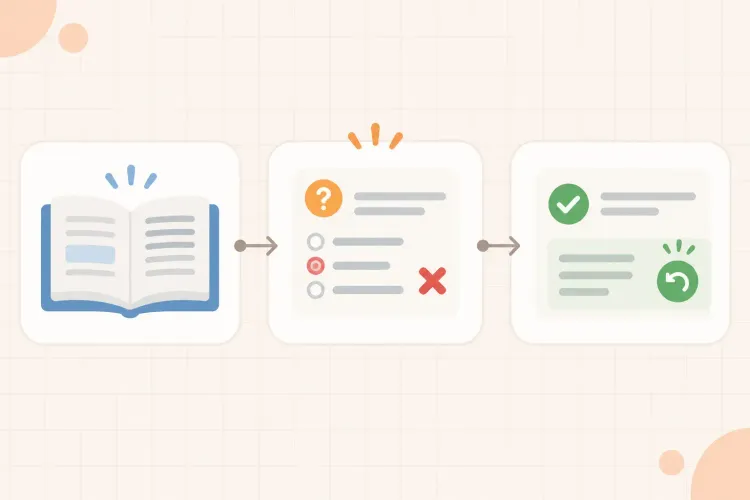


Many practice questions look useful because they mention the right topic. But a question can be on the syllabus and still produce weak practice if the answer is vague, the wording gives away the point, or the question tests recognition instead of understanding.
A good practice question gives you a specific job to perform, an answer you can check, and a reason to use the knowledge again. It should make a gap visible, not merely confirm that the page looks familiar.
What makes a good practice question?
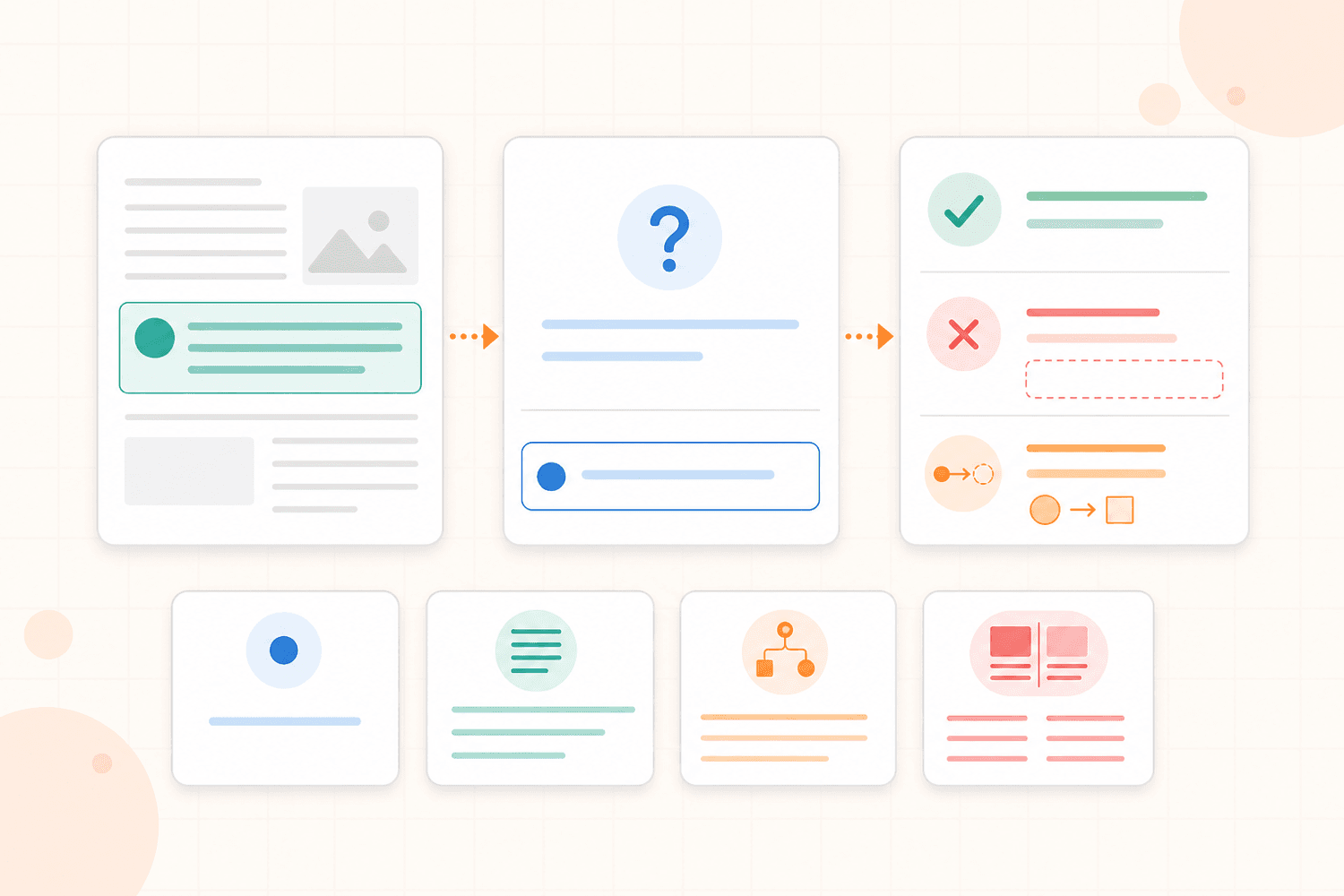
The best practice questions usually have five qualities:
- A clear target. The question tests a defined fact, relationship, procedure, decision, or explanation.
- A specific task. It tells you whether to define, explain, compare, calculate, predict, or apply.
- A checkable answer. You can compare the response with a source, worked solution, marking guidance, or a model answer.
- Enough difficulty to reveal a gap. You cannot answer by copying a sentence or recognizing the wording immediately.
- A useful next step. Your result tells you what to review, practise, or try under a changed condition.
If a question misses one of these qualities, it may still be a useful conversation starter. It is less useful as a study tool because the result gives you little information about what you actually know.
A quick test is to finish this sentence before using the question: “A correct answer must include…” If the ending is hard to complete, the prompt probably needs a clearer target, condition, or answer standard.
Start with the learning task
Do not begin by turning every sentence in your notes into a question. Begin with what the course asks you to do. A definition-heavy unit needs some recall questions, but a problem-solving or essay exam needs questions that make you use relationships, evidence, and conditions.
| Learning task | Question prompt | What a useful answer should show |
|---|---|---|
| Recall a fact | What is the function of the mitochondrion? | The correct fact, stated precisely |
| Explain a relationship | Why does oxygen matter at the end of the electron transport chain? | A connected cause-and-effect sequence |
| Apply a rule | Which method would you use here, and why? | The method plus the clue that supports it |
| Compare ideas | How does natural selection differ from genetic drift? | A meaningful difference and its consequence |
| Predict a change | What would happen if this condition were removed? | A reasoned prediction based on the mechanism |
| Evaluate evidence | Which result best supports the claim, and what is its limitation? | A judgment supported by specific evidence |
The prompt should match the kind of answer you will need in class or on the exam. A student preparing for an essay should not rely only on “What is X?” questions, just as a student preparing for a calculation should not spend all their practice defining formulas.
Give each question one job
Questions become difficult to answer when they ask for too much at once. “Explain the whole chapter and discuss all its implications” is not a demanding question. It is an undefined assignment.
Keep the main task narrow enough that you can tell what went wrong. You can connect several questions later, but each question should have a dominant job:
- Define: What does this term mean in this unit?
- Explain: Why does this process happen, and what links the steps?
- Compare: What is the most important difference between these two ideas?
- Apply: Which concept or method fits this new situation?
- Predict: What changes when one condition is altered?
- Diagnose: What mistake would produce this result?
One job does not mean one-word answers. An application question may require a paragraph or a full calculation. It means the question has a clear purpose, so you can judge whether the response met it.
Make the wording specific
Vague wording creates vague revision. Questions such as “What does this chapter cover?” or “Explain chapter four” are hard to mark because there is no clear boundary around a good answer.
Add the detail that makes the answer checkable:
- name the process, example, or comparison
- specify the condition that changes
- state the number of steps, reasons, or pieces of evidence when that matters
- identify the audience or answer format if the assessment requires it
- remove clues that give away the answer before you think
“What are the three stages of cellular respiration, and where does each occur?” gives you a clearer task than “Explain cellular respiration.” “Which stage is most affected when oxygen is unavailable, and why?” goes further by asking you to connect a condition to a mechanism.
Specificity also protects you from making cards or questions that are too broad to review. If the answer would fill a whole page, split the prompt into smaller questions and add one synthesis question afterward.
Build difficulty with conditions and transfer
A question can be precise without being easy. Add difficulty by changing the situation, not by making the wording confusing.
Useful ways to do this include:
- remove a condition and predict the consequence
- change the numbers while keeping the method the same
- provide a new example that has the same underlying structure
- ask which piece of evidence would change your conclusion
- present two similar concepts and ask what distinguishes them
- include a plausible error and ask how you would diagnose it
For example, instead of asking “What is the formula for standard deviation?”, ask “Which spread measure would help compare these two data sets, and what would a larger value tell you?” The second question still depends on foundational knowledge, but it also asks you to choose and interpret.
Difficulty should come from the thinking task. It should not come from hidden assumptions, trick wording, or an answer key that accepts several unrelated responses. The University of Waterloo’s guidance on effective study questions makes the same practical point: questions become more useful when they move beyond simple recall and require you to put the answer in your own words.
Write the answer key before trusting the question
Every practice question needs a checking standard. Before you add a question to your set, write a short answer key or outline. This exposes problems that are easy to miss when you write only the prompt:
- the question has more than one defensible answer
- the expected answer is much broader than the wording suggests
- an important condition is missing
- the answer depends on a definition your source never established
- the question is testing a detail that will not matter for the assessment
For a calculation, include the setup and the reason for each major step, not only the final number. For an explanation, list the essential links in the chain. For an evaluation, state what evidence would support the judgment and what limitation should be acknowledged.
When you answer later, do not ask only whether your response resembles the model. Ask whether it contains the required idea, uses the condition correctly, and reaches the right conclusion for the right reason.
Weak question versus useful question
Suppose your notes say: “Osmosis is the movement of water across a selectively permeable membrane from a region of higher water potential to lower water potential.”
| Weak prompt | Why it is limited | More useful prompt |
|---|---|---|
| What is osmosis? | It may produce a memorized definition without showing whether you can use it. | A cell is placed in a solution with lower water potential. Which direction will water move, and why? |
| Explain the cell membrane. | The scope is too large to check consistently. | Which membrane property allows osmosis to occur, and what would change if the membrane were not selectively permeable? |
| Define water potential. | Useful for initial learning, but not enough on its own. | Two solutions have different water potentials. Predict the movement of water and explain what happens as equilibrium approaches. |
The improved prompts still allow a short answer, but they require a decision or prediction. That gives you more information than repeating the definition and creates a natural opportunity to check whether the mechanism is understood.
Use a mix of question types
A practice set should not contain twenty versions of the same prompt. Vary the task while keeping the set tied to the material and assessment:
- start with a few recall questions for essential terms and steps
- add explanation questions for relationships and mechanisms
- include application or prediction questions for transfer
- use comparison questions for concepts that are easy to confuse
- finish with one synthesis question that links the main ideas
The mix should reflect the exam rather than follow a fixed recipe. A vocabulary test may need more precise recall. A biology, economics, or history exam may need more explanation and application. A mathematics set may use “choose,” “solve,” and “justify” more often than “define.”
This is also why answering questions yourself matters. Carnegie Mellon’s explanation of retrieval practice helps clarify the principle: the question should make you retrieve or use knowledge, not merely recognize it while rereading.
Generate questions with AI, then edit them
AI can help you turn a lecture, PDF, or set of notes into a first batch of practice questions. It should not decide that the questions are accurate, well scoped, or appropriate for your assessment without checking.
Give the tool a bounded source and a clear request:
Example request: Create eight practice questions from these lecture notes. Include two recall questions, three explanation questions, two application questions with changed conditions, and one comparison question. Give a concise answer key and identify the section of the notes supporting each answer. Do not add facts that are not in the source.
Then audit each result:
- Is the answer supported by the source?
- Does the prompt ask for one clear task?
- Is the answer specific enough to check?
- Does it match the course or exam format?
- Would a changed example expose whether the idea transfers?
For a lecture video, first turn the lecture into notes and practice material, then edit the questions against the transcript, slides, and timestamps. For a long PDF, work from the important sections rather than asking for a quiz about every page. In both cases, the source gives the questions their boundaries and the answer key something reliable to check.
The goal is not to generate the largest question bank. It is to create a small set whose answers reveal what you can recall, explain, and apply.
How to tell if a practice question is good
Before studying from a question, check:
- Target: What exact knowledge or skill is this testing?
- Task: What must the learner do with it: recall, explain, compare, apply, predict, or diagnose?
- Scope: Is the question small enough to answer without guessing what it means?
- Difficulty: Does it require thinking, without relying on trick wording?
- Evidence: Can the answer be verified against a reliable source or clear standard?
- Transfer: Could the learner answer a changed version, not only this exact wording?
- Next action: Will a wrong or incomplete answer identify the next thing to practise?
A good practice question does more than fill a quiz. It creates a useful test of your understanding. Write prompts that ask for a specific action, check the answer against the source, and vary the condition when you need to test transfer. The quality of the question determines how much useful information your practice gives you.