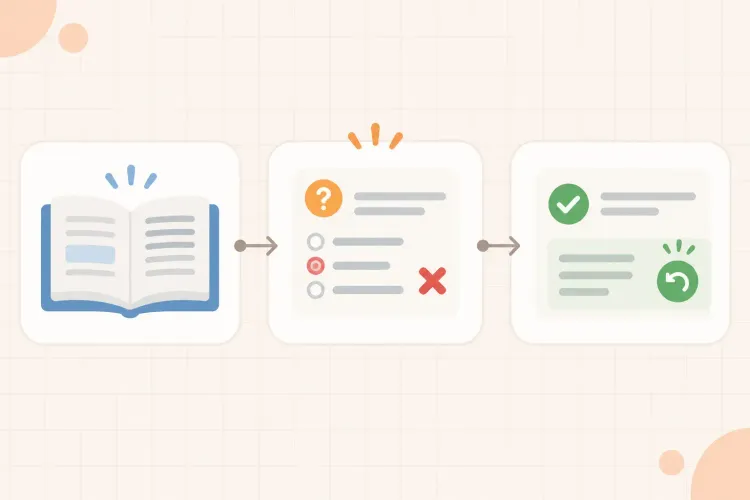

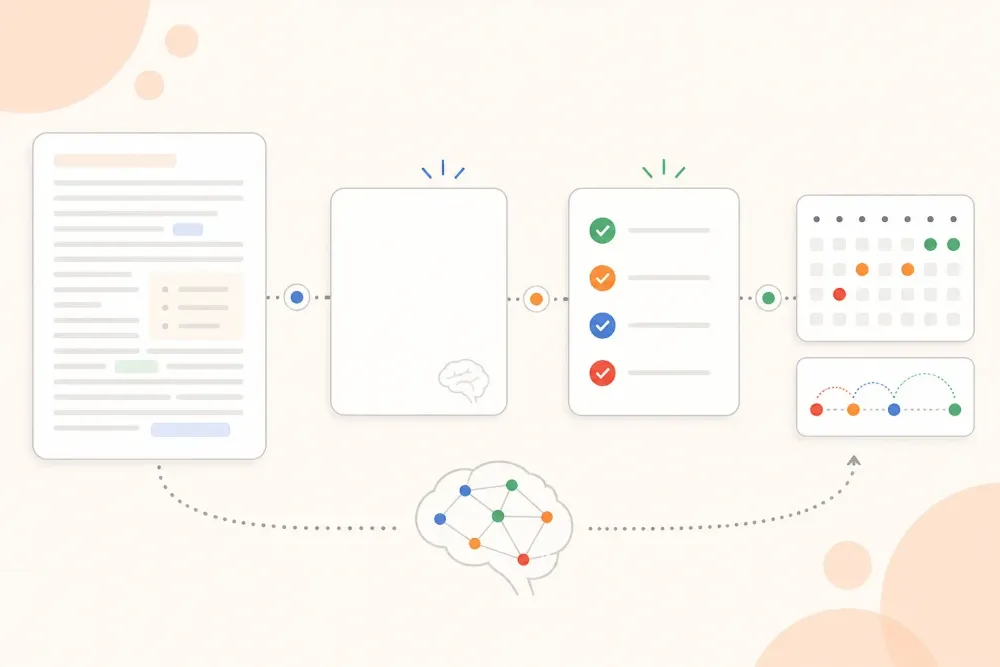
Reading a page can feel productive while leaving very little that you can explain later. You recognize the words, remember where an idea appeared, and still cannot reconstruct the answer when the book is closed. That does not mean you are incapable of learning. It usually means the study session created familiarity but gave you too few chances to retrieve, connect, and use the idea.
If you keep forgetting what you read, start by checking more than whether the page looks familiar. Read a manageable section with a question in mind, close the source, explain the answer without its wording in front of you, and return only to the missing part. Then try again after a delay. This changes reading from an activity you complete into information you can actually produce.
Why do I forget what I read seconds later?
Forgetting usually comes from several problems working together: attention was incomplete, the material was not connected to what you already know, the session relied on recognition rather than recall, or you did not revisit the idea after the first exposure. The fix depends on which part failed.
If the idea disappears as soon as you move to the next paragraph, first check whether you actually processed it. You may have been reading on autopilot, holding too many new terms at once, or moving on before forming a clear meaning. Pause at the end of a short section and state the point in your own words. If you cannot, return to that section and make one question more specific.
Forgetting later is different. Some loss over hours or days is normal, especially when the material is new, but a single reread does not give you much evidence that it will last. A delayed question, a changed example, and a targeted correction show whether the knowledge is becoming available without the page in front of you.
Familiarity is not the same as recall
When you reread a paragraph, the wording becomes easier to recognize. That ease can feel like learning. But an exam, conversation, or assignment rarely shows you the same paragraph with the important sentence highlighted. You have to generate the explanation from a question, a problem, a diagram, or a changed example.
Test the difference by closing the source and asking, “What is the main claim, and why is it true?” If you can recognize the answer but cannot produce it, the idea is familiar but not yet reliably retrievable.
Reading is often too passive
Reading is necessary when a topic is new, but it does not show whether you can use what you just read. Highlighting, copying, and rereading can leave the material looking organized while the difficult work of reconstruction has not happened.
Give each section a job. Read to answer one question, follow one mechanism, interpret one diagram, or understand one worked example. Then pause before the next section and make the explanation visible without looking.
The material has no retrieval cue
“Study this chapter” is too broad to guide memory. A narrower question gives your mind a path back into the material: “Why does oxygen matter at the end of the electron transport chain?” or “When would this statistical test be inappropriate?”
Good prompts also make the answer checkable. If your question could be answered with an entire chapter, it is not yet a useful retrieval cue. Split it into the definition, relationship, process, condition, or example you need to reconstruct.
You are trying to hold too much at once
Long chapters and dense lecture notes overload working memory. If you move through several pages before stopping, earlier details may blur together before you have connected them. This is not solved by forcing yourself to reread the same block immediately.
Use answer-sized sections. A section can end at a clear heading, a diagram, a worked example, or a change in subtopic. Make one short reconstruction, repair the gap, and then continue.
Attention was divided during encoding
If you were switching tabs, checking notifications, or reading while exhausted, parts of the material may never have been processed deeply enough to retrieve. You cannot recall information that you barely noticed.
Before reading, remove one major interruption and decide what you are looking for. If the problem is fatigue rather than distraction, shorten the section and choose a later point for the harder material. A smaller attentive pass is more useful than a long session that produces no clear explanation.
You did not use the idea after reading it
Memory becomes more durable when you have to reconstruct information, explain a relationship, or apply a principle. A single exposure leaves the idea dependent on the page layout and wording.
After reading, change the task. Explain the process from a blank page, answer a question, solve a new version of the example, or predict what would change if one condition were different. The goal is not to make every reading session difficult. It is to find out whether the understanding survives when the source stops helping.
You reviewed too soon and only once
Immediate rereading can make an answer feel available because the source is still active in your mind. That is useful for correcting an error, but it is weak evidence that the idea will remain tomorrow.
Return after a delay and try the question before reopening the page. If the answer is incomplete, repair the smallest missing part and schedule another attempt. Spacing is not a separate trick added after studying. It is how you find out whether the knowledge is becoming stable.
This is why a broad review of learning techniques rates practice testing and distributed practice more highly than rereading alone. For a concise overview of that evidence, read the Dunlosky et al. review of effective learning techniques, which also explains why no single method fits every subject or learner.
Why reading feels productive when recall is weak
Reading has visible signs of progress. Pages move, highlights accumulate, and difficult sentences become more familiar. Recall is less comfortable because it may produce a blank, a partial answer, or a mistake.
That discomfort is useful information. A failed attempt tells you what the page did not make usable. The important distinction is not between easy and hard study. It is between activity that leaves a trace of completion and activity that gives you evidence about what you can do.
Use this quick diagnosis:
| What you notice | Likely problem | Better next step |
|---|---|---|
| The paragraph looks familiar but you cannot explain it | Recognition without recall | Close the source and answer one narrow question |
| You remember terms but not how they connect | Missing relationships | Draw or describe the cause-and-effect chain |
| You can repeat the example but not solve a new one | Imitation without application | Change one condition and solve again |
| You forget everything after several pages | Study unit is too large | Stop at a heading, diagram, or example and reconstruct |
| You make confident mistakes | Weak checking or misleading familiarity | Record confidence, then compare your answer with the source |
| You remember today and lose it tomorrow | Too little spacing | Retry the question later before rereading |
How to remember what you read
Use a short loop after each meaningful section:
- Set the question. Write what you want the section to help you explain.
- Read for the answer. Follow the reasoning, conditions, examples, and relationships rather than collecting sentences.
- Close the source. Put away the page, tab, or notes.
- Produce an answer. Explain the idea aloud, write a few lines, draw the process, or solve a related problem.
- Check the gap. Compare your attempt with the source and mark what was missing, unclear, or wrong.
- Retry later. Answer the same question after a delay, then use a changed example to test transfer.
The first attempt should be brief but genuine. Looking at the heading and mentally agreeing with the explanation is not the same as reconstructing it. Your answer can be rough. It needs to show what remained available without the source.
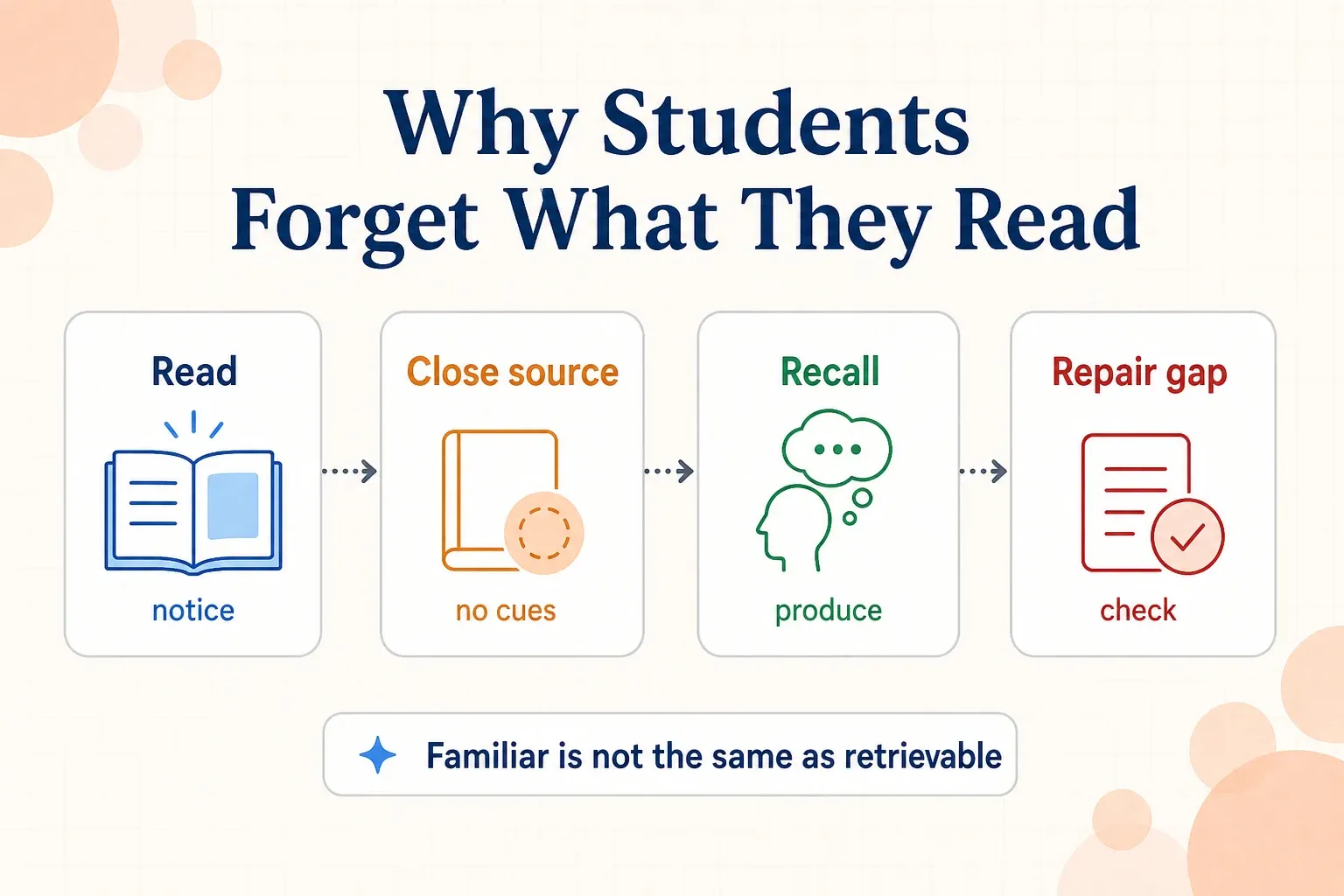
The point of the loop is not to interrupt every sentence. Use it at natural boundaries and make the retrieval task match what you need to do later. If the assessment requires an explanation, write an explanation. If it requires calculations, set up a problem. If it requires interpreting a diagram, rebuild the relationships rather than memorizing the image's position on the page.
A concrete example: from familiar biology to usable understanding
Imagine reading about cellular respiration. After two pages, you can recognize “electron transport chain,” “proton gradient,” and “ATP synthase,” but you cannot answer what happens when oxygen is unavailable.
The problem is not simply that you need to reread the pages. Your first retrieval question could be:
Why does the loss of oxygen affect both the electron transport chain and ATP production?
With the source closed, write the chain you can remember. You might recall that oxygen is involved at the end, but omit why electrons accumulate and why the proton gradient stops being maintained. Reopen the relevant paragraph, add those missing links, and close the source again.
Now change the question: “If oxygen becomes available again, what should happen to the electron carriers, the proton gradient, and oxidative phosphorylation?” If you can follow the consequences without copying the original paragraph, you have moved beyond recognizing vocabulary.
This kind of example is more useful than measuring progress by pages read. It shows exactly where memory failed and turns that failure into a smaller question you can retry.
Fix the problem according to the source
Different sources create different failure points. Keep the same read, close, produce, check, retry logic, but change the task to fit the material.
Textbook chapters
Turn headings into questions before reading. Use worked examples as problems to attempt, not solutions to copy. For diagrams, explain the relationships and labels from a blank page. If a chapter is dense, split it at its natural explanations and keep a short list of unresolved questions.
Lecture slides and notes
Slides often provide structure but not the full explanation. Use the lecturer’s emphasis, examples, and transitions to identify what the slide alone does not show. After class, write what each major slide was trying to establish, then mark the missing connection rather than rewriting every line.
PDFs and long digital documents
Search can help you locate a definition or section, but finding a phrase is not the same as learning it. Use the document to answer a narrow question, record the page or section that supports the answer, and then close it. For a longer file, you can study a PDF without rereading every page by sorting sections into questions, evidence, and gaps.
Notes you already made
Do not assume complete notes are complete understanding. Cover the answer and use the note as a prompt. If you cannot explain a bullet without following its wording, rewrite it as a question or add the relationship that makes it meaningful.
What to do when you forget immediately
Forgetting right after reading does not mean the session failed. It tells you that the material needs a stronger cue, a smaller unit, a clearer explanation, or another attempt.
Use this repair sequence:
- Name the exact question you could not answer.
- Try once more without looking, even if the first attempt was incomplete.
- Reopen only the paragraph, diagram, example, or definition that resolves the gap.
- Explain the repaired point in different words.
- Add one nearby question that tests the relationship or condition.
- Return later and answer both questions before checking.
Avoid immediately reading the entire section again. A broad reread can make the page feel clear without showing whether the specific gap changed. If you need a fuller answer-first method, use active recall to test what you can produce before you return to the source.
How to know whether you actually remember it
Use more than one signal. A reliable answer should survive a small change in the task and a gap in time.
Ask yourself:
- Can I explain the idea without repeating the source’s sentence?
- Can I state the condition, cause, or limitation that matters?
- Can I answer a question that starts from a different angle?
- Can I use the idea in a new example or problem?
- Can I do this tomorrow without rereading first?
You do not need perfect wording. You need accurate meaning and enough structure to use the idea. If you can define a term but cannot distinguish it from a similar term, the next task is comparison. If you know a process’s stages but cannot explain the transitions, the next task is causal reasoning. If you can solve one copied example but not a changed one, the next task is application.
For a more deliberate check, turn reading into a short practice test and use the misses to choose what to repair. Testing is not only for exam week. It is a way to replace the vague feeling of understanding with evidence.
Common mistakes that keep reading from sticking
Avoid these patterns:
- reading a full chapter before asking what you can recall
- highlighting a sentence instead of explaining its role
- copying notes while the source is open and never testing them later
- using questions so broad that their answers become another chapter
- rereading immediately whenever you feel uncertain
- practicing only the examples whose method you have already seen
- reviewing the same topic once and assuming it is stable
- judging the session by minutes or pages instead of usable answers
These habits are understandable because they feel orderly. The correction is not to make every session complicated. Add one production step at the right boundary, then let the result decide whether you need explanation, repair, application, or later review.
A simple checklist for your next reading session
Before you begin, choose one section and write one question. During reading, look for the answer, its reason, and any condition that changes it. At the boundary, close the source and make the answer visible. Check the attempt, repair one gap, and keep the question for a later retry.
If the answer is incomplete, that is not a reason to start the entire chapter again. It is a signal about the next useful action. Narrow the question, reconnect the missing relationship, and try again after a delay.
The goal is not to remember every sentence you read. It is to make the important ideas available when the page is gone. Read for a purpose, close the source, reconstruct the meaning, repair the gap, and return later. Familiarity can begin the process, but retrieval is what shows whether the learning stayed with you.