
Biology exams are difficult to prepare for when every chapter looks like a long list of terms. The solution is not to memorize more isolated facts. It is to connect each term to a structure, process, condition, or consequence, then practice retrieving and applying those connections.
Start by setting the exam boundary. Then use a six-step biology study system: map the process, connect structure to function, rebuild diagrams from memory, explain cause and effect, apply the idea to an unfamiliar situation, and repair the exact gap you miss. Vocabulary still matters, but it becomes easier to remember when it has a role within the process or system.
Set the exam boundary before you revise
Start with the specification, syllabus, or course checklist for your exam rather than the first chapter in your textbook. Mark the processes, structures, required practicals, and command words you are expected to know. This gives your revision a boundary and helps you notice when a detailed textbook explanation goes beyond what your paper can assess.
Then use one recent paper to see how that knowledge is tested. You do not need to complete the whole paper at this stage. Scan for recurring question types, diagrams, data tasks, and longer explanations, and add those tasks to your practice list. After you answer questions, a mark scheme can help you turn lost marks into specific repairs rather than another round of general rereading.
How to study for a biology exam
Use this sequence for each major topic:
- Map the purpose and process. What does the system do, and what are its main stages?
- Connect structure to function. What does each part look like, and why does that shape or location matter?
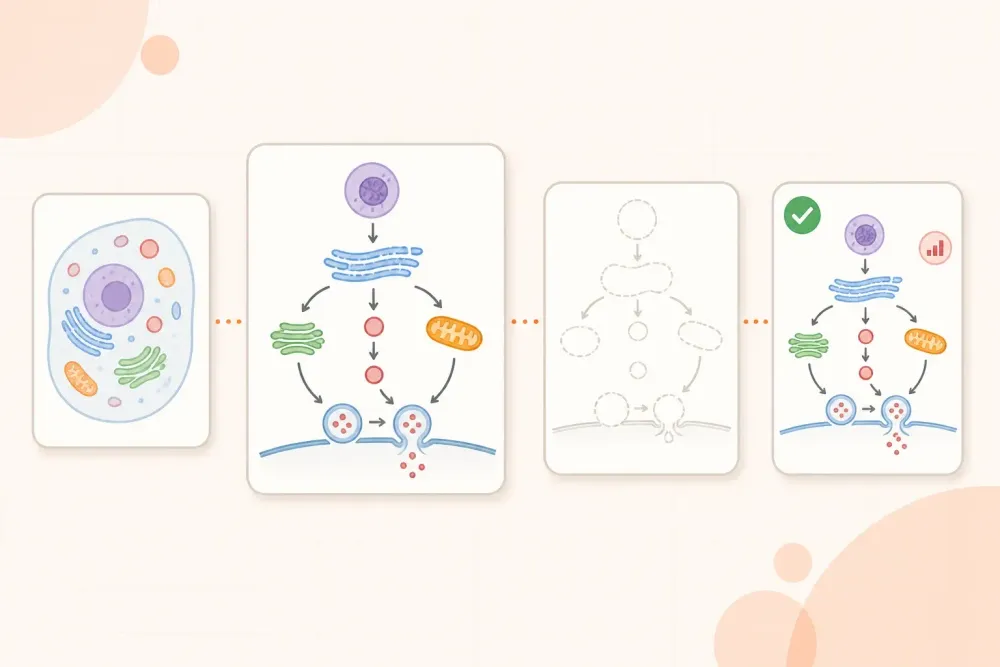
- Rebuild a diagram. Draw or label it with the source closed, then check the sequence and relationships.
- Explain the mechanism. Say what changes, why it changes, and what happens next.
- Change the condition. Practice a question about an unfamiliar organism, environment, mutation, treatment, or data set.
- Repair the gap. Record whether the problem was vocabulary, sequence, mechanism, diagram, data interpretation, or question wording.
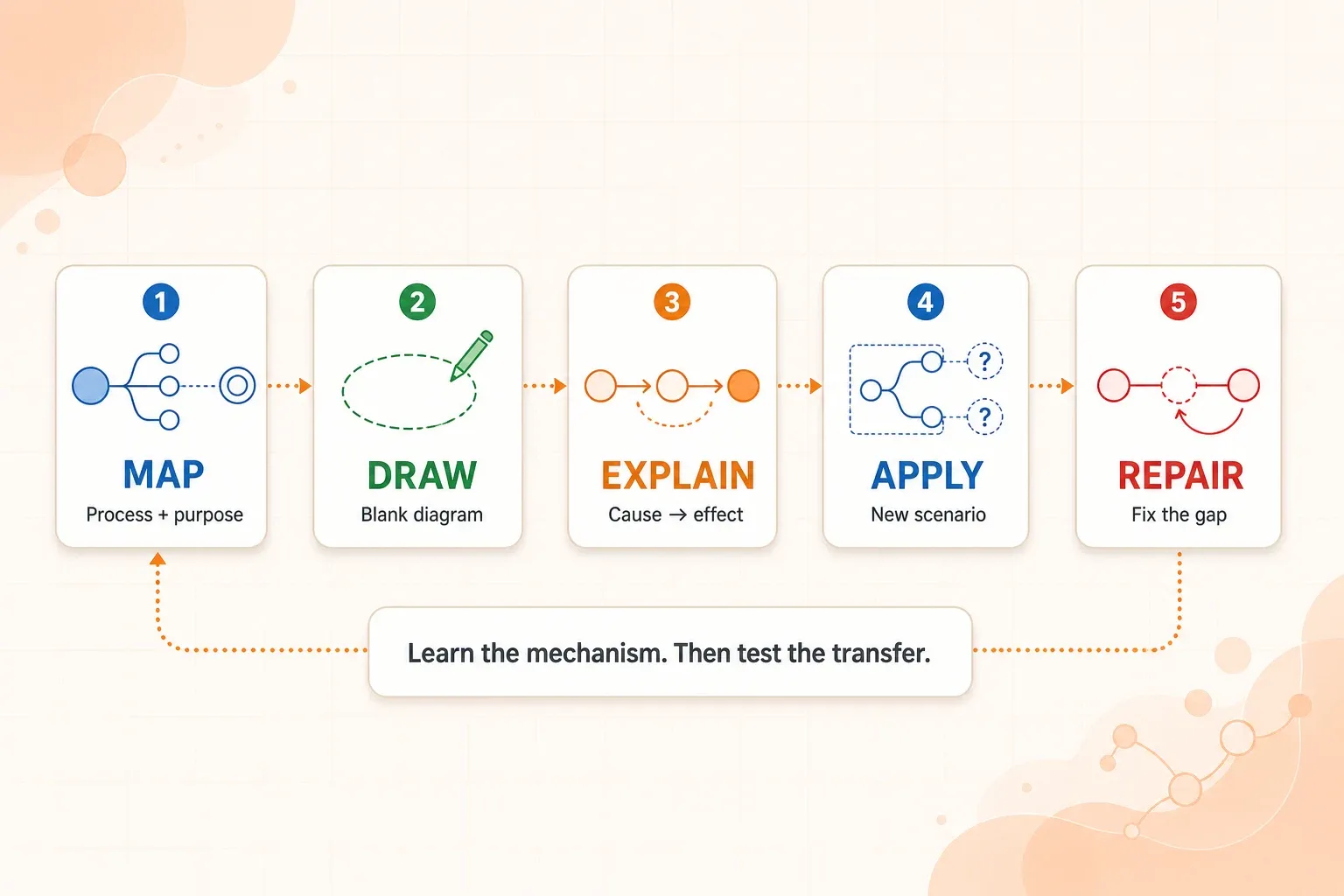
This keeps your study practice close to the work biology exams actually require. You are not only trying to recognize a term or redraw a familiar page. You are practicing how to use a biological model when the question changes the context.
Start with the process, not the vocabulary list
Before making flashcards or rereading a chapter, choose one process and write its purpose in plain language. For example:
- Cellular respiration: transfers energy from fuel molecules into ATP through linked stages.
- The immune response: detects a threat, coordinates a response, and produces defenses that help remove it.
- Osmosis: moves water across a selectively permeable membrane because of a difference in water potential or solute concentration.
The first sentence does not need every detail. It gives the topic a direction. Once you know what the process is trying to accomplish, attach the stages, structures, and vocabulary to that purpose.
Then turn the process into a chain:
starting condition -> structure or event -> immediate change -> next step -> outcome
For each arrow, ask what causes the transition. If a chain jumps from one term to another without a reason, that jump is a study gap. Biology questions often test the missing link rather than the labels at either end.
Build a biology process map
A process map should show relationships, not just collect keywords. Use a small number of nodes and label the arrows with verbs such as moves, binds, breaks down, activates, inhibits, diffuses, or triggers.
For each process, include:
| Add this | Question it answers |
|---|---|
| Purpose | What problem does the process solve? |
| Inputs | What materials, signals, or conditions does it need? |
| Stages | What happens first, next, and last? |
| Structures | Where does each stage happen, and which parts are involved? |
| Control points | What speeds, slows, starts, or stops the process? |
| Outcome | What is produced, changed, or removed? |
| Changed condition | What happens if one input or step is altered? |
Do not try to fit an entire unit onto one map. A map for protein synthesis can focus on the information flow from DNA to RNA to protein. A separate map can show how a mutation changes the sequence and potentially changes the protein. Smaller maps are easier to retrieve and combine later.
Learn diagrams by drawing them from memory
Looking at a labeled diagram can create a sense of familiarity without proving that you can reproduce it. Close the source and draw the structure or process from a blank page. Then compare your version with the original.
Use three passes:
- Shape pass: draw the main outline, compartments, branches, or direction of flow.
- Label pass: add the structures and locations that matter for the question.
- Function pass: write what each important part does and how it connects to the next stage.
For a complex diagram, learn the parts in groups before rebuilding the whole. A nephron, for example, can be divided into filtration, selective reabsorption, and water regulation. An organelle diagram can be divided into boundary, internal structures, and the functions attached to each structure.
The goal is not artistic accuracy. The goal is to place the important structures correctly and explain why they belong there. If the exam asks you to label, annotate, or draw a process, this is much closer to the task than rereading the finished diagram.
Explain mechanisms with cause and effect
Biology answers become clearer when each sentence makes the next sentence possible. Use a cause-and-effect frame:
When [condition] changes, [structure or process] changes because [mechanism], which leads to [consequence].
For example, if oxygen becomes unavailable during aerobic respiration, the electron transport chain cannot pass electrons to the final acceptor. The proton gradient is no longer maintained, oxidative phosphorylation stops, and the cell must rely on pathways that regenerate the oxidized carriers needed for glycolysis.
The important part is not memorizing that paragraph word for word. It is understanding the dependency chain. If a question changes the condition, you can follow the effects instead of searching for a sentence that looks familiar.
When explaining a mechanism, check that you have included:
- the starting condition
- the structure, molecule, or population involved
- the action or change
- the reason the change occurs
- the immediate and later consequence.
If an answer names the structure but does not explain what it does, it is descriptive rather than mechanistic. Add the missing action and causal link.
Learn vocabulary inside a useful sentence
Terms are easier to retrieve when they are attached to a distinction or action. Instead of learning only “competitive inhibitor,” write a prompt such as:
What changes when a competitive inhibitor occupies an enzyme's active site, and how could increasing substrate concentration affect the competition?
This prompt connects the term to location, mechanism, and a changed condition. You can still create a short definition card for the exact meaning, but do not let vocabulary cards become the whole biology workflow.
Group terms that are easy to confuse and compare them on one clear basis:
- structure versus function
- cause versus consequence
- innate versus adaptive response
- active versus passive transport
- transcription versus translation.
For each pair, write one similarity, one difference, and one clue that tells you which term fits the question. This gives the vocabulary a retrieval path when the wording is unfamiliar.
Practice application questions, not only recall questions
After learning a process, change one part of the situation. Ask what would happen if:
- a structure were damaged
- a key molecule were absent or overproduced
- temperature, pH, light, water availability, or oxygen changed
- a mutation altered a sequence
- a population faced a different selection pressure
- an experiment produced an unexpected result.
Answer in a chain rather than jumping straight to the final outcome. State the changed condition, identify the first affected step, and follow the consequences. This is the difference between remembering a process and being able to transfer it.
For example, if a mutation changes a protein's active site, do not stop at “the enzyme will not work.” Explain how the altered shape affects binding, how that changes the reaction rate, and what downstream material or pathway is affected. The level of detail should match the question and the mark allocation.
Use data and practical questions as biology practice
Many biology exams ask you to interpret an experiment, graph, table, or unfamiliar result. Content knowledge helps, but it is not enough. Practice the decision sequence:
- Identify the variables. What was changed, measured, and controlled?
- Describe the pattern. What increases, decreases, stays stable, or differs between groups?
- Use evidence. Quote a comparison or trend from the data rather than making a general claim.
- Explain the biology. Connect the pattern to a process or mechanism.
- Check the limits. Avoid claiming more than the sample, range, or method supports.
When you review a practical question, separate a content error from a method error. You may understand osmosis but lose marks by confusing the independent and dependent variables. You may recognize the trend but fail to cite data. Each mistake needs a different repair.
The University of Queensland also recommends using past papers and interpreting data when preparing for biology exams. Its biology study guidance on past papers and data interpretation is a useful reference for building practice beyond vocabulary recall.
Build a biology error log
After each question set, keep a short record of what went wrong. Use a category that tells you what to do next:
| Error type | What it looks like | Repair |
|---|---|---|
| Vocabulary | A term is missing or used for the wrong structure | Define it in contrast with the confusing term |
| Sequence | The stages are in the wrong order | Rebuild the process as a flow map |
| Mechanism | The answer names a change but not why it occurs | Add the cause-and-effect link |
| Diagram | A label, direction, or structure is misplaced | Redraw the relevant part from memory |
| Application | The familiar process does not transfer to the new case | Practice another changed-condition question |
| Data | The trend, variable, or evidence is misread | Annotate the graph and write one evidence sentence |
| Command word | The answer describes when it needed to explain or evaluate | Rewrite the answer to match the instruction |
An error log is not a second set of notes. It is a list of decisions for the next practice session. Keep the repair small enough to attempt again.
Use active recall without reducing biology to trivia
Active recall is useful for biology, but the prompt must match the knowledge you need to use. Mix several prompt types:
- Term: What does this structure or process mean in this course?
- Mechanism: Why does this change produce that result?
- Diagram: Draw or label the structure with the source closed.
- Sequence: What happens first, next, and last?
- Application: What changes if this condition is altered?
- Evidence: What does this graph or table show, and what does it not show?
You can use active recall to retain biology content, but do not stop at short definition cards. Add process, diagram, and application prompts so the practice reflects the exam.
If your material is spread across lecture notes, slides, or a PDF, you can also turn selected lecture notes into quiz questions. Review the generated questions against the source and rewrite broad prompts into specific biology tasks.
A worked example: study a process instead of a list
Imagine that the topic is gas exchange in the lungs. A list-based approach might memorize “alveoli, diffusion, thin walls, large surface area, ventilation, blood supply.” A process-first approach connects them:
- Ventilation maintains a concentration gradient between the alveolar air and the blood.
- The alveoli provide a large surface area and a short diffusion distance.
- Oxygen diffuses into the blood while carbon dioxide diffuses in the opposite direction.
- Blood flow carries oxygen away and brings carbon dioxide toward the exchange surface.
- If ventilation or blood flow changes, the gradient and rate of gas exchange change.
Now test the model. What happens if the alveolar wall becomes thicker? Which part of the chain changes first, and what evidence would show the effect? That question makes the vocabulary useful because each term has a role in the explanation.
Space your biology review across several sessions
Biology topics benefit from returning to the same process in different forms. A practical sequence is:
- First session: map the process and resolve the main definitions.
- Next session: draw a diagram or flow sequence from memory.
- Later in the week: answer changed-condition and mechanism questions.
- After another gap: mix the topic with related processes and interpret one data set.
- Before the exam: use the error log to select the diagrams, processes, and question types where you still lose marks.
Do not repeat the exact same prompt every time. A process you can define may still be difficult to draw, explain, or transfer to data. Change the retrieval task while keeping the biological relationship constant.
Common mistakes when studying biology
Memorizing every term before understanding the topic
This creates a large vocabulary list with no structure. Start with the purpose and process, then attach terms to the parts they name.
Copying labeled diagrams
Copying can make a diagram look familiar. It does not prove that you can reproduce the important structures or explain their functions. Draw from memory and check afterward.
Rewriting the textbook instead of studying
Long summaries can preserve information while avoiding retrieval. Keep the explanation short, then ask a question that makes you produce the process, diagram, or mechanism.
Practicing only multiple-choice questions
Multiple-choice questions can reveal recognition and discrimination errors, but they may not train full explanations or data interpretation. Mix formats.
Ignoring the practical and data side of biology
Knowing the content does not automatically teach you how to identify variables, describe a trend, or support a conclusion with evidence. Practice those skills directly.
Reviewing every topic equally
An error log lets you spend more time on the process, diagram, or question type that still causes errors. Do not restart the entire unit after every mistake.
Final biology exam checklist
Before the exam, check that you can:
- explain the purpose and stages of each major process
- connect important structures to their functions
- draw or label the key diagrams with the source closed
- explain cause and effect when a condition changes
- use vocabulary inside a precise answer
- interpret a graph, table, or practical scenario
- identify the command word and answer the task it sets
- name your recent errors and complete the right repair
- retrieve the material after a gap rather than only immediately after studying it.
Biology becomes more manageable when facts stop sitting alone. Map the process, draw it from memory, explain the mechanism, change the condition, and use each mistake to choose the next practice task.