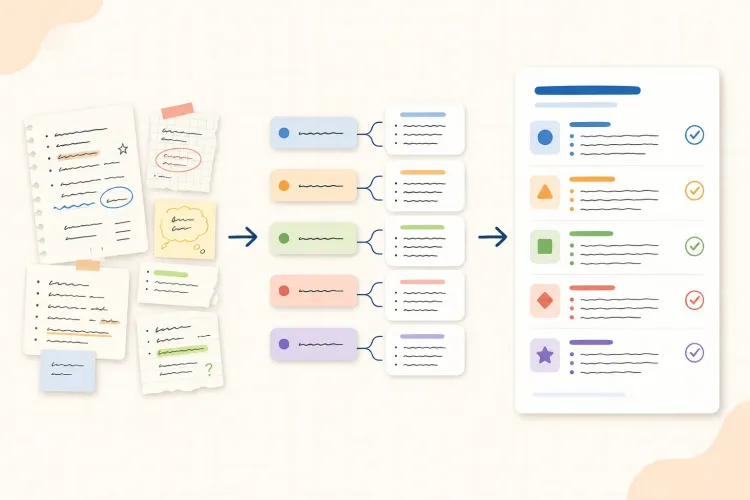

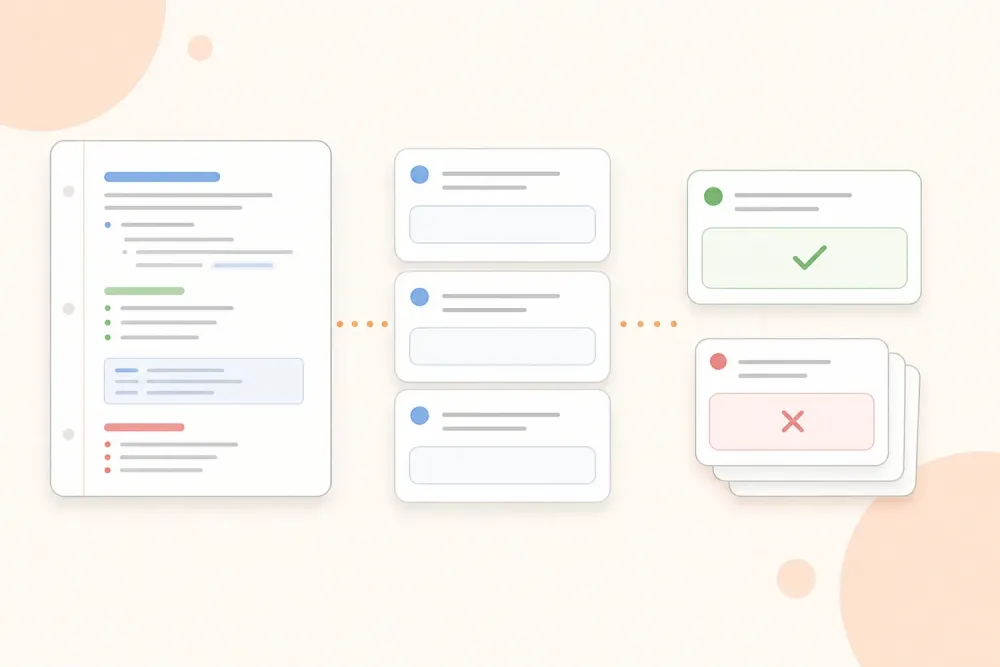
Lecture notes are useful for recording information, but they are not automatically useful for testing yourself. To turn notes into quiz questions, you need to change each important idea into a task: define it, explain it, compare it, use it, or predict what happens next.
The goal is not to turn every sentence into a question. It is to build a small set of prompts that reveals what you can produce without looking back. That is what turns the notes into practice testing rather than another way to reread them. Research on test-enhanced learning supports this distinction: testing can strengthen later retention more than additional studying.
How to turn lecture notes into quiz questions
Use this sequence for lecture notes, whether they are handwritten, typed, or cleaned up from a transcript:
- Mark the important ideas. Look for learning objectives, repeated concepts, diagrams, examples, and points your instructor emphasizes.
- Name the job of each idea. Decide whether the idea calls for a definition, explanation, comparison, application, sequence, or evaluation.
- Write a question with a clear boundary. The prompt should point to one main task, not an entire chapter.
- Check the source for the essential answer. Keep enough detail to judge the response, but do not copy the whole note.
- Try the question with the notes closed. If the answer is vague, change the question or repair the underlying note.
This order matters. If you write questions before deciding what the note is doing, you tend to produce shallow prompts such as “What is this?” or questions that simply repeat the wording of the slide.
Start by marking the job of each note
Most useful lecture notes contain more than facts. A single page may include a definition, a cause-and-effect explanation, a comparison, a diagram, and an example. Each kind of note needs a different question shape.
- Term or definition: Ask what the idea means in the context of the course.
- Mechanism or cause: Ask why something happens or how one step leads to another.
- Comparison: Ask what changes between two ideas and why the difference matters.
- Example: Ask which principle the example demonstrates or how that principle applies to a new example.
- Process: Ask what happens first, next, and last, or what would break if one step changed.
- Rule or formula: Ask when to use it, what each part means, or how the result changes when an input changes.
The note tells you the content. The job tells you what kind of thinking the question should require.
Use the right question type
A useful question should match the way the idea will be used. These examples use the same lecture topic but ask for different kinds of understanding:
| Note contains | Question to write | What it tests |
|---|---|---|
| A key term | What does competitive inhibition mean? | Definition |
| A causal explanation | Why does competitive inhibition reduce enzyme activity? | Mechanism |
| Two related concepts | How is competitive inhibition different from noncompetitive inhibition? | Comparison |
| A worked example | What would happen to the reaction rate if substrate concentration increased? | Application |
| A diagram or sequence | What changes first when the inhibitor binds? | Process |
Avoid writing five versions of the same definition just because it is easy. For a central concept, use a simple question ladder: What is it? Why does it work? What changes if a condition changes? Use only the rungs the notes support.
Choose a quiz format after choosing the thinking task
The format should serve the question, not decide it:
- Short answer: Use it for definitions, mechanisms, and applications when you want to produce the answer without cues.
- Multiple choice: Use it to distinguish between plausible explanations or diagnose a common mistake. Write distractors that reflect real misunderstandings, not random wrong answers.
- Fill in the blank: Use it for a precise term, label, or step in a sequence.
- True or false: Ask the learner to correct a false statement as well, because guessing alone reveals little.
If a format makes the answer too easy to recognize, change it. A multiple-choice question can check recognition; a short-answer version usually gives you a clearer test of what you can retrieve unaided.
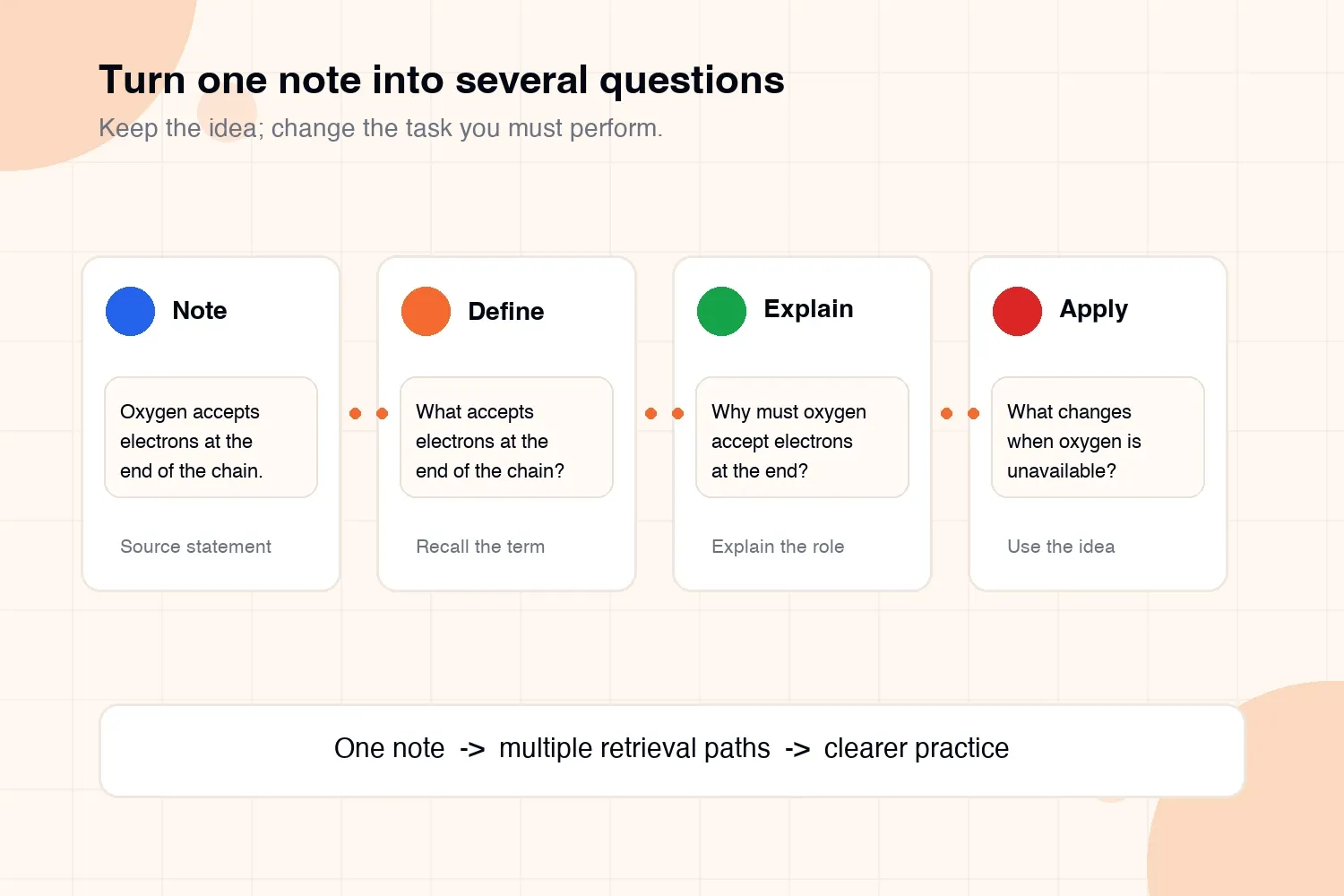
Example: turn one lecture into a question set
Imagine your notes from a 50-minute biology lecture include these lines:
- Oxygen accepts electrons at the end of the electron transport chain.
- The proton gradient stores potential energy.
- ATP synthase uses that gradient to make ATP.
- Fermentation regenerates NAD+ when oxygen is unavailable.
- Exercise changes the demand for oxygen and ATP.
Do not use a single question such as “Explain cellular respiration.” That prompt is too broad to answer or grade. Split the notes into questions that each expose one relationship:
- What role does oxygen play at the end of the electron transport chain?
- How does the proton gradient store usable energy?
- Why can ATP synthase make ATP when protons move through it?
- Why does fermentation help a cell continue glycolysis without oxygen?
- What changes in ATP demand during intense exercise?
- How would ATP production change if the electron transport chain stopped?
The first four questions retrieve the lecture's main mechanisms. The last two ask you to transfer those mechanisms to a changed condition. That mix is more useful than six questions that only ask for definitions.
Write questions with a clear boundary
A question has a clear boundary when you know what a complete answer must contain. “What is important about the electron transport chain?” has no clear stopping point. “What happens to the proton gradient when the chain stops?” gives you a specific relationship to explain.
Useful boundaries come from:
- A named concept: What does this term do?
- A pair: What is the difference between these two processes?
- A condition: What changes if this input disappears?
- A sequence: What happens before and after this step?
- A decision: Which rule or method would you use here, and why?
If you cannot tell whether an answer is complete, the problem is often the prompt rather than your memory. Narrow the topic, add the condition, or ask for one relationship instead of the whole explanation.
Turn weak questions into useful ones
Weak questions often look reasonable because they use course vocabulary. The test is whether the prompt asks for a specific relationship, condition, or decision. If almost any response could fit, rewrite it.
Weak: What is the autonomic nervous system?
Better: Which functions does the autonomic nervous system regulate without conscious control?
The second question gives the answer a boundary: it asks for a function and a contrast with conscious control.
Weak: Explain supply and demand.
Better: What usually happens to price when demand rises and supply stays constant?
The second question turns a chapter heading into a relationship you can apply.
Weak: Know the stages of mitosis.
Better: What changes in the cell during metaphase, and what happens immediately after it?
The second question asks for a sequence and a transition rather than a label list.
Keep the answer short enough to check
The answer should contain the essential explanation, not a second copy of the lecture. A short answer is easier to compare with the source and easier to repair when you miss one part.
For a definition, one or two sentences may be enough. For a mechanism, keep the cause-and-effect chain. For an application, include the rule and the result. If one question needs a page-long answer, split it into smaller prompts or move the task into a full written practice response.
Do not demand identical wording. A correct answer can use different language if it preserves the essential relationship from the notes. The point is to check understanding, not reproduce the slide.
What not to turn into a question
Not every line in your notes deserves a quiz question. Skip or combine details that are:
- A repeated example that adds no new relationship
- A transition sentence between two main ideas
- A citation or administrative reminder
- A minor detail that will not help you explain, compare, or apply the topic
- A fact you already know and that does not connect to a more important idea
Prioritize notes that explain how something works, why it matters, when to use it, or what changes under a different condition. A smaller question set with visible purpose is easier to review than a complete transcription of the lecture.
A 15-minute notes-to-questions workflow
Use this short workflow after class or after cleaning up a lecture transcript:
- Scan for structure. Mark headings, repeated terms, diagrams, examples, and instructor emphasis.
- Choose six to ten targets. Select ideas that explain relationships or support likely exam tasks.
- Assign a question type. Label each target as definition, mechanism, comparison, application, sequence, or decision.
- Draft without copying. Write the question in your own words before returning to the answer.
- Verify the essential answer. Check the notes and remove anything that does not help you judge the response.
- Test two questions immediately. If either prompt is vague, rewrite it while the lecture is still fresh.
- Mark the gaps. Keep missed questions visible so they guide the next review.
Generate a first quiz from your lecture with AI
When your lecture notes are long, an AI study tool can handle the first pass. Muneo can turn a lecture PDF or pasted notes into a quiz draft, which is useful for covering the material before you refine the questions yourself. The tool saves drafting time; it does not decide which ideas matter most in your course.
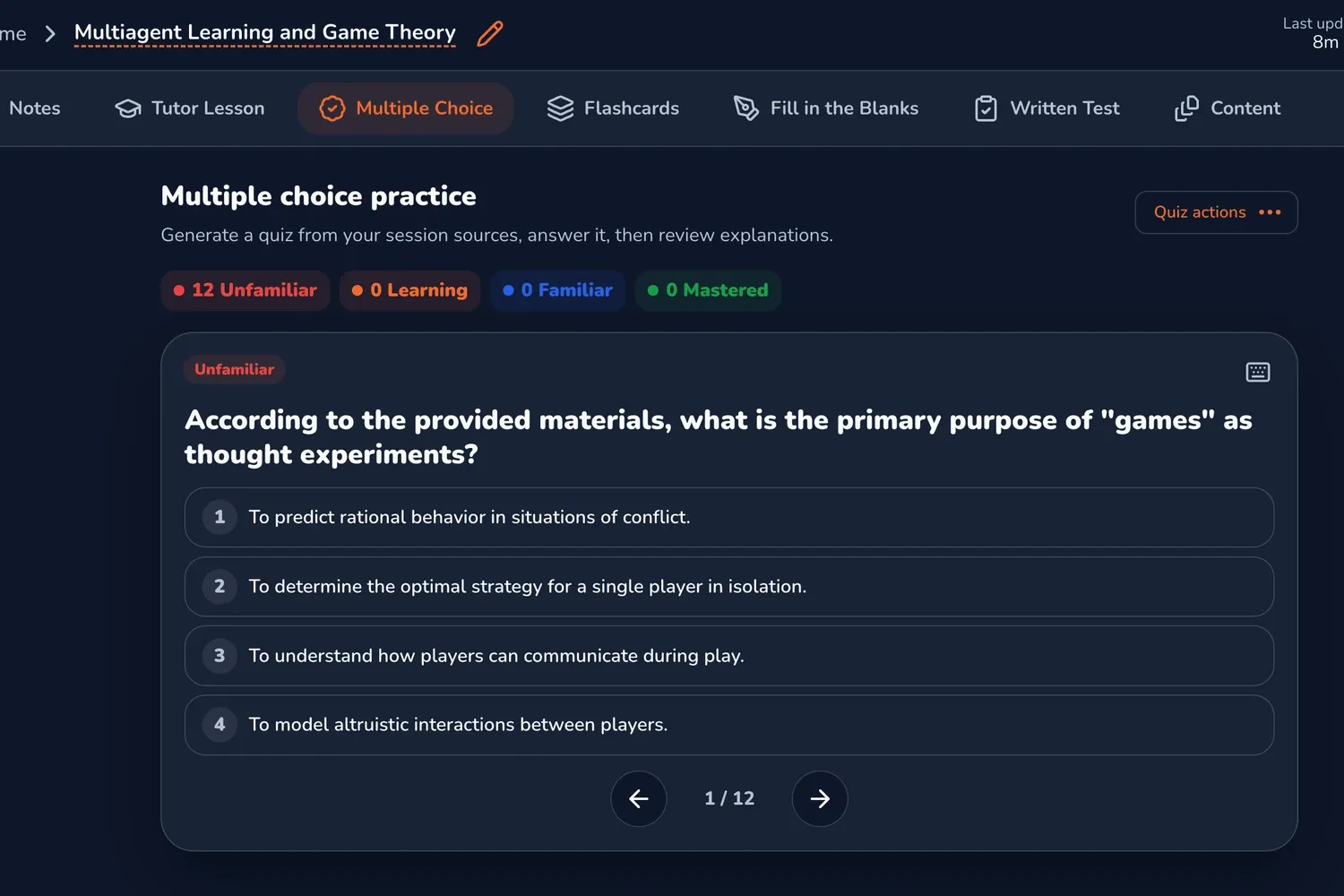
Use the generated quiz as a starting point. Check each answer against the lecture, remove duplicates, and rewrite questions that only test wording recognition. Ask for a deliberate mix of definitions, mechanisms, comparisons, and applications:
Example prompt: From these lecture notes, identify eight examinable ideas. For each idea, write one question, label the thinking task, and give a concise answer supported by the notes. Do not add facts that are not in the notes.
Whether you write the questions by hand or generate a first draft with Muneo, keep only questions that test a meaningful idea. Automatic generation cannot decide which details your instructor values or whether a prompt tests understanding.
Review the questions, not just the notes
Close the lecture notes before answering. Say or write the response, then check the source for the missing relationship. If you miss a question, decide whether the problem was the question, the note, or your understanding.
A missed question should change something. Narrow the prompt, add the missing condition, repair the note, or schedule another attempt. If you only mark it wrong and continue, the question has measured the gap without helping you close it.
For science-heavy material, research on retrieval practice and meaningful learning offers further context. You can also see the active-recall guide. The practical rule is simple: turn the note into a question, answer before checking, and let the missed part choose the next review.
Good notes preserve what the lecture said. Good quiz questions reveal what you can do with it. Keep the notes as your source, use the questions as your test, and do not confuse a complete transcript with complete understanding. To begin, take one lecture, choose six to ten important ideas, and write one bounded question for each.