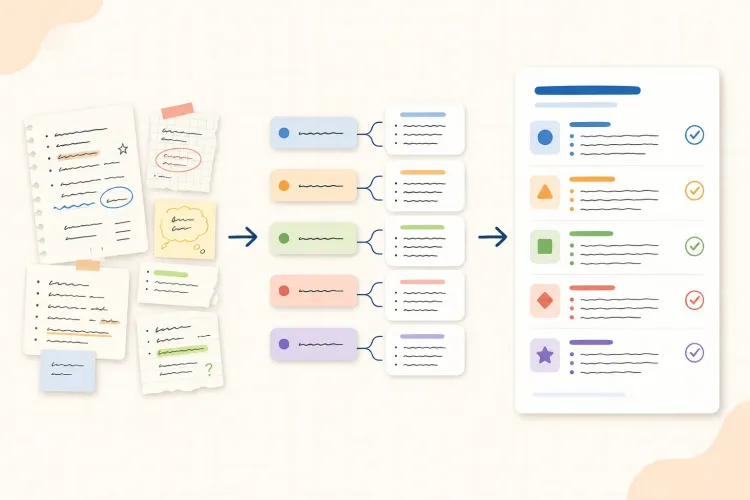


Notes and summaries both feel productive because they turn messy material into something cleaner. But cleaner material is not automatically learned material.
A useful note preserves context: what was said, how ideas connect, where examples came from, and what the teacher or source emphasized. A useful summary compresses that material into the main idea. But neither one proves that you can remember, explain, or apply the topic later.
The practical answer is this: notes capture material, summaries compress meaning, and practice turns both into study. If notes or summaries never become questions, explanations, flashcards, or written answers, they usually stay passive.
So, are notes or summaries better for studying?
Neither is automatically better. Use notes for first exposure, when you need context, examples, details, and emphasis from the source. Use summaries after you already have the material, when you need to compress it into the main idea.
Many students call short, condensed notes "summary notes." That can work, but only if the result still helps you practice. If the shorter version removes the examples, steps, or questions you need later, it becomes too vague to study from.
| Study need | Better first move | Why |
|---|---|---|
| Learning something new | Take notes | You need context, examples, and details before compressing them. |
| Reviewing a known topic | Write a summary | You need to identify the main idea and remove noise. |
| Preparing for a test | Turn either one into practice | You need to produce answers without looking. |
The mistake is treating either format as finished study. Notes and summaries work best as raw material for practice.
What notes are good for
Good notes help when the source is too long, too fast, or too detailed to keep in your head at once. They give you something reliable to return to.
They are especially useful when you need to capture:
- Definitions, formulas, dates, or steps.
- Examples your teacher emphasized.
- Diagrams, processes, or comparisons.
- Questions you had while learning.
- Mistakes or unclear parts to revisit later.
The Cornell note-taking system is useful here because it separates the page into notes, cue questions, and a short summary. Cornell's Learning Strategies Center describes the method as a way to record information, create cues, and summarize the page afterward.
The important idea is not the exact layout. Good notes should leave a path back into thinking, not just a page of copied text. You can read Cornell's explanation of the Cornell note-taking system for the full structure.
Good notes do not need to be beautiful. They need to make later study easier.
The example below shows notes doing their job: they keep enough context to return to the source, but they are still structured enough to become questions or recall practice.

What summaries are good for
A summary is useful when it forces you to decide what the material actually means.
A weak summary copies a paragraph in fewer words. A strong summary answers questions like these:
- What is the central idea?
- Why does it matter?
- What are the key parts?
- How does this connect to what came before?
- What example would prove you understand it?
The Learning Scientists' guide to summarization makes a similar distinction. Summarizing can help when students identify important ideas and put them into their own words. It is less useful when it becomes shallow copying.
That is why summaries should be short, selective, and followed by a check against the source.
A summary should make the topic smaller without making it vague.
Where both methods fail
Notes and summaries fail when they let you recognize material instead of retrieving it.
Recognition feels like this:
- "This slide looks familiar."
- "This paragraph makes sense while reading."
- "The summary feels clear now."
- "The example is recognizable."
Those feelings are not useless, but they can be misleading. Exams and real tasks usually ask for more: explain the idea, solve the problem, compare two concepts, remember the steps, or apply the method without the source open.
This is where notes and summaries need to become practice. If you want the deeper method behind this, the next step is to use notes for active recall: hide the answer, try to produce it, then check what was missing.
A better study loop
The best workflow is not choosing one format and defending it. Use notes when you need context, summaries when you need compression, then practice.
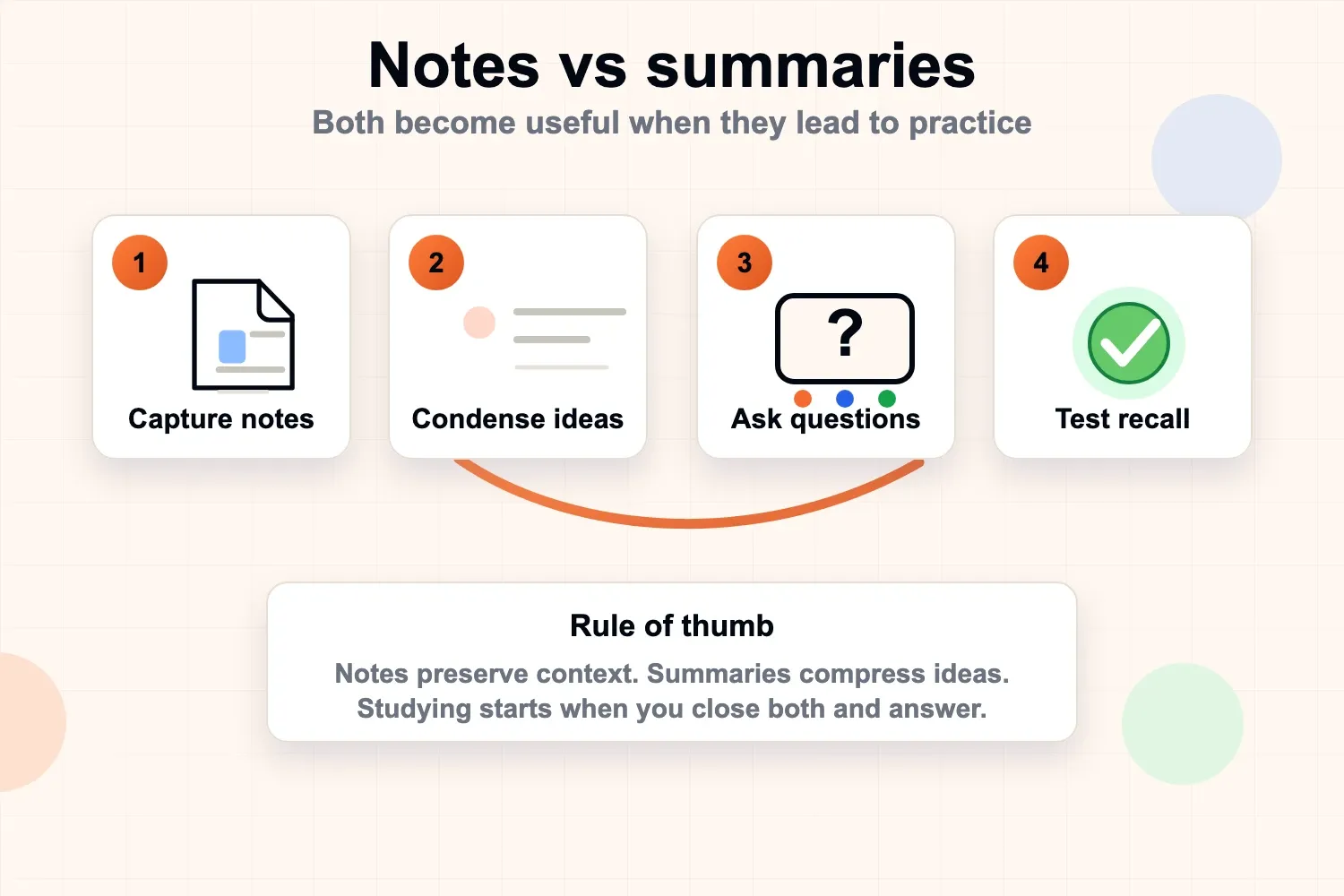
Use this loop:
- Capture: write enough notes to preserve the source.
- Condense: turn a section into a short summary in your own words.
- Question: convert the summary or note headings into questions.
- Test: answer without looking.
- Fix: check the source and mark what was missing.
The key move is step four. Until you answer without looking, you do not know whether the note or summary helped.
How to make notes useful
Useful notes should be easy to turn into questions later.
Instead of writing only:
- Photosynthesis happens in chloroplasts.
- Light-dependent reactions produce ATP and NADPH.
- The Calvin cycle uses carbon dioxide.
Add prompts beside the notes:
- Where does photosynthesis happen?
- What do light-dependent reactions produce?
- How is the Calvin cycle connected to carbon dioxide?
This small change makes the note active. You are no longer just saving information; you are preparing a way to test it.
For lectures or videos, note-taking is easier when the first pass captures structure instead of every sentence. If a lecture is long, you can turn a lecture video into cleaner notes, then decide which parts deserve questions, flashcards, or written practice.
How to make summaries useful
A useful summary is short enough to remember and specific enough to test.
After a lecture section, PDF page, or textbook heading, try this format:
- Main idea: one sentence.
- Why it matters: one sentence.
- Example: one concrete case.
- Question: one thing you should be able to answer later.
For example, after a lesson on supply and demand:
| Part | Example |
|---|---|
| Main idea | Price changes when supply and demand shift. |
| Why it matters | It explains why shortages, surpluses, and market shocks affect prices. |
| Example | A bad harvest can reduce supply and raise food prices. |
| Question | How would a sudden increase in demand affect price and quantity? |
This works better than a long paragraph because it separates understanding from testing. The summary gives you the idea. The question checks whether you can use it.
When to use notes, summaries, or both
Use notes when the material is new, detailed, or fast-moving. You need enough context to return to it later.
Use summaries when the material is already captured and you need to compress it into the main idea.
Use both when the topic is important and likely to appear on a test or assignment. Notes keep the detail, summaries force selection, and practice exposes gaps.
| Situation | Best first move |
|---|---|
| Live lecture | Take structured notes |
| Long PDF chapter | Mark sections, then summarize each key idea |
| Exam review | Turn notes and summaries into questions |
| Confusing topic | Explain the summary out loud, then check the source |
| Easy topic | Skip long notes and do quick recall instead |
Choose based on the task, not habit.
What this looks like in real study material
For a biology chapter, notes should preserve details you may need later: vocabulary, process steps, diagrams, and exceptions. A summary should compress the same chapter into the main idea: what the process does, why each stage matters, and where students usually get confused. To study it, close both and answer: “How does light energy become stored chemical energy?”
For a history lecture, notes are useful for dates, people, causes, evidence, and consequences. A summary is useful for the bigger argument: why the event happened and why it changed what came next. To test yourself, try answering: “Which cause mattered most, and what evidence supports that?”
For a programming video, notes can keep syntax, code examples, and mistakes to avoid. A summary should explain the concept in plain English. Then practice by writing a small example without looking.
How AI changes notes and summaries
AI can make notes and summaries faster, but it can also make passive studying easier to miss.
A generated summary is helpful if it gives you a clearer first pass. It is not enough if you only read it and move on. The same applies to AI notes: they save time only when they help you return to the source, ask better questions, and test yourself.
A better AI workflow is:
- Give AI the source material.
- Ask for structured notes or a short summary.
- Check the output against the source.
- Turn the result into questions.
- Answer before looking at the generated explanation.
If you use AI for studying, the safer rule is to make it support the session, not replace the thinking. This is the same principle behind using AI without outsourcing the work.
How to tell if they are working
A note is working if it helps you rebuild the source later. After reading it, you should remember the examples, the steps, the confusing parts, and why the topic mattered.
A summary is working if it helps you explain the idea without hiding behind the original wording. It should be short, but not so vague that every detail disappears.
Use this quick test:
- If you cannot remember the context, your notes are too thin.
- If you cannot state the main idea, your summary is too vague.
- If you can recognize the answer but cannot produce it, you need practice.
- If you can explain it without looking and check it against the source, the note or summary did its job.
That is the real difference. Notes and summaries are not judged by how clean they look. They are judged by whether they help you think with the page closed.
The takeaway
Notes and summaries are useful, but they are not the same as studying.
Use notes to capture context. Use summaries to compress meaning. Then close both and answer questions from memory. If the page is still giving you the answer, you are organizing. When you close it and try, you are studying.