
Messy notes are not useless notes. Class notes, lecture notes, and rough digital note dumps usually contain the raw material you need: definitions, half-finished explanations, examples from class, questions you never resolved, and reminders about what the lecturer emphasized. The problem is that those pieces are mixed together, so studying from them means searching and interpreting at the same time.
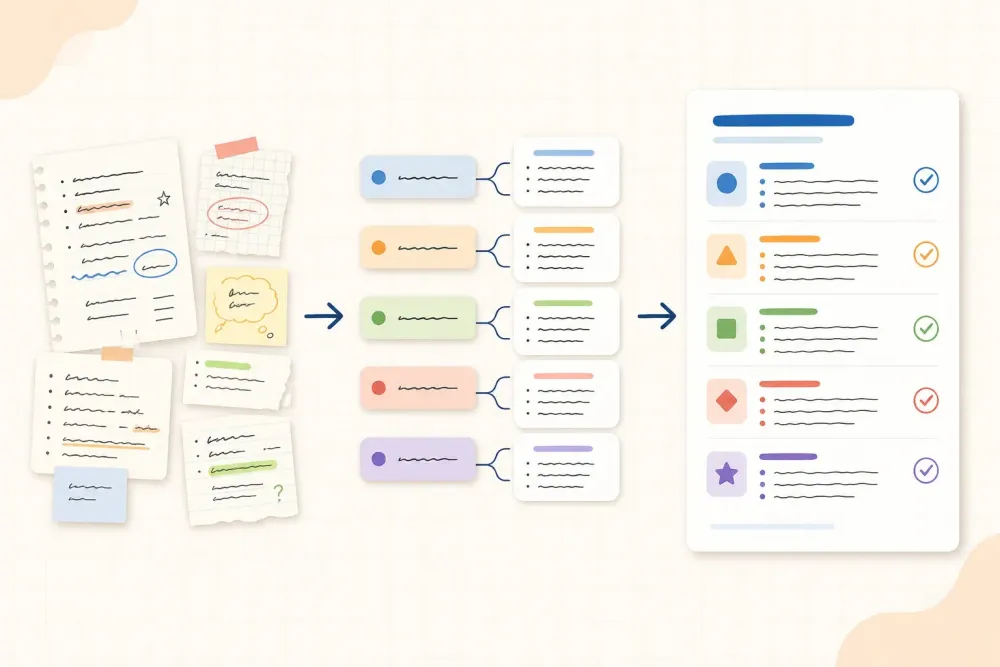
A study guide should give you a clear route through the material. It is not a polished copy of every page of notes. Turn them into one by preserving the original, sorting ideas by topic, resolving gaps, and condensing each topic into something you can understand and review.
How to turn messy notes into a study guide
Use this sequence when your notes are scattered across pages, documents, screenshots, or quick capture fragments:
- Keep the raw notes unchanged. Make a copy before cleaning so you can check what you originally captured.
- List the topics. Organize around the concepts the exam or assessment is likely to cover, not only the order of the lecture.
- Group related material. Move definitions, examples, diagrams, and explanations under the topic they support.
- Mark gaps and uncertainty. Separate missing information from information you simply need to understand better.
- Rewrite selectively. Use short explanations, relationships, and examples instead of rewriting every sentence.
- Check the guide against the source. Confirm that the cleaned version has not changed the meaning or dropped an important condition.
The result should be shorter than the raw notes but more useful than a summary that only lists main ideas. It should tell you what each topic means, how it connects to the rest of the course, and where you still need to look or practise.

Start with the raw notes, not a blank document
Before you organize anything, make one working copy of the notes and keep the original file or notebook untouched. This matters when your notes contain abbreviations, arrows, incomplete sentences, or a detail that seems unimportant until it is connected to another idea.
Do a quick inventory rather than trying to clean every line immediately. Mark each fragment as one of four things:
- A concept, definition, rule, or formula
- An explanation, example, diagram, or comparison
- A question, uncertainty, or missing step
- An action, reminder, or piece of course administration
This first pass separates study material from tasks such as "email the tutor" or "submit worksheet." Those reminders may matter, but they do not belong in the study guide itself.
Start this cleanup while the lecture is still reasonably fresh if you can. You will remember what abbreviations, arrows, and unfinished sentences referred to. This does not mean rewriting everything the same day; it means preserving enough context to make later sorting less speculative.
Group notes by topic, not by the order you wrote them
Chronological notes preserve the lecture, but exams usually ask about concepts and relationships rather than about the order in which material was presented. Create a topic list from the syllabus, learning objectives, slide headings, tutorial questions, or exam guide. Then place each note fragment under the topic it helps explain.
A useful topic is specific enough to study but broad enough to hold a few connected ideas. "Cellular respiration" may be too broad for one section, while "electron transport chain and proton gradient" gives you a manageable unit. If a fragment could fit under two topics, place it where it answers a question and add a short cross-reference rather than duplicating the whole note.
| Messy note pattern | Study-guide decision |
|---|---|
| The same definition appears three times | Keep one checked version and note the different example if it adds meaning |
| A diagram has labels but no explanation | Add the relationship or process the diagram is meant to show |
| An arrow points to an unfinished thought | Mark it as a gap instead of guessing what it means |
| A reminder is mixed into a topic | Move it to a separate task list |
Clean the structure before polishing the wording
Do not begin by making every sentence sound perfect. First give the guide a stable structure. A simple topic template works well:
- What it is: the short definition or central idea
- How it works: the steps, causes, or relationships
- How to recognize it: the signal, example, or condition that matters
- What changes it: an exception, comparison, or changed condition
- What is still unclear: the gap you need to resolve
Not every topic needs all five parts. The template is a checklist for missing thinking, not a format that every section must fill mechanically. A formula may need variables and an example; a theory may need assumptions and a comparison; a process may need a sequence and a failure point.
Selective rewriting is faster and more useful than copying. Keep a lecturer's exact wording when the wording is a definition or condition that could be assessed. Rewrite surrounding explanation in your own words so you can tell whether you understand it.
If you are unsure whether a fragment belongs in the final guide or should stay in the source notes, use this distinction between recording information and condensing it for review.
Mark gaps instead of hiding them
A clean-looking guide can still be unreliable if you silently complete missing information. Use a visible marker such as [check source], [need example], or [explain step 2]. Then resolve each marker using the lecture slides, textbook, handout, recording, or a question for your instructor.
Separate three situations that often get mixed together:
- Missing: the notes do not contain the information.
- Unclear: the information is present, but you cannot explain it yet.
- Conflicting: two notes or sources appear to disagree.
Each situation needs a different repair. Find a source for missing material, explain unclear material with an example or worked step, and compare sources when the notes conflict. Do not turn uncertainty into a confident sentence just because the guide looks better that way.
Add examples and connections, not more volume
A study guide becomes useful when it helps you recognize and use an idea. For each major topic, add one concrete example, one connection to another topic, or one changed condition. These additions usually help more than another paragraph of general explanation.
For example, a note that says "competitive inhibition increases Km" is easier to use when the guide also states what happens to Vmax and how the result differs from noncompetitive inhibition. A history topic becomes more useful when the guide connects a policy to its cause and consequence. A statistics formula needs a sentence explaining when the formula applies, not only the symbols.
Keep the example close to the idea it explains. Do not create a separate example appendix that forces you to search through the guide while reviewing.
Example: turn a messy biology lecture into a study guide
Imagine that your notes from a 50-minute biology lecture contain copied slide definitions, a half-drawn cellular-respiration diagram, an example about oxygen availability, and a margin note saying "the professor warned that students often mix these up." The raw capture is useful, but it is not ready for review.
A cleaned guide could have four sections:
- Purpose and stages: what cellular respiration does and where glycolysis, the citric acid cycle, and oxidative phosphorylation occur.
- Energy transfer: how electron carriers and the proton gradient connect to ATP production.
- Changed conditions: what happens when oxygen is limited and why the pathway changes.
- Common confusion: how substrate-level phosphorylation differs from oxidative phosphorylation.
The incomplete diagram becomes a marked gap, the professor's warning becomes a comparison note, and the oxygen example becomes an application section. The point is not to add more material; it is to make the existing material easier to locate and explain.
Use AI only after you decide what the notes mean
AI can help group fragments, suggest headings, or flag repeated ideas, but it should not decide whether an unclear note is correct. Preserve the raw notes, give the tool the relevant source material, and review every uncertain or newly completed statement against the original.
A useful instruction is: "Organize these notes by topic. Keep the original meaning, mark incomplete or uncertain points, remove duplicates only when they are genuinely repeated, and do not add facts that are not supported by the source." The important output is not polished prose. It is a structure you can inspect and correct.
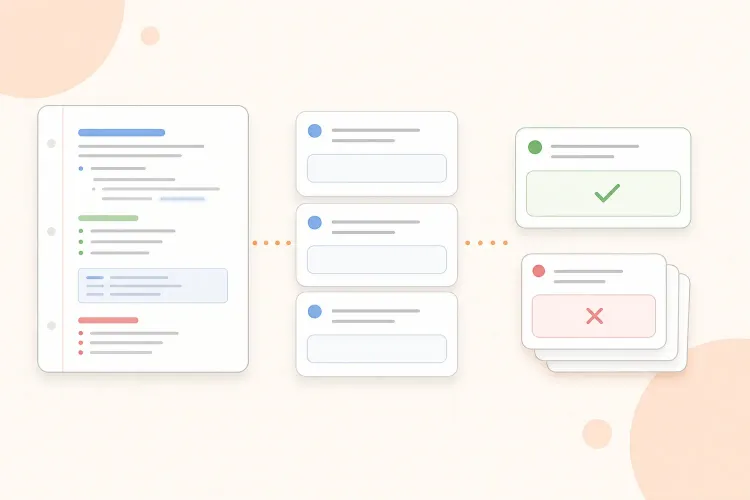
Once the guide is accurate, you can turn selected study-guide sections into quiz questions as a separate practice step. Keep that step separate so the guide remains readable and source-grounded.
That separation matters: the guide organizes the material, while active recall makes you retrieve it.
Check whether the guide is ready
A study guide is ready to study from when you can answer yes to these questions:
- Can you find each major topic without searching through the raw notes?
- Does each topic explain the idea rather than only name it?
- Are examples, diagrams, and conditions attached to the concepts they explain?
- Are uncertain points marked and either resolved or listed for follow-up?
- Can you tell which parts came from the source and which parts are your own explanation?
- Is the guide short enough to review without becoming another full set of notes?
If the answer to the last question is no, remove repetition before reducing the font size or adding another layer of formatting. A guide that contains everything is still difficult to study.
If you need a quick cleanup
When you do not have time to rebuild the whole guide, make a triage pass:
- Collect only the likely material. Start with the syllabus, objectives, relevant notes, and the sources your assessment uses.
- Mark priority topics. Flag concepts that are repeated, connected to several sections, or likely to be assessed.
- Group and compress. Move the most useful fragments under those headings, remove obvious duplicates, and keep one example where it clarifies the idea.
- Leave a gap list. Record what still needs a source check or explanation instead of hiding it in polished prose.
This pass gives you a reliable starting map without pretending that every topic is mastered. You can return to the lower-priority material after the central concepts and gaps are visible.
To double-check what belongs in the guide, the University of Toronto's exam study-guide template starts with course materials, learning objectives, and past assessments before moving to topics and examples.
Messy notes do not need to become beautiful notes. They need to become findable, accurate, and useful for your next study action. Preserve the source, group the ideas, mark the gaps, and rewrite only what makes the material easier to understand and review.