
An effective study group is not a room where everyone rereads the same notes. It is a structured session in which each person tries to retrieve, explain, question, and repair their understanding. The group should leave with clearer reasoning, a short list of unresolved gaps, and a next action for each person.
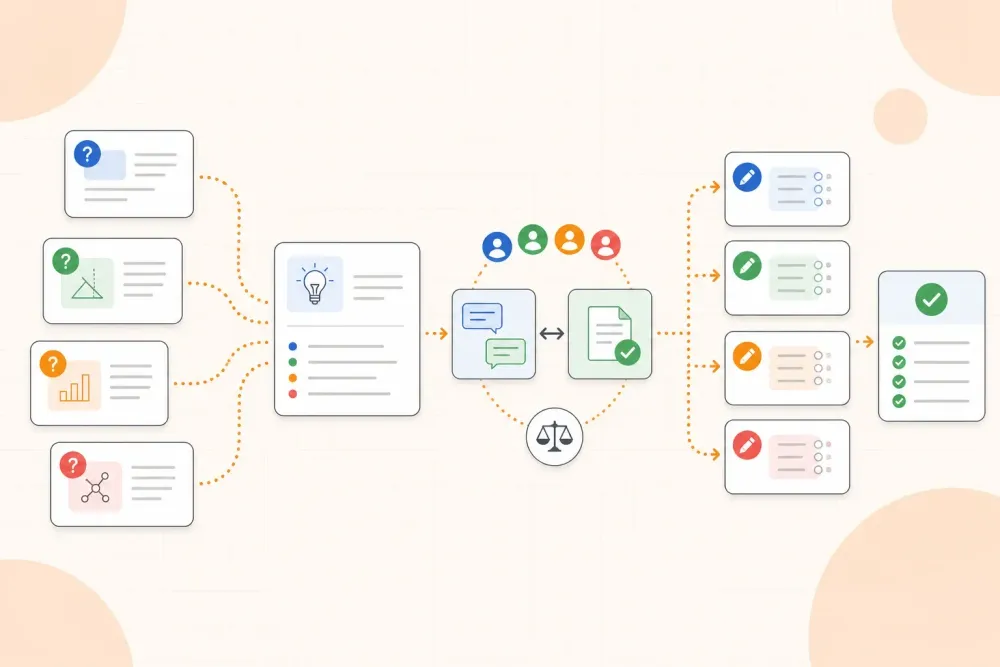
The framework is simple: choose one shared outcome, prepare individually, assign light roles, answer before discussing, compare reasoning, verify disagreements against the course source, and record what still needs work. That structure gives conversation a learning purpose instead of letting the most confident person do all the explaining.
How to run an effective study group
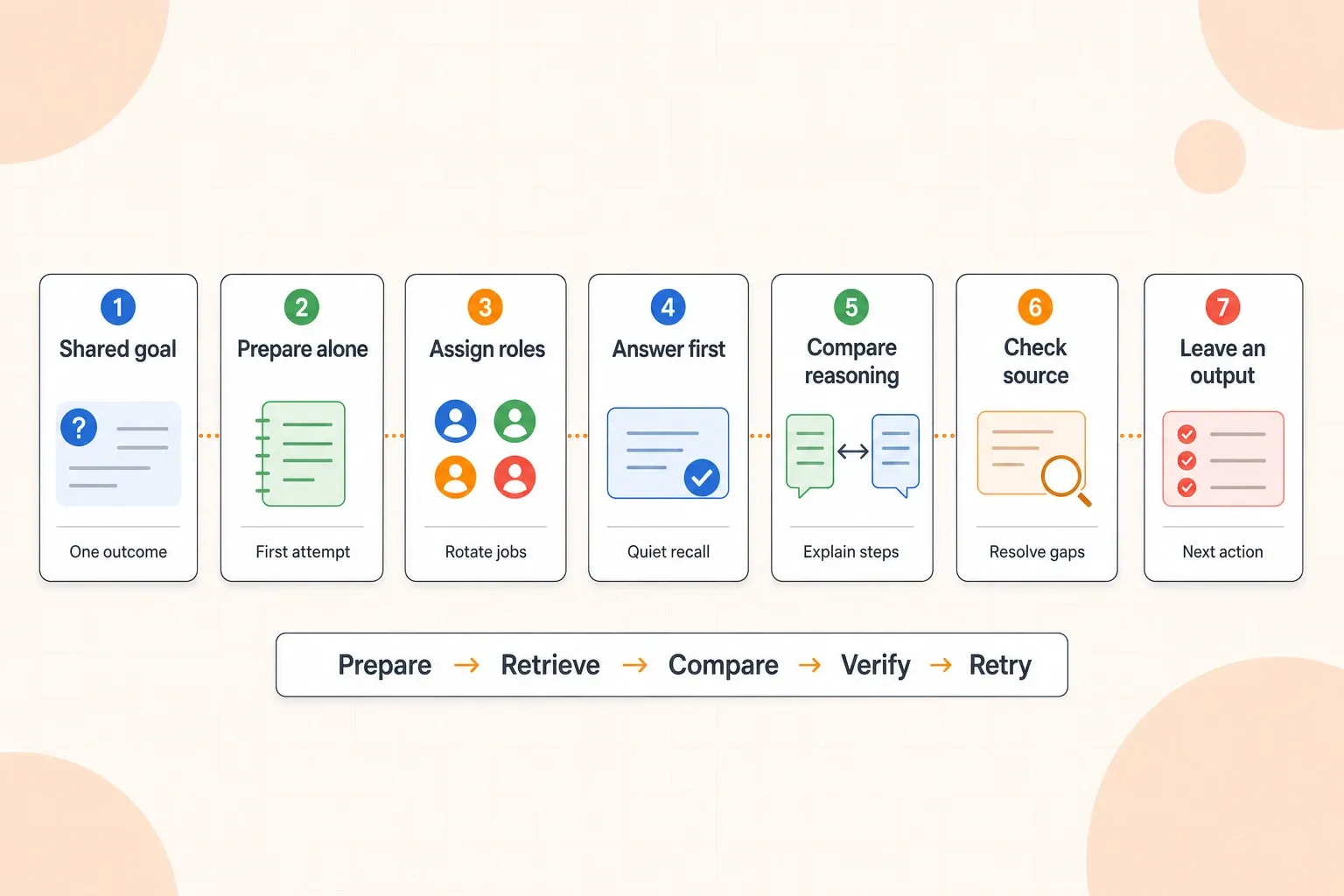
Use this sequence whenever you meet to study:
- Choose one outcome. Decide what the group should be able to explain, solve, or produce before the session ends.
- Prepare alone first. Read the relevant material and attempt a few questions so the meeting begins with genuine questions to work on.
- Assign temporary roles. Rotate a facilitator, timekeeper, source checker, or problem presenter so the work is shared.
- Answer before discussing. Give everyone quiet time to retrieve an answer or plan a solution before anyone leads the group.
- Compare reasoning, not just answers. Ask what clue, definition, or step led each person to their conclusion.
- Check disagreements. Return to the lecture, textbook, mark scheme, or other agreed source instead of voting on who sounds most confident.
- Leave with an output. Save a corrected explanation, solved problem set, question list, or individual retry plan.
This is what makes group study different from an informal revision chat. The conversation is still useful, but each activity should reveal what the group understands and what still needs work.
Decide whether a group is the right tool
Group study helps most when the material is easier to understand through explanation, comparison, or application. It is useful for testing whether an argument holds together, comparing different approaches to a problem, practicing an oral answer, or finding a missing connection in a process.
It is less useful when nobody has opened the material, the group is trying to cover an entire course in one meeting, or the main task is silent memorization. Learn basic definitions and complete an initial reading alone; use the group to test, explain, and extend that preparation.
Group size matters too. A group of two to five people is usually enough to create different viewpoints without making every question a scheduling problem. Larger groups can work, but they need firmer facilitation and shorter turns so that quiet members are not reduced to listeners.
Choose members who are likely to prepare and contribute rather than simply choosing people you already know. Before the first meeting, agree on the start and end time, the material to bring, how phones will be handled during turns, and how unresolved questions will be followed up. A short agreement makes participation predictable and gives the group a fair way to respond when someone repeatedly arrives unprepared.
Set an outcome before you set a meeting time
“Study biology” is not a useful group goal. A workable outcome describes what will be different by the end of the meeting:
- explain the stages of cellular respiration without notes;
- solve four thermodynamics problems and compare the setup choices;
- build a shared list of likely essay claims and supporting evidence;
- answer six practice questions, then classify the disagreements;
- rehearse an oral explanation and improve it after peer questions.
Choose one main outcome and, at most, one supporting outcome. If the group needs a long list of topics, divide it into separate sessions or assign some preparation to individual members first.
Before the meeting, share the topic, the source everyone should use, the questions or problems to attempt, and the expected output. Cornell's guidance on setting up a study group offers a useful check that the group has a clear purpose and workable format before it meets.
Prepare individually so the group has something to work with
Group time is wasted when it is spent discovering what the session is about. Each person should arrive with a basic first attempt, even if that attempt is incomplete.
Preparation can be short and specific:
- Read or review the agreed section.
- Close the source and write what you can recall.
- Attempt the assigned questions or outline the problem-solving steps.
- Mark one point that is clear, one point that is uncertain, and one question to bring to the group.
This answer-first preparation turns the meeting into shared feedback rather than shared highlighting. It is an active-recall step: produce an answer before looking for confirmation, then use the correction to decide what needs attention.
If everyone is using different files or versions of the material, agree on a source before the meeting. When notes, readings, and practice outputs are scattered, use this system for organizing study materials across classes to give the group one reliable starting point.
Use roles to distribute the work
Roles should make participation easier, not create a permanent group leader. Rotate them from one session to the next, or after each major activity.
| Role | Main responsibility | Useful question |
|---|---|---|
| Facilitator | Keep the group on the outcome and invite quieter members in. | Is the group still working on the agreed question? |
| Presenter | Explain a solution, claim, diagram, or process without reading it aloud. | What is the reasoning behind this step? |
| Source checker | Verify disputed details against the agreed course material. | Where does the source support or qualify this claim? |
| Timekeeper | Mark transitions and protect time for the final output. | Should this be resolved now or recorded for follow-up? |
The roles do not replace subject knowledge. They create the conditions in which people can use that knowledge: everyone gets a turn, uncertainty becomes visible, and the session produces something concrete.
The University of Washington's guidance for effective groupwork also recommends agreeing on the goal, reading the questions in advance, and bringing the materials the group will need.
Use a repeatable 60-minute session plan
A simple time limit keeps the group from spending the whole meeting on its first difficult question. Adjust the blocks for your subject, but reserve time for individual thinking and a final output:
- 5 minutes: Set the target. Restate the shared outcome and choose the first question, problem, or explanation.
- 10 minutes: Retrieve alone. Everyone writes an answer or solution plan with the source closed.
- 30 minutes: Compare and explain. Rotate presenters, ask follow-up questions, and record disagreements rather than letting one person take over.
- 10 minutes: Check and repair. Use the agreed source to resolve the most important disagreements and rewrite the rule, explanation, or method.
- 5 minutes: Close individually. Each person records one retry question or next problem to complete alone.
The schedule sets boundaries; it is not a script. If one disagreement needs more time, record it and move on unless resolving it is essential to the session outcome.
Make answer-first turns the default
The easiest way for a study group to become passive is to let one person explain everything while everyone else nods. Reverse the order:
- Read the question or prompt aloud.
- Give everyone quiet time to write an answer, plan, or prediction.
- Ask one person to share their reasoning.
- Ask another person to challenge, extend, or restate it.
- Check the result against the source or answer criteria.
For factual material, ask for a definition, mechanism, comparison, or consequence. For problem-solving material, ask what the first decision is and which clue supports it. For essay preparation, ask for a claim and evidence before discussing style.
Do not make every turn a performance. A person can share an incomplete attempt and explain where they stopped. That is more useful than waiting until the answer sounds polished, because the group can respond to the actual reasoning rather than an edited summary.
Use peer teaching without turning it into a lecture
Teaching can reveal whether someone understands a topic, but a long uninterrupted explanation can recreate the passive classroom experience. Keep explanations short and give the listener a job: check the explanation.
After someone explains a concept, another member should do one of three things:
- give a new example;
- name a condition where the explanation would change;
- ask a question that tests the connection between two ideas.
If the explanation concerns a process, ask the presenter to pause at each transition and explain what causes the next step. If it concerns an argument, ask which evidence supports the claim and what would weaken it. If it concerns a calculation, ask why that method was chosen before checking the arithmetic.
The goal is not for the presenter to sound like a teacher. The goal is to make the explanation precise enough that someone else can use it.
Resolve disagreements with a source-checking rule
Disagreement is valuable only when the group has a way to investigate it. Confidence, seniority, or speed are not evidence.
When two answers differ:
- Restate the exact point of disagreement.
- Let each person show the step, definition, assumption, or source passage behind their answer.
- Check the agreed lecture notes, textbook, rubric, data, or worked example.
- Record the corrected rule and the reason the other approach failed.
- Create one follow-up question if the disagreement exposed a deeper gap.
This keeps the group from converting uncertainty into a majority vote. It also protects against confidently repeating a note-taking error or an oversimplified explanation.
A worked example: a biology study group
Suppose four students are preparing for an exam on cellular respiration. Their first instinct is to divide the chapter into four parts and have each person summarize one section. That may produce coverage, but it does not show whether anyone can explain how the stages connect.
They replace the plan with one shared outcome: explain what happens to the electron transport chain and ATP production when oxygen is unavailable, then answer two unfamiliar application questions.
Before meeting, each person writes an answer with the source closed and marks the step they are least certain about. During the session:
- The facilitator asks everyone to state the causal chain before opening notes.
- The presenter explains why oxygen matters at the end of the electron transport chain.
- The source checker compares the explanation with the lecture diagram and corrects an imprecise statement.
- Another member changes the condition and asks what happens when oxygen becomes available again.
- The group records one corrected explanation and two retry questions.
The group has done more than divide the reading. It has tested a mechanism, surfaced a weak link, checked the explanation, and created practice for the next session.
Finish with an individual next step
A group session should end before the conversation becomes aimless. Reserve the last few minutes for three outputs:
- a shared record of the corrected ideas or methods;
- unresolved questions that need a source, instructor, or individual review;
- one next problem, prompt, or explanation each person will complete alone.
The last item matters. Collaborative understanding does not guarantee individual recall, so each person should close the group material and produce something independently. That final answer-first step is part of practice testing: produce an answer, check it, and let the result shape the next review.
When the group stops helping
Change the format when the same problems keep appearing:
- one person answers every question;
- conversation replaces attempts;
- disagreements are settled by confidence instead of evidence;
- the group keeps expanding its topic list;
- nobody leaves with an individual retry;
- the group is solving homework for someone instead of explaining the method.
The answer is not always to cancel the group. Shorten the agenda, rotate the roles, require an answer before discussion, or spend the first part of the next meeting preparing individually. If the group still cannot produce useful evidence of learning, return to solo work and bring a narrower question to the next session.
An effective study group is a small practice environment: prepare alone, retrieve in front of others, explain the reasoning, verify disagreements, and leave with a next attempt. The group works when every conversation ends by making someone’s understanding more precise or their next action more obvious.