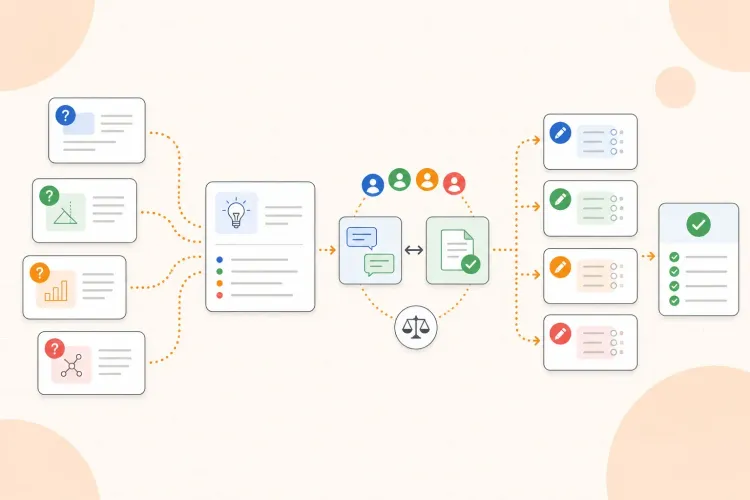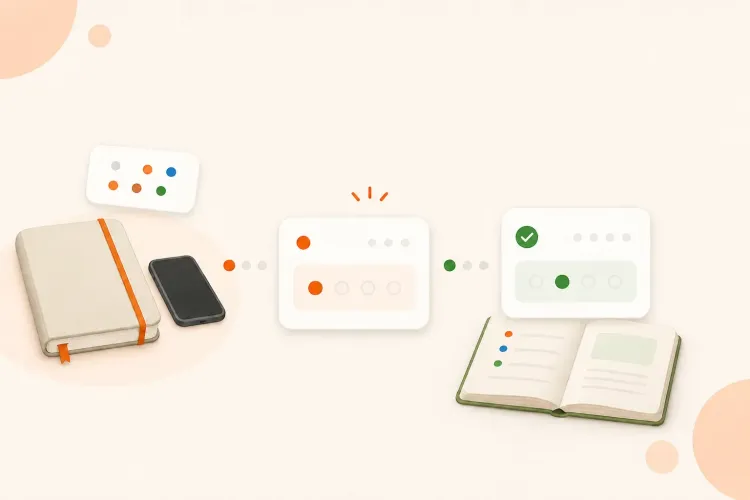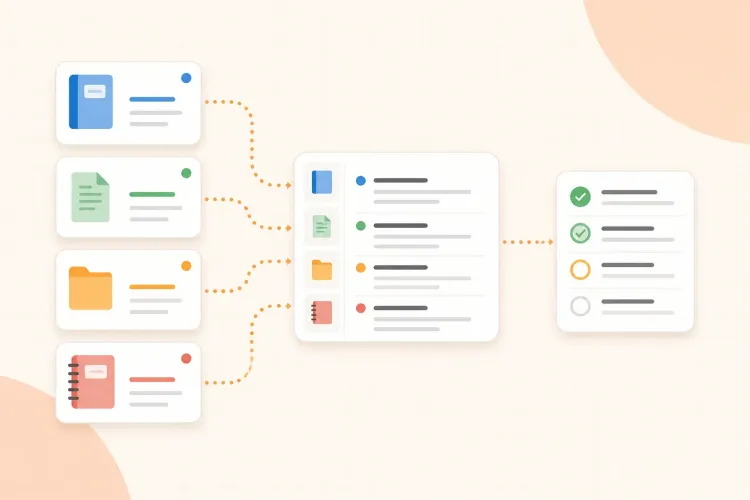

When you are tired, the goal is not to complete the study session you would have planned on a better day. The goal is to choose a useful task that your current attention can still support. That might mean testing a familiar topic, sorting the next questions to answer, or stopping before repeated mistakes turn into false confidence.
A tired session becomes wasteful when you confuse time spent with learning. Rereading the same page, copying notes, or staring at a difficult problem can feel responsible while giving you very little evidence of what you can actually recall or use. Instead, match the task to your energy, make one small attempt, check the result, and decide whether to continue.
How to study when you are tired without wasting the session
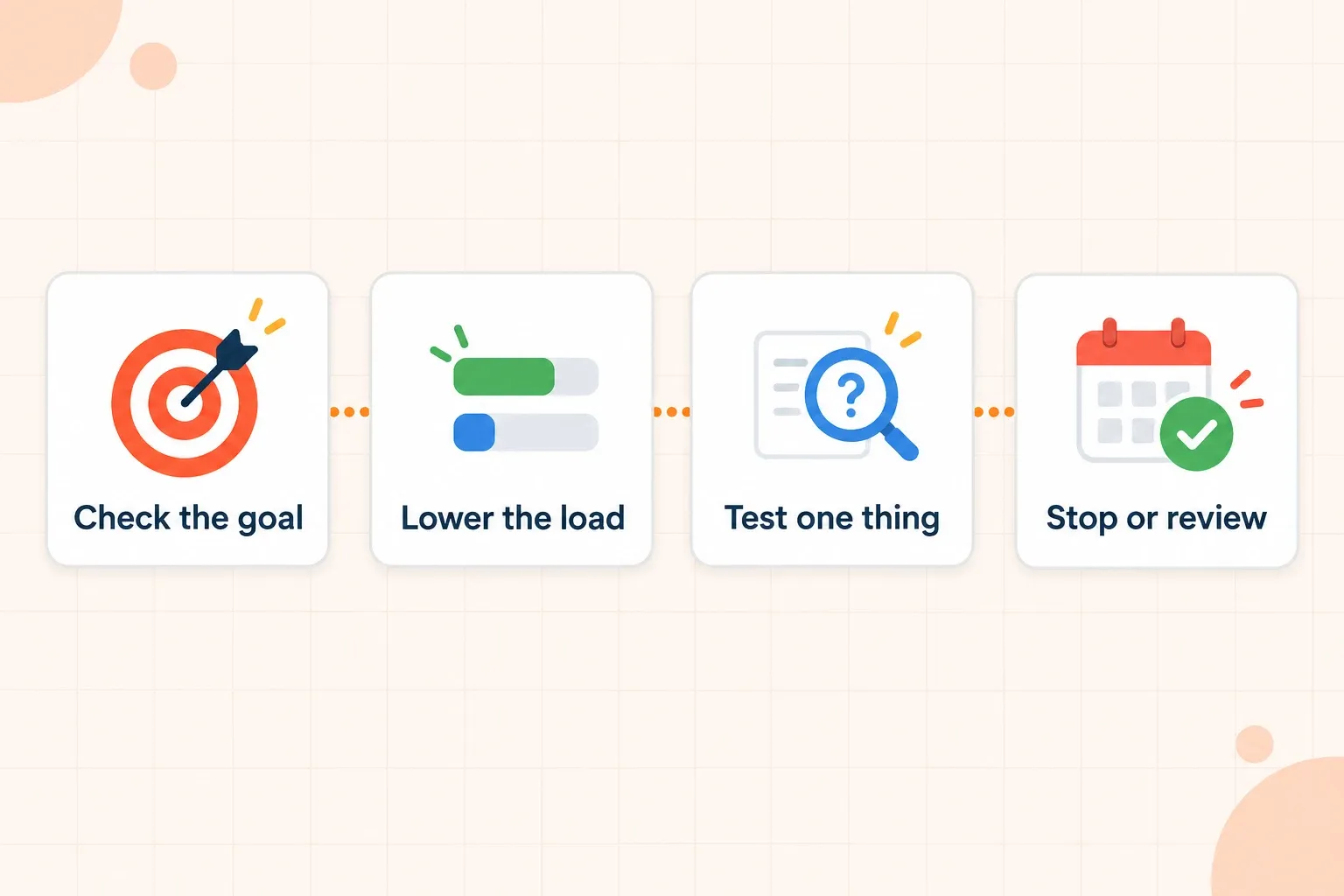
Use this sequence:
- Name the constraint. Decide whether you are sleepy, mentally overloaded, distracted, or simply unwilling to start.
- Choose a task that fits. Reduce the difficulty or scope without removing the learning demand.
- Make one closed-source attempt. Answer, explain, classify, calculate, or plan before looking at the material.
- Check the result. Find out whether the problem was memory, understanding, application, or attention.
- Choose the next move. Continue with a smaller step, switch to a lighter task, or stop and schedule the review.
The important distinction is between lowering the load and lowering the standard. A shorter answer, one example, or one topic can be enough. Passive copying is usually not a good substitute for a smaller act of recall or explanation.
First identify what kind of tired you are
“Tired” can describe several different problems, and they do not all need the same response.
| What is getting in the way? | What you may notice | Best first move |
|---|---|---|
| Sleepiness | You reread lines, lose your place, or struggle to keep your eyes open | Stop if accuracy is falling; otherwise do one short, familiar retrieval task |
| Mental overload | You understand each sentence but cannot decide what matters next | Reduce the scope to one concept, question, or worked example |
| Distraction | You keep switching tabs, checking messages, or restarting | Remove the immediate distraction and define one visible next action |
| Low motivation | You can work once started but keep avoiding the first step | Make the first action tiny: open the source and write one question |
| Physical discomfort | Hunger, thirst, pain, or an unsuitable environment keeps interrupting you | Fix the basic condition before asking for deeper concentration |
Use this as a study decision, not a label. If you are too sleepy to work safely or cannot judge your own answers, resting is more useful than extending the session. If you can work once started but keep avoiding the first step, the main problem may be starting friction rather than fatigue. A specific way to make starting easier can help you test that distinction.
Fix the easy problems before lowering the task
Sometimes the problem is not the study task itself. Before asking your tired brain to concentrate, remove the simple source of friction:
- drink water or eat if you have skipped a meal
- move away from your bed and sit somewhere that supports attention
- improve the light and put your phone out of reach
- stand up or walk briefly if you have been sitting for a long time
- open only the source and tool needed for the next task
These changes will not create energy you do not have. They simply prevent an uncomfortable setup from making the session harder than it needs to be. If you are already falling asleep, use the stopping rule later in the article instead of treating a reset as permission to keep forcing the work.
Match the task to the energy you actually have
Do not begin with the hardest possible task just to prove that you are studying. Begin by choosing the most demanding task you can complete accurately right now.
| Energy available | Useful study tasks | Tasks to postpone |
|---|---|---|
| Enough for new learning | Work through a difficult concept, solve an unfamiliar problem, or write an explanation | Low-value formatting and sorting |
| Enough for focused review | Answer questions, correct a practice attempt, compare two ideas, or explain a diagram | Starting a long new chapter without a clear question |
| Enough for light recall | Define terms from memory, label a figure, check an error log, or choose tomorrow’s practice questions | Complex calculations and long written answers |
| Not enough for reliable work | Put materials away, note the exact next step, and rest | Any task where you are guessing or repeatedly losing the instructions |
The lighter options still need an answer or decision. Label a diagram without checking first. Explain one term in your own words. Mark which question you would attempt next and why. That keeps the session connected to learning rather than turning it into administration.
Start with one closed-source attempt
When energy is limited, it is tempting to read because reading feels easier than answering. Make the first move a small attempt instead. Close the source and do one of the following:
- write three facts you remember
- answer one question without hints
- explain one mechanism in two sentences
- label one diagram
- solve one representative calculation
- predict the next step in a procedure
- list the part of the topic you cannot yet explain
Then check the source. A short attempt gives you a better choice for the rest of the session: repair one gap, answer another question, or stop. This is a small form of practice testing because it creates evidence before you read more.
The attempt does not need to be impressive. Its job is to reveal whether you have enough attention for the task you chose.
Turn a tired session into a repair session
You do not always need to learn new material. A tired session can still be useful if it repairs something specific from an earlier attempt.
Choose one visible weakness:
- a definition you keep confusing
- a step in a procedure you cannot justify
- a graph label or unit you omit
- a calculation where the setup goes wrong
- a practice answer that is too vague
- a question type you keep avoiding
Write the repair as an action, not a feeling. “Review biology” is too broad. “Explain why the rate falls after the enzyme’s optimum temperature” gives you something you can attempt and check. “Get better at statistics” is vague. “Choose the correct test for these two data sets and justify the choice” is usable.
If the repair needs more concentration than you have, record the exact question and schedule it for a better time. Planning the next attempt is useful only when it names the source, task, and stopping point.
Use a stopping rule instead of forcing the session
A study session should end when continuing no longer produces trustworthy work. Look for concrete signs:
- you read the same instruction several times without being able to restate it
- you make the same avoidable error after checking it
- your answers become guesses rather than attempts
- you cannot tell whether a response is correct or incomplete
- you keep changing tasks to avoid making a decision
- you are too sleepy to work safely or remember what you just did
Before stopping, leave a short restart note: the topic, the exact question to answer, the material to open, and the first action. This removes the need to reconstruct your plan when you return.
What to do when you are tired before an exam
The closer the exam is, the more important it becomes to protect accuracy. Do not turn fatigue into a reason to reread the entire course. Use the remaining energy to identify what is most likely to cost you marks and test one representative question from each weak area.
Use this sequence:
- List the topics or question types you still need to judge.
- Attempt one question or explanation without notes for each priority.
- Mark the exact gap: missing fact, unclear mechanism, wrong method, or careless presentation.
- Repair only the highest-value gaps you can still work on accurately.
- Write the first task for the next review and stop when your answers become unreliable.
This keeps the pre-exam session focused on finding the next useful repair, not on covering more pages. You are not trying to feel fully prepared before you stop. You are trying to leave with a more accurate picture of what needs attention next.
Common mistakes when studying tired
Rereading because it feels safe
Rereading can refresh context, but it does not tell you what you can retrieve. Start with one small question or explanation, then use the source to repair the answer.
Making the task smaller until it has no learning demand
Sorting files, changing colours, and rewriting headings can be useful preparation, but they are not a substitute for answering, explaining, calculating, or choosing. Keep one real learning action in the session.
Treating a long session as automatically better
A session that lasts longer is not necessarily more useful. Use the quality of your answers and decisions as the signal, not the number of minutes on the clock.
Starting the hardest new topic late at night
New material usually needs more attention than a focused review or a small repair. If you are already struggling to follow instructions, capture the next step and return when you can work with more accuracy.
A useful low-energy study session
Choose one source and one outcome. For example, use a lecture PDF and aim to identify three questions you can answer tomorrow. Close the source, write the questions, answer one if you can, and mark what needs checking. If you still have reliable attention, repair one small gap. If not, leave the restart note and stop. You can keep the source, questions, and restart note in one study workspace if that makes the next session easier to resume.
A useful session leaves you with one of three things: a verified answer, a precise repair task, or a clear restart point. You do not need to force all three.
How to decide what to study when tired
Ask yourself:
- Can you read and follow the instructions accurately?
- Can you produce an answer without copying?
- Can you check whether the answer is right or incomplete?
- What is the smallest task that would reveal a useful gap?
- Would continuing improve the next attempt, or only extend the time?
If you can answer and check, choose a small retrieval or repair task. If you can plan but not perform reliably, write the restart note. If you cannot follow the task safely or accurately, stop and rest.
Studying when tired is not about proving that you can push through anything. It is about choosing work that still gives you honest feedback, then stopping before your work stops being trustworthy. Match the task to your energy, make one real attempt, check it, and leave the next step clear.