


A syllabus is useful because it shows the boundaries of a course: the topics, learning outcomes, required material, and sometimes the assessment format. But a bullet such as "understand cellular respiration" is not yet something you can practise. It is a scope label, not a question.
To turn a syllabus into study questions, convert each important point into a prompt that tells you what to recall, explain, compare, calculate, or apply. Then check the prompt against your lecture notes, textbook, slides, or other course sources so the question reflects what you are actually expected to know.
How to turn a syllabus into study questions
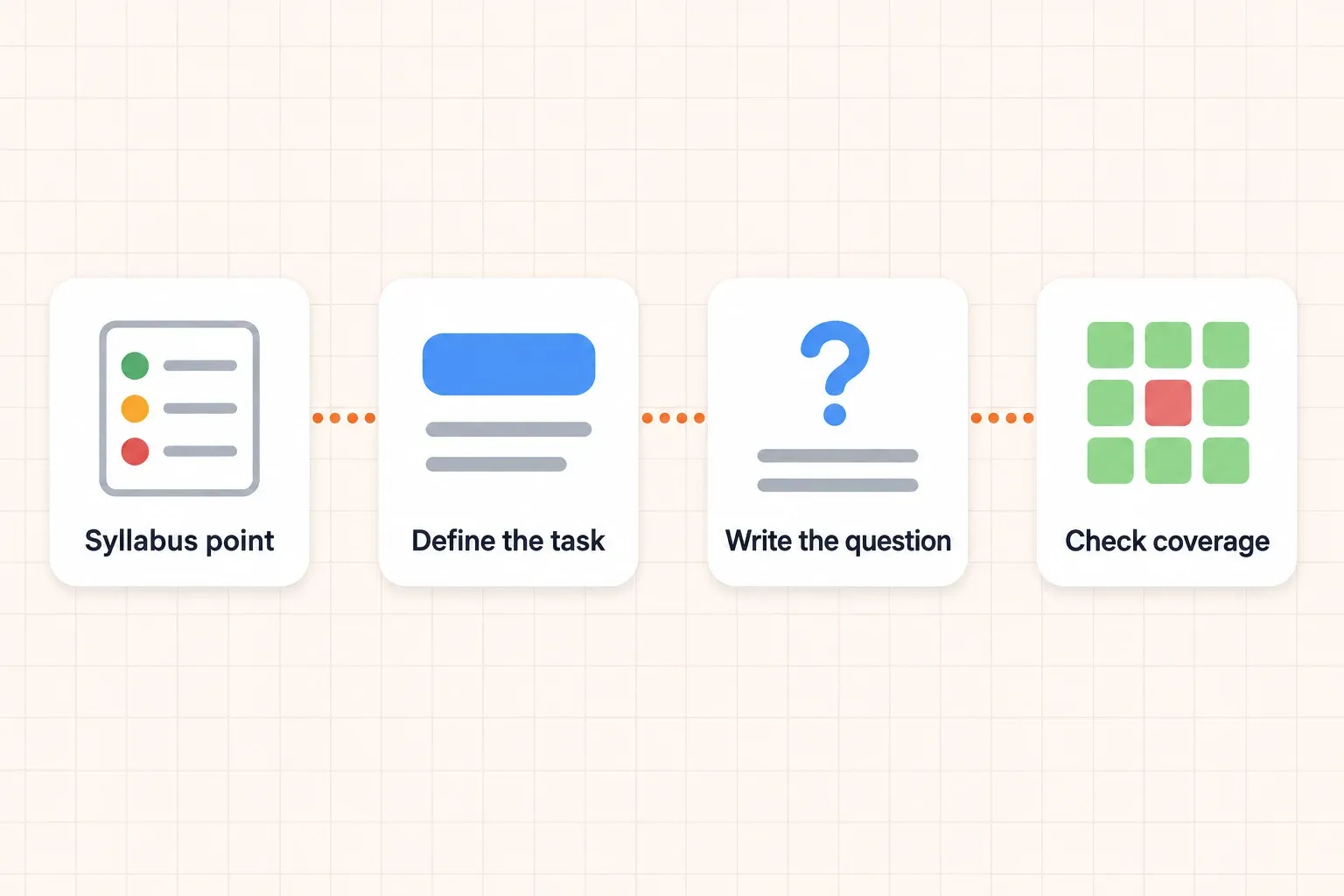
Use this sequence:
- Extract the examinable topic or outcome.
- Identify the action the course expects you to perform.
- Add the condition, comparison, evidence, or limit that makes the prompt specific.
- Write a question you can answer without looking at the source.
- Check the answer against the course material and mark its review status.
The goal is not to rewrite the syllabus as a longer document. It is to create a coverage map that tells you what to practise and where your answers still break down.
Read the syllabus as a coverage map
Start by copying the syllabus into a working document or table. Keep the original unchanged, then separate each line into the part that defines the scope and the part that suggests how you may be assessed.
For each topic or outcome, extract:
- The topic: What concept, process, text, case, or problem type is included?
- The action: Are you expected to define, describe, explain, compare, calculate, analyse, or apply it?
- The boundaries: Which period, population, formula, theory, source, or example limits the topic?
- The evidence: Which studies, quotations, diagrams, data, or worked examples belong with it?
- The assessment clue: Does the syllabus mention an exam section, practical task, essay, or problem set?
This prevents a common mistake: treating every line as the same kind of knowledge. A definition, a process, and an application need different questions.
Separate course administration from study content
Not every line in a syllabus belongs in your question bank. Deadlines, attendance rules, reading instructions, office-hour details, and grading policies matter, but they are usually reminders rather than material you need to practise for the exam.
Keep two lists:
- Course logistics: dates, submissions, required readings, assessment rules, and questions for the instructor.
- Study scope: terms, concepts, processes, methods, examples, and outcomes that you may need to demonstrate.
This keeps the question bank focused. You can still link a study question to a reading or lecture, but you do not need to turn a submission deadline into a flashcard.
| Syllabus wording | Question to write |
|---|---|
| Define the main terms in a theory | What does each term mean, and what distinguishes it from a related term? |
| Explain the stages of a process | What happens at each stage, and how does one stage lead to the next? |
| Analyse a case using the course model | Which parts of the model appear in the case, and what evidence supports the connection? |
| Solve problems involving a formula | What information is given, which formula applies, and how should the result be interpreted? |
| Evaluate competing explanations | Which explanation is more convincing under the stated conditions, and why? |
Turn one syllabus point into a real question
A useful question is narrower than the topic label but broad enough to test understanding. Add an action and a boundary to the syllabus point. The boundary might be a condition, example, comparison, time period, data set, or practical consequence.
For example, take the syllabus point explain how supply and demand affect price. Possible questions include:
- What happens to equilibrium price when demand increases and supply stays constant?
- Why does a price ceiling create a shortage in this model?
- How would the prediction change if supply became less responsive?
The questions share one syllabus point, but each tests a different relationship. That gives you better coverage than asking the same broad question three times.
Make vague prompts specific enough to answer
A prompt such as "What do I know about photosynthesis?" is too broad to diagnose anything. You could write a page and still not know which part was missing. Add the operation and the limit.
| Broad prompt | More useful version |
|---|---|
| What is memory? | How do encoding, storage, and retrieval differ in this model? |
| Study the French Revolution | What economic and political pressures contributed to the revolution, and how did they interact? |
| Know integration by parts | When should integration by parts be chosen, and how does the method proceed on a representative problem? |
| Understand climate feedback | How does a positive feedback loop amplify an initial change, and what example demonstrates it? |
A prompt is specific enough when you can tell what a complete answer would contain. If two people could answer it with completely different scopes, add a boundary before you put it into the bank.
When a syllabus point is too vague
Words such as understand, know, and be familiar with do not tell you enough on their own. Do not fill in the missing scope by guessing. Check the learning outcomes, lecture headings, assessment brief, past-paper wording, and the examples your instructor used.
If the point is still broad, split it into three questions: one about the central idea, one about the relationship or process, and one about using it in a changed case. That gives you a workable starting set without pretending the syllabus contains details it does not provide.
Use the command word to choose the task
The verb in a syllabus outcome often tells you what kind of question to write. Define usually needs a precise meaning. Describe needs features or steps. Explain needs a cause, mechanism, or relationship. Compare needs a shared basis. Apply needs a new situation. Evaluate needs evidence and a judgement.
Do not treat the command word as decoration. Changing describe to explain changes the answer you must produce. Changing explain to apply means the prompt should include a case or condition where the idea has to be used.
Build questions at more than one depth
One syllabus point usually benefits from more than one question. Create a small progression so you can see whether the problem is missing information, weak explanation, or failure to transfer the idea.
For a topic such as enzyme inhibition, a useful progression could be:
- Recall: What is competitive inhibition?
- Explain: Why can increasing substrate concentration reduce its effect?
- Interpret: What pattern in a graph would suggest competitive inhibition?
- Apply: How would the prediction change if the inhibitor bound irreversibly?
The first question checks the term. The later questions test mechanism, evidence, and changed conditions. You do not need dozens of prompts for every bullet; you need enough variation to reveal what kind of understanding is missing.
How many questions should you write per syllabus point?
Start with two or three questions for a straightforward point: one direct recall question, one explanation or interpretation question, and a changed-condition question when the topic supports it. Add more only when the outcome contains several distinct parts or your answers reveal different gaps.
Stop when new questions repeat the same task with different wording. A small set that covers definition, reasoning, and application is more useful than ten near-identical prompts that make the question bank difficult to review.
Add an answer boundary to every question
A good question tells you when the answer is complete. Add a boundary such as in two causes, using the graph, with one example, for the first two stages, or including the relevant unit.
Answer boundaries make review more honest. If the prompt asks for two causes and you can give only one, the gap is visible. Without the boundary, you may stop after a vague sentence and mark the question as complete.
Connect each question to a course source
The syllabus defines the scope, but it may not contain the explanation, example, or convention your instructor expects. Add a source column to your question bank and record where the answer should come from: a lecture, textbook section, slide, lab handout, assigned paper, or worked problem.
This is also where you catch bad assumptions. A syllabus may say "analyse two theories", while the lecture emphasizes a particular comparison or the textbook uses a different definition. Keep the syllabus as the coverage map, but use the course sources to check the answer. Kwantlen Polytechnic University's learning-centre guide uses the same starting point: build study questions from syllabus topics and course material.
Keep a coverage table while you study
A simple table makes the syllabus-to-question conversion visible:
| Syllabus point | Study question | Source | Status |
|---|---|---|---|
| Topic or outcome | What you must answer | Where to verify it | Not started, attempted, partial, or secure |
Use not started when no question exists yet, attempted when you have answered once, partial when a specific requirement is missing, and secure only when you can answer correctly more than once or in a changed form. The status should reflect what you can answer, not how confident you feel before trying.
Generate questions without losing the syllabus
An AI tool can help expand a syllabus point into definitions, explanations, applications, and changed-condition prompts. The useful workflow is to give it the syllabus point and the relevant course material, ask it to show which source supports each question, and reject anything that introduces a topic outside the course.
Do not ask for a large question bank before deciding what the syllabus line means. A tool can produce many plausible questions from a vague input, but volume does not fix an unclear scope. If you already have lecture notes, you can turn them into quiz questions after defining the syllabus coverage and then check the generated set against your table.
Turn the question list into a revision sequence
The question bank tells you what to practise; it does not decide when you will do it. Group questions by topic, note the source needed for each one, and place the first attempt before the final days of the course. Then leave space to retry partial answers rather than scheduling only first exposure.
If the question list has become a large collection of tasks, build a revision timetable around the questions you need to answer. The timetable should protect time for retrieval and repair, not just time to read each topic once.
Review the questions themselves
A question bank can fail even when it covers every syllabus line. Review each prompt before relying on it:
- Is the topic clearly identified?
- Does the command word match the intended task?
- Is the scope narrow enough to answer?
- Is there a condition, comparison, or evidence requirement where one is needed?
- Could this question appear in the course's assessment format, or does it only test keyword recognition?
- Can the answer be checked against a reliable course source?
- Does the set include more than simple definitions?
For a deeper test of question quality, see how to tell whether a practice question is specific and useful.
A final syllabus-to-question checklist
Before you start a long revision session, confirm that:
- every important syllabus point has at least one question;
- broad outcomes have been split into specific tasks;
- questions use different depths, not only definitions;
- answer boundaries make completeness visible;
- each question has a course source for checking;
- partial answers lead to a new repair question;
- the question list has been placed into a realistic review sequence.
A syllabus becomes useful for studying when it stops being a list you reread and becomes a set of answers you can attempt, check, and improve.