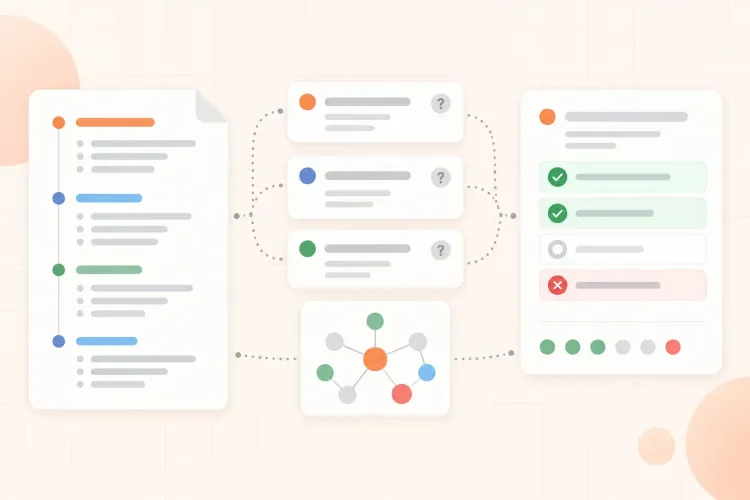

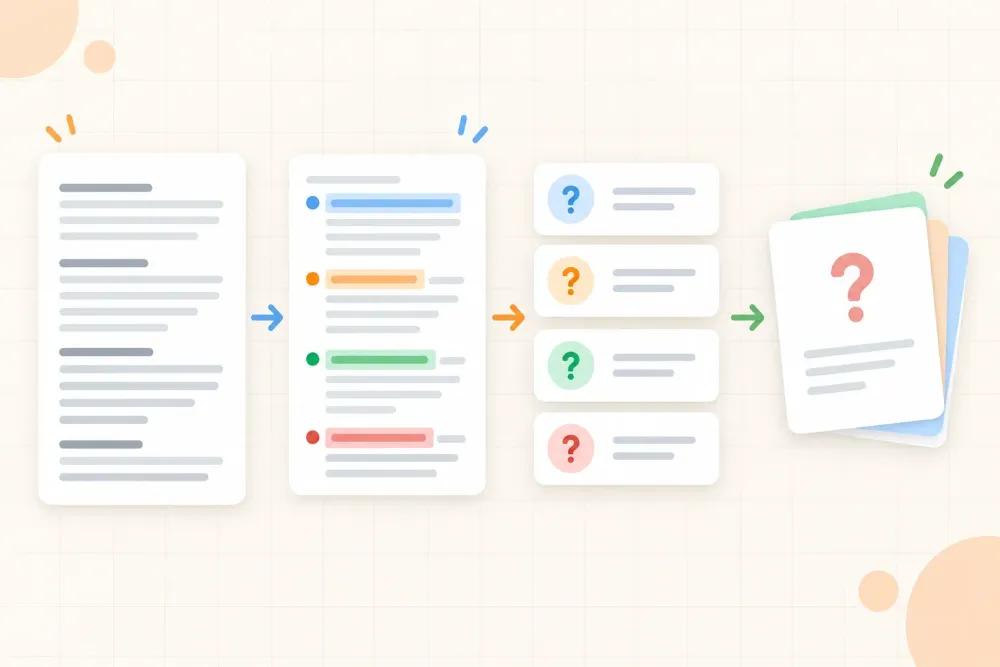
To turn a lecture transcript into recall questions, do not ask for a complete summary and stop there. Use the transcript to find the ideas the lecturer developed, convert those ideas into questions you can answer without looking, and keep the relevant timestamp beside each question so you can check the original explanation.
The finished set should help you do four things: retrieve the main idea, explain how it works, apply it to a new situation, and identify what you still cannot explain. A transcript is useful because it preserves the lecturer's sequence and emphasis, but it is not automatically a study guide. It still contains repetition, filler, unfinished phrases, and details that may not matter for your assessment.
How to turn a lecture transcript into recall questions
Use this sequence after the lecture or recording is finished:
- Map the lecture. Mark the main topic changes, examples, definitions, demonstrations, and moments where the lecturer signals importance.
- Keep the context. Save the timestamp or section heading beside each important idea.
- Write the answer before the question. Reduce each idea to what a good answer would need to explain.
- Choose the task. Ask for a definition, explanation, comparison, prediction, application, or evidence-based judgment.
- Check the question. Make sure the transcript supports one clear answer and that the wording does not give it away.
- Answer with the transcript closed. Then return to the source to check accuracy and repair the gap.
This sequence prevents a common failure: producing dozens of polished questions that are really just headings in disguise. A useful question creates a small act of retrieval. It asks you to reconstruct something, not simply recognize a phrase you have just read.
Can AI turn a lecture transcript into recall questions?
Yes. AI can make a useful first pass by identifying topics, drafting question types, and keeping each question near the transcript section that supports it. It should not decide automatically that every sentence is worth studying or fill missing information from general knowledge.
Give the tool a clear boundary:
- use the transcript as the primary source,
- keep timestamps or section labels beside each question,
- separate what the lecturer said from outside context,
- mark uncertain or unsupported questions for review,
- create a small, varied set rather than one question for every sentence.
The useful output is not the longest question bank. It is a checked set that lets you attempt the lecture with the source closed, then return to the exact passage when an answer is incomplete.
Start with the lecture's structure
Do not begin by treating every sentence as equally important. A lecture usually has a small number of ideas that organize the rest. Find those first.
Look for:
- a question the lecture keeps returning to,
- a concept that is defined and then used in an example,
- a process explained in stages,
- a contrast between two similar ideas,
- a diagram, calculation, demonstration, or case,
- a limitation, exception, or change of condition,
- a phrase that signals importance, such as “the key point” or “notice what happens when.”
Write a short outline before generating questions. For example, a biology lecture might have this shape:
| Lecture section | What to extract |
|---|---|
| Electron carriers | What they carry and where they go |
| Electron transport chain | How electron movement supports the proton gradient |
| Oxygen | Why the final acceptor matters |
| Fermentation | How cells regenerate NAD+ when oxygen is unavailable |
| Exercise example | How the pathway changes under a different demand |
This outline is more useful than a chronological transcript dump. It gives each question a job and makes it easier to notice when the set contains five versions of the same definition but no application question.
Clean the transcript before writing questions
You do not need to rewrite the whole transcript, but you should remove the errors that would distort a question. Make one quick pass for:
- misheard technical terms,
- duplicated lines caused by captions or transcription,
- unfinished sentences that only make sense with the recording open,
- references such as “this diagram” or “the next slide” with no visible context,
- examples that were corrected or qualified later in the lecture.
Keep the original wording available while you clean it. If you are unsure whether a term is wrong, replay the short segment or check the associated slide instead of silently guessing. Mark a doubtful passage as needing verification. A clean-looking transcript is not necessarily an accurate one, and a question built on a transcription error can make later review less reliable.
Preserve timestamps and lecturer context
A transcript without context can flatten a lecture. The same term may be defined early, qualified later, and used in a worked example near the end. Keep a timestamp or a short source label beside each question so you can return to the relevant explanation.
For each selected idea, record:
- the topic or section,
- the timestamp or page reference,
- the key statement in your own words,
- the condition or example that makes it meaningful,
- the question you will answer later.
The timestamp is not decoration. It lets you distinguish a missing fact from a missing explanation. If you can state that oxygen is involved but cannot explain its role at the end of the electron transport chain, you need the part of the lecture where the mechanism was built, not another general definition.
It also helps when a transcript contains recognition errors. A term that looks unusual in the text may become clear when you replay the surrounding sentence, if the recording is available, or compare it with the slide shown at that moment. Treat the transcript as a searchable map of the recording, not as an infallible replacement for it.
Turn one idea into the right question type
The question should match the thinking the lecture asks you to do. Varying the wording is not enough if every question still asks for a short definition.
Definition
Use a definition question when the term itself is necessary for later reasoning.
Lecture idea: Oxygen is the final electron acceptor in the electron transport chain.
Recall question: What role does oxygen play at the end of the electron transport chain?
The answer should include the role, not just the phrase “final electron acceptor.”
Explanation
Use an explanation question when the lecturer built a cause-and-effect chain.
Recall question: Why does the electron transport chain stop supporting oxidative phosphorylation when oxygen is unavailable?
This requires you to connect the missing acceptor to electron flow, the proton gradient, and ATP production.
Comparison
Use a comparison question when the lecture separated two concepts that students often confuse.
Recall question: How does fermentation differ from oxidative phosphorylation in its immediate purpose?
The question is better than “What is fermentation?” because it makes the boundary between the pathways visible.
Prediction
Use a prediction question when the lecture changed one condition.
Recall question: If oxygen becomes available again after fermentation has been supporting glycolysis, what should happen to electron flow and NADH reoxidation?
Prediction questions reveal whether you understand the mechanism well enough to move it beyond the example used in class.
Application
Use an application question when the lecture used a case, graph, calculation, or unfamiliar situation.
Recall question: A cell has plenty of glucose but cannot pass electrons to oxygen. Which part of energy production is directly limited, and why?
The answer must select the relevant process and justify it. That is different from repeating the definition of aerobic respiration.
Once you have the transcript's structure, the same process works with cleaned lecture notes. You can turn lecture notes into questions that test understanding, while keeping the transcript available when a definition or explanation needs checking.
Write the answer before you keep the question
A question is easier to evaluate when you know what a complete answer should contain. Before keeping it, write a short answer outline with two to four points.
For the oxygen example, the answer outline might be:
- oxygen accepts electrons at the end of the chain,
- without that acceptor, electron transfer backs up,
- the proton gradient is no longer maintained effectively,
- oxidative phosphorylation slows or stops, while fermentation may help regenerate NAD+ for glycolysis.
Now check the question against the outline. If it only asks “What is oxygen's role?”, the last three points may be unnecessary. If it asks why oxidative phosphorylation stops, the outline fits. This small check keeps questions answerable and stops one card from trying to test an entire lecture.
Avoid questions that hide the answer in their wording:
- Too obvious: What is the role of oxygen as the final electron acceptor?
- More useful: What breaks down in the electron transport chain when oxygen can no longer accept electrons?
The second question still names the context, but it requires you to reconstruct the consequence.
Check every question against the transcript
Generated questions need a source check. A plausible question can quietly change a condition, combine two separate explanations, or turn a cautious claim into an absolute one.
Use this checklist:
- Supported: Can you point to the sentence, slide, or example that supports the answer?
- Specific: Does the question identify the concept or condition clearly enough?
- Single task: Is it asking for one coherent piece of reasoning rather than a whole chapter?
- Answerable: Does the transcript contain enough information for a correct answer?
- Accurate: Has a transcription error or generated wording changed the meaning?
- Useful: Would missing the answer tell you what to review next?
Delete a question when the source does not support it. Do not fill the gap with background knowledge and present it as if it came from the lecture. If outside context is helpful, label it separately so you know what your course material actually covered.
This is also where timestamps earn their place. When an answer feels uncertain, open the nearby section rather than searching the entire recording. If the lecturer explains a diagram that the transcript describes poorly, use the slide or replay the short segment, if available, before editing the question.

Keep the question set small enough to use
The goal is not to convert every sentence. Start with a compact set that covers the lecture's structure:
- one question for the central question or learning objective,
- one for each major concept or process,
- one comparison for a commonly confused pair,
- one question about a diagram, example, or calculation,
- one prediction that changes a condition,
- one limitation, exception, or boundary,
- one question that combines two related ideas.
For a 50-minute lecture, that might produce 10 to 15 useful questions. The number is not a rule. Stop adding questions when new ones repeat an existing task without exposing a different part of your understanding.
A short, varied set is easier to answer several times across a week. It also makes the error pattern visible. If you miss four questions about mechanisms but answer definitions correctly, the next review should focus on causal links rather than another vocabulary pass.
Answer in stages, then review the misses
Use the questions in three passes:
- First attempt: Answer without the transcript. Write enough to show the relationship, sequence, or condition, not just a keyword.
- Source check: Compare your answer with the relevant timestamp. Mark a missing fact, missing connection, wrong condition, or unsupported claim.
- Changed question: Try a new version that changes the example, order, or condition.
This answer-first sequence follows the same principle described in the Open University's guidance on reviewing what you know: try to recall the material before returning to your notes, then use the result to decide what needs attention.
Suppose you answer “Why does oxygen matter?” with “It is used in respiration.” That answer shows topic recognition but not the mechanism. Return to the timestamp, add the missing chain, then answer a changed question such as “What would happen to the proton gradient if oxygen became unavailable?”
If the transcript comes from a YouTube lecture, you can turn the video into study-ready notes before selecting the questions you want to practice. Keep those notes tied to the original transcript and timestamps, then make your own first attempt before reading the explanation.
Common mistakes with transcript-based questions
Turning every sentence into a question
This creates noise. Select ideas that organize the lecture, explain a process, distinguish concepts, or support an assessment task.
Removing all spoken context
A clean definition may lose the example or condition that made the idea understandable. Keep the context that changes how the answer should be used.
Asking only “what” questions
Definitions are useful, but a lecture often matters because it explains why, how, or under what conditions something happens. Add explanation, comparison, prediction, and application questions.
Trusting a generated answer without checking it
A fluent answer is not evidence that the transcript supports it. Check the source, especially for numbers, exceptions, causal claims, and technical terms.
Reviewing the same wording immediately
If you recognize the question but cannot answer a changed version, the wording may be doing too much of the work. Change the case or condition before deciding that the idea is secure.
Keeping questions you cannot diagnose
If a question covers five ideas, a wrong answer does not tell you which part failed. Split it into smaller questions with answer outlines you can check.
A final quality check
Before adding a transcript question to your review set, ask:
- Can you answer it without seeing the transcript?
- Does it test a specific idea rather than a whole lecture?
- Is the answer supported by the recording, slides, or notes?
- Does the question require more than recognizing a phrase?
- Is the timestamp close enough to verify the explanation?
- Would a wrong answer tell you what to revisit?
- Can you write a changed version that tests the same idea?
A transcript becomes useful study material when it helps you retrieve the lecture's reasoning, not when it simply gives you a cleaner copy of what was said. Select the idea, keep its context, ask for a real mental task, check the source, and retry the part that did not hold.