

Textbooks are useful because they contain explanations, examples, diagrams, and practice material in one place. They are also easy to study badly: reading page after page, highlighting too much, and finishing with the feeling that the chapter looked familiar.
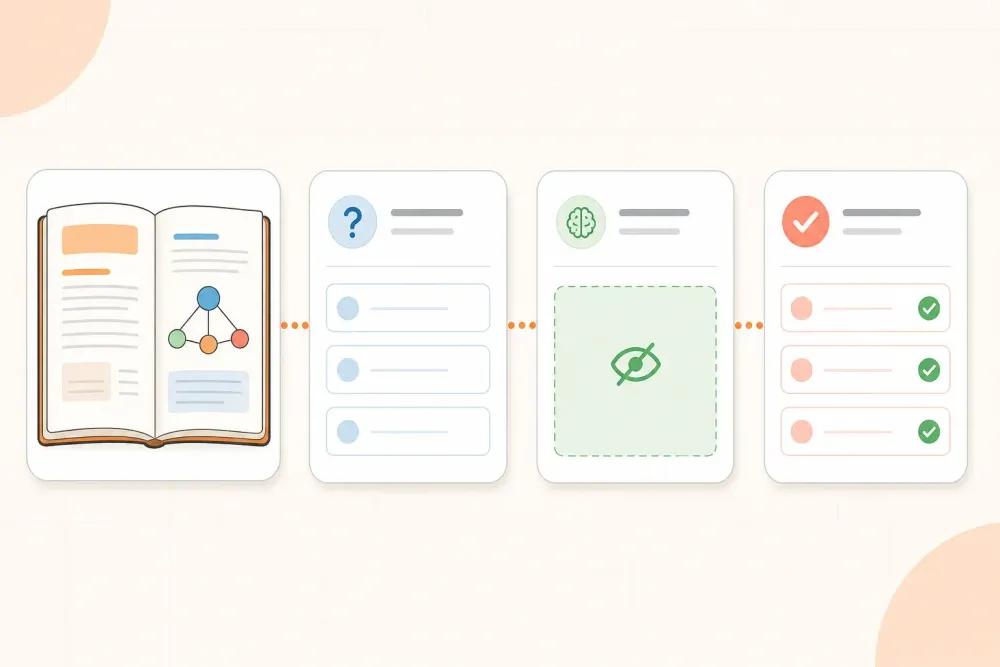
To study from a textbook effectively, give each section a job. Preview the chapter, turn headings into questions, read to answer them, close the book and retrieve the main idea, then return only to the parts you could not explain. This keeps the textbook as a source for understanding rather than a script you repeatedly reread.
How to study from a textbook effectively
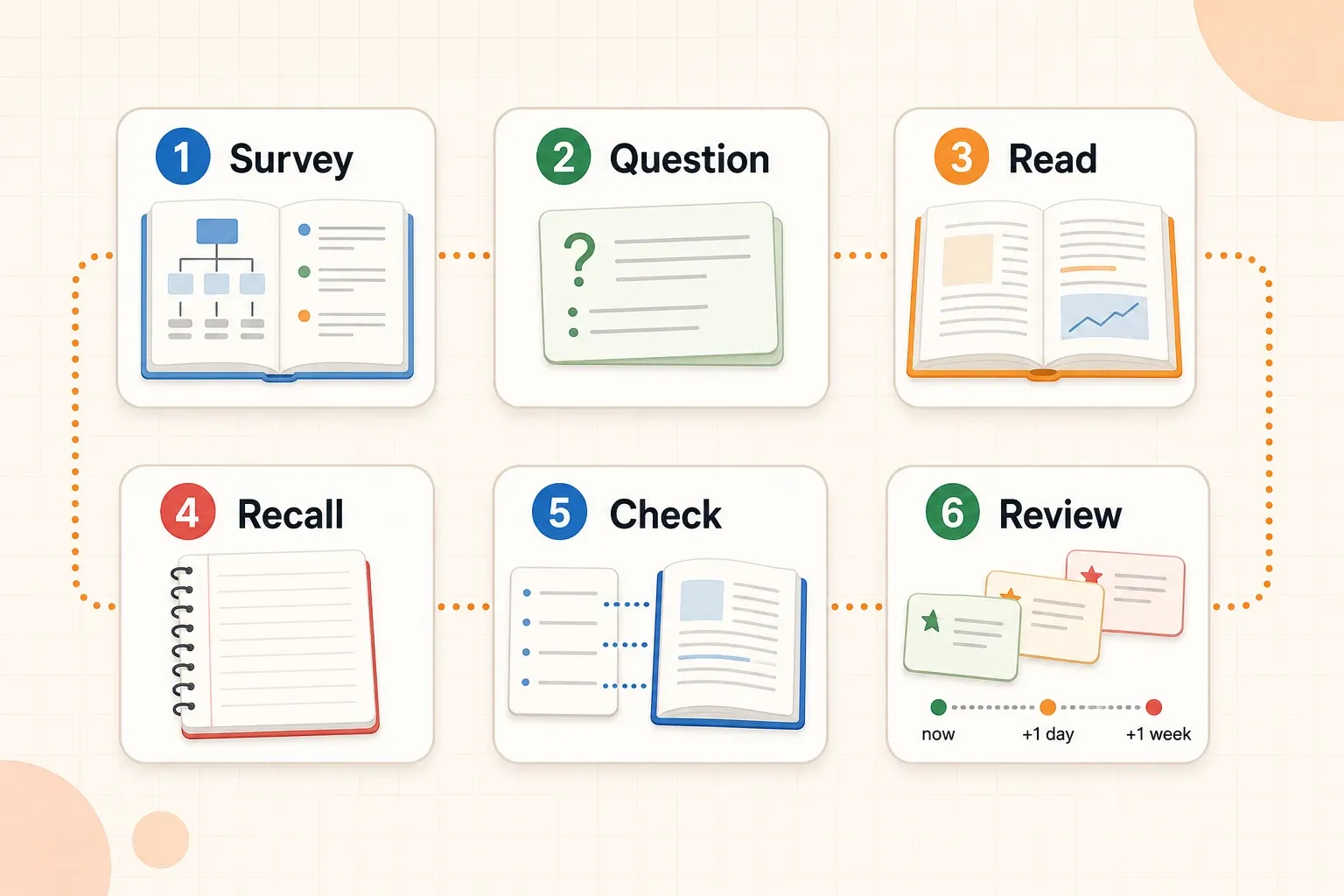
Use this loop for each chapter or assigned section:
- Survey the structure. Read the title, headings, summary, diagrams, tables, and end-of-chapter questions.
- Set questions. Turn important headings into questions you should be able to answer after reading.
- Read for those answers. Look for the explanation, conditions, examples, and relationships that answer each question.
- Close the book. Explain the section in your own words or write what you remember before checking.
- Repair the gaps. Reopen only the pages needed to correct an incomplete or inaccurate explanation.
- Review later. Return to the questions after a gap and answer them without the book open.
This is close to the SQ3R reading system: survey, question, read, recite, and review. The useful part is not memorizing the acronym. It is changing the order from “read everything, then hope it stayed” to “set a purpose, retrieve, and use the result to decide what needs another look.” Cornell’s SQ3R textbook-reading system describes a similar structured pass through a chapter.
Start with the chapter map, not the first paragraph
Before reading closely, spend a few minutes finding the shape of the chapter. Look at:
- the chapter title and learning objectives;
- main headings and subheadings;
- bold terms, definitions, and summary boxes;
- diagrams, graphs, worked examples, and captions;
- the chapter summary and review questions.
You are not trying to learn the material during this pass. You are building a map of what the chapter is trying to explain and where the difficult parts might be.
This first look also helps you decide whether the textbook should be your main source. If the chapter follows the course closely, it can provide the main explanation. If the lecturer, syllabus, or exam guide emphasizes different topics, use those signals to decide which sections deserve the most attention.
Turn headings into questions
Headings are often compressed learning objectives. Turn them into questions before reading the section below them.
| Textbook heading | Study question |
|---|---|
| The stages of cellular respiration | What happens in each stage, and how are the stages connected? |
| Types of market structure | How does each market structure affect competition and pricing? |
| The structure of an argument | What makes an argument convincing rather than merely descriptive? |
| Solving quadratic equations | How can you decide which method to use, and how can you check the result? |
A useful question asks you to explain, connect, distinguish, or apply something. “What is this section about?” is usually too broad to guide your reading. “Why does this process need oxygen?” or “When would this method fail?” gives you something specific to find and later retrieve.
Keep the question separate from the answer. If you write both together while looking at the page, you create a neat note but remove the opportunity to test yourself later.
Read in answer-sized sections
Do not decide that a whole chapter is one study unit. A section ending at a clear heading, worked example, or diagram is often a better stopping point.
As you read, look for four things:
- the main claim or rule;
- the reason, mechanism, or relationship behind it;
- an example that shows how it works;
- a condition, exception, or limitation.
Reading for an answer does not mean scanning until you find a sentence that matches your question. Follow the explanation around it: identify what causes the result, how the example demonstrates it, and which condition would change it. Mark a page reference or write a short cue, then keep reading until you can explain the point in your own words.
For a worked example, cover the solution before reading it. Identify what the question gives you, what it asks for, and which method you would try. Then compare your approach with the book's method. If you read the solution first, it can feel obvious without showing whether you could choose the method independently.
Use diagrams, tables, and examples as information
Textbook visuals are not decoration. A diagram may show a sequence, hierarchy, cycle, or relationship that is difficult to retain from prose alone.
For each important visual, ask:
- What does each part represent?
- What changes from one stage to the next?
- Which arrows, labels, or comparisons carry the meaning?
- Can you redraw or explain the visual without looking?
Try a blank-page reconstruction when the diagram represents a process or system. Draw the rough structure from memory, label the parts you know, and then check the textbook for missing or misplaced elements. The purpose is not artistic accuracy. It is to find which relationship or sequence is still unclear.
For a table, cover one column and explain how the entries relate. For a graph, describe the trend, identify the variables, and explain what the pattern does and does not show. This turns looking at a visual into an act of interpretation.
Take notes that preserve the reasoning
Textbook notes should make later retrieval easier, not reproduce the chapter in a smaller font. A useful note usually contains:
- the question the section answers;
- a short explanation in your own words;
- one example or application;
- a connection to a nearby idea;
- a question or uncertainty to check later.
If your notes are becoming long, stop and ask whether they are recording a decision or merely storing the source. You can always return to the page. The note should help you reconstruct the idea without requiring another full read.
For a dense chapter, keep a simple three-part margin system:
- Core: the idea or rule you need to explain;
- Connection: how it relates to another topic or example;
- Gap: what you cannot yet explain or apply.
This is especially useful when the textbook introduces a process over several pages. A single paragraph may define a term, while a later example shows why the term matters. Your notes should connect those parts rather than treating every page as a separate fact list.
Close the textbook and retrieve the section
After a manageable section, close the book. Answer the question you created, explain the main idea aloud, or write a short reconstruction from memory.
Your first attempt does not need to be polished. It needs to reveal what you can produce without visual support. Then compare it with the textbook and mark the difference:
- Missing: an idea, step, condition, or label did not appear;
- Unclear: you remembered the term but could not explain the relationship;
- Inaccurate: the explanation, sequence, unit, or example was wrong;
- Secure: you could explain and apply the idea without checking.
Only the first three categories tell you to reopen the source. Read the relevant passage, correct your explanation, and close the book again. Avoid turning the check into another full chapter reread.
This is where the textbook workflow becomes active recall: answer first, then check. The textbook supplies the explanation, but your attempt to reconstruct it shows whether the explanation is usable. The Learning Scientists describe a similar answer-first approach in their Be Your Own Teacher guide: generate questions, answer without looking, and use the comparison to find what needs more work.
When to review a textbook chapter
Do not wait until you have finished the whole book before returning to the questions. Review the chapter at three useful points:
- At the end of the section: close the book and retrieve the explanation while the structure is still fresh.
- The next day: answer the chapter questions again without rereading first, then repair only the gaps that return.
- Before the assessment: mix questions from this chapter with questions from earlier chapters so you practice choosing the relevant idea, not just remembering the chapter order.
The review does not need to repeat the entire reading session. Its purpose is to test whether you can reconstruct the chapter without the page layout in front of you. Once you can answer a question correctly and explain it on two attempts, deprioritize it and spend the next review on an unresolved process, distinction, diagram, or application.
What to do when the textbook is too dense
Some chapters are hard to navigate on a first pass, full of unfamiliar terms, or much longer than the time you have. Do not respond by highlighting every sentence or abandoning the chapter entirely.
Use a two-pass approach:
Pass one: build orientation
Read the introduction, headings, summaries, key diagrams, definitions, and one representative example from each major section. Write the questions you need the chapter to answer and mark the sections that remain confusing.
Pass two: repair the important gaps
Return to the sections that are central to the course, required for later topics, or likely to appear in assessment. Read them carefully, work through the examples, and retrieve the explanation without looking.
This does not mean skipping randomly. Use the syllabus, lecturer guidance, learning objectives, review questions, or known assessment requirements to decide what deserves the second pass. If you need to work from a long digital book or scanned chapter, you can make a PDF easier to study, but keep the same answer-first and retrieval steps.
Textbook questions are practice material, not just homework
End-of-chapter questions often reveal what the author considers important. Use them in stages:
- Read the question and identify the skill or concept it tests.
- Attempt it without looking at the worked solution.
- Show enough reasoning to expose your method.
- Check the solution and classify the first point where your approach changed.
- Write a short correction or a new question that tests the same idea.
For conceptual questions, answer in complete reasoning rather than a keyword. For calculations, show the setup and units. For application questions, explain why the example fits the concept instead of only naming the concept.
If the textbook has many review questions, do not answer every one in the same order. Start with a small sample from different sections, then use your errors to choose what to practice next. This gives you evidence about coverage without spending all your time on the easiest examples.
Turn one chapter into a review set
At the end of a study session, you should have more than a highlighted chapter. Create a compact review set with:
- five to ten section questions;
- two or three process, diagram, or relationship prompts;
- one application question that changes the context;
- a short list of terms or steps you could not retrieve;
- page references for the gaps you need to repair.
For example, after studying a chapter on cell respiration, your review set might ask you to explain the role of oxygen, reconstruct the stages in order, compare aerobic and anaerobic pathways, and predict what changes when one condition is removed. Those prompts are more useful than a page of copied definitions because they ask you to rebuild the chapter from different starting points.
If the source is already in your notes, you can turn your checked notes into quiz questions after confirming that they are accurate. Keep the questions tied to the textbook's sections and examples rather than generating a large set that you will never review.
A textbook study session that produces evidence
Finish the session with four concrete outputs:
- A small question set: questions from the headings, learning objectives, diagrams, and end-of-chapter exercises.
- A retrieval record: the explanations, processes, or applications you could produce with the book closed.
- A repair list: the first missing, unclear, or inaccurate element in each weak answer, with the relevant page reference.
- A later review point: the questions and gaps you will answer again after a delay.
The important output is not the number of pages you covered. It is the evidence you produced about what you can explain, apply, and still need to revisit.
Common textbook-study mistakes
Avoid these habits:
- reading the chapter from start to finish without setting questions;
- highlighting definitions without explaining their role;
- copying worked examples instead of attempting the setup;
- making notes so complete that you never practice from them;
- treating every page as equally important;
- checking the answer before making a real attempt;
- reopening the whole chapter for one small gap;
- finishing the chapter without keeping questions for later retrieval.
Textbooks work best when they alternate between explanation and production. Read enough to understand the idea, close the source, try to reconstruct it, and use the gap to choose your next action.
The goal is a usable understanding of the chapter
Studying from a textbook effectively does not mean reading faster or filling more pages with notes. It means turning the chapter into questions, explanations, examples, and later retrieval attempts.
Use the textbook to build understanding, close it to test what you can produce, and return only to the parts that need repair. By the end of a session, you should know not just what the chapter contains, but which ideas you can explain without it and which ones need another deliberate attempt.