

It can take only a few seconds to fall behind in a lecture: the instructor changes slides, introduces a new term, and you are still trying to finish the previous sentence. The natural response is to type faster or copy the slides word for word. That usually makes the problem worse because your attention moves from understanding the explanation to keeping up with the page.
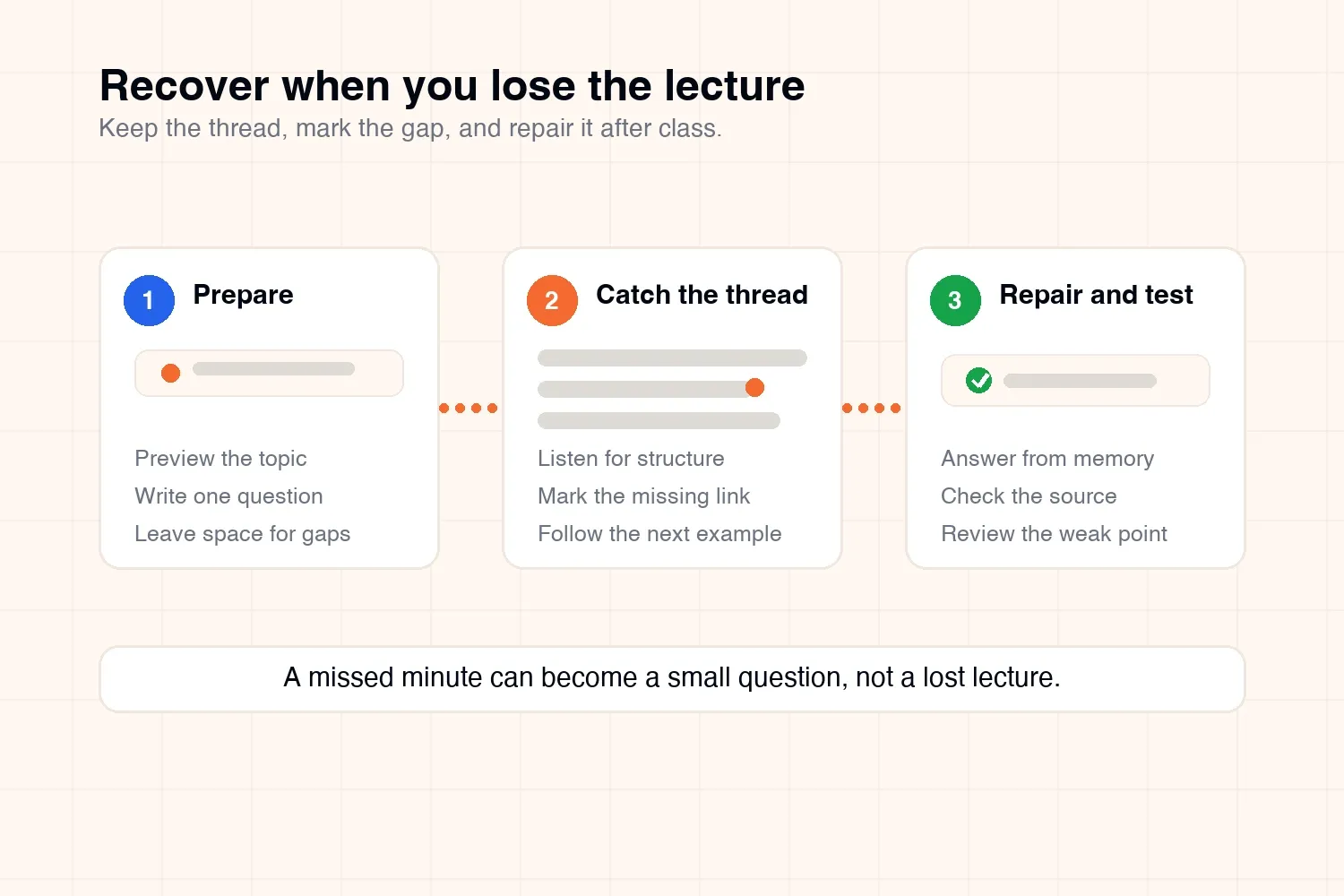
A better approach is to follow the lecture's main line instead of collecting every sentence. Before class, give yourself a small map. During class, capture main ideas, examples, and questions. When you miss something, mark the gap and continue. After class, use the source and a short recall check to repair only what matters.
What to do when you feel lost in a lecture
Use this 30-second reset instead of trying to reconstruct the last five minutes while the lecture continues:
- Stop writing full sentences.
- Write the current topic or slide heading.
- Add one short phrase for the main idea.
- Mark anything unclear with a question mark or a two-word note.
- Rejoin the lecture at the next example, summary, or transition.
You are not abandoning the missing explanation. You are preventing one missed moment from turning into a missed lecture. A placeholder such as `? why does resistance increase here` is more useful than a blank page and less distracting than ten rushed lines.
How to keep up during lectures: a simple before, during, and after system
Use each stage for one clear purpose: prepare a map before class, choose what matters while listening, and repair gaps before they spread.
1. Prepare a small map before class
Spend five minutes looking at the syllabus, assigned reading, previous notes, or the first slide. You do not need to learn the material in advance. You only need to identify the topic, the vocabulary you already recognize, and one question you expect the lecture to answer.
Label your notes with the course, date, lecture topic, and source. Then leave room for additions or questions. This gives you a clear place to put new information once the lecture begins.
2. Listen for the lecture's structure
Do not treat every sentence as equally important. Listen for transitions, repeated terms, examples, contrasts, definitions, and conclusions. Phrases such as `the key point`, `in contrast`, `for example`, or `what this means` often tell you how the explanation is organized.
The University of Waterloo's guidance on active listening makes a similar distinction: notice what is repeated, what is new, and what the instructor emphasizes rather than trying to capture every word. Read the active-listening cues if you want a fuller checklist.
A useful note has at least one of these purposes: it records a central idea, preserves an example that makes the idea concrete, shows a relationship between concepts, or captures a question you need to resolve. If a line does none of these, it probably does not need to be captured word for word during class.
3. Use compact notes instead of a transcript
Write in fragments, symbols, arrows, and short labels. For example:
- `enzyme binds substrate -> active site changes shape`
- `example: competitive inhibitor`
- `? why does temperature stop helping after optimum`
The goal is not to create polished notes while the instructor is speaking. The goal is to leave yourself enough structure to reconstruct the explanation later. You can clean up the language after class, when you have time to think.
If your notes are mostly copied slide text, add one line that answers: `What was the instructor trying to explain with this?` That question turns a visual reference into a learning cue.
4. Mark gaps without stopping the lecture
Use a consistent marker for anything you did not understand: a question mark, `CHECK`, or a colored dot. Add just enough context to find the gap later. `? step 2 in proof` is useful. `confusing` is not.
There are three common kinds of gaps:
- Missing fact: you do not know a term, formula, date, or definition.
- Missing connection: you know both ideas but not how one leads to the other.
- Missing example: you understand the rule in theory but cannot recognize it in a problem.
Naming the gap makes the later repair faster. It also stops you from treating the whole lecture as unclear when only one link in the explanation is missing.
5. Repair the gaps soon after class
Later the same day, or within 24 hours, return to the marked questions while the lecture is still fresh. First, try to answer each question from memory. Then check the slides, textbook, recording, or your instructor's explanation. Add a short correction, not a second transcript.
For a difficult concept, use this repair format:
- What was the question?
- What can you explain without looking?
- What does the source add or correct?
- Can you give a simple example now?
This turns a live lecture into material you can review. To turn organized lecture notes into questions, you can clean up and test your notes with an AI-assisted workflow, while keeping the original source available for checking.
What to do if you missed an entire lecture
When you miss a class, do not begin by reading every slide from the beginning and highlighting everything. Start with the lecture title, learning objectives, assigned material, and any notes from a classmate. Build a five-line outline first: the topic, the first main concept, the second main concept, one important example or formula, and the question that remains unresolved.
Then identify the parts that are likely to affect the next assignment or lecture. Ask a classmate, teaching assistant, or instructor about those specific gaps. A focused question such as `The definition is clear, but why does the model change in this case?` is easier to answer than `What happened in the lecture?` If the pace or format keeps creating the same problem, ask the instructor or your accessibility office what support is available.
If you have a recording or transcript, use it to locate the missing explanation rather than watching passively from start to finish. Use recordings or transcripts only when your instructor and institution allow them. Pause at transitions, write one question per segment, and test yourself before replaying the answer.
A realistic 50-minute lecture example
Imagine a biology lecture on membrane transport. Before class, you write down three prompts: what moves across the membrane, what drives the movement, and how active transport differs from diffusion.
During class, you capture the main contrast, one diagram, and the instructor's example of a sodium-potassium pump. When the explanation moves quickly through the energy step, you write `? ATP change -> pump direction` and continue. After class, you answer the question from memory, check the diagram, and add a two-sentence explanation. Finally, you write four practice questions and circle the one you still cannot answer.
You did not create a perfect transcript. You created a map of the lecture, repaired one visible gap, and left yourself a way to find the next weak point.
Common mistakes that make lectures feel harder
Trying to write everything
Trying to transcribe a lecture live can compete with listening. Capture the idea, its relationship to the previous idea, and one example. The exact wording can be checked later if it matters.
Waiting until the end to ask what was confusing
A vague note becomes harder to repair as details fade. Mark the exact point of confusion while you still know where it appeared.
Rereading notes without testing them
Recognition can make notes feel familiar without showing whether you can explain them. Close the source and answer a few questions before looking back. For a deeper explanation of why this matters, see why testing yourself beats rereading.
Using AI to replace attention during class
AI can help organize notes, clarify a marked question, or create practice prompts after the lecture. It may help identify repeated ideas in a transcript, but it cannot replace your attention during class or reliably judge what mattered in context. Keep the source, verify important explanations, and use AI to support the repair step rather than to outsource the entire lecture.
A compact lecture checklist
Before class:
- Preview the topic and write one question.
- Label the notes and leave space for gaps.
During class:
- Follow the structure, not every sentence.
- Capture main ideas, examples, and relationships.
- Mark a gap in a few words and keep listening.
After class:
- Answer marked questions before checking.
- Repair only what is missing or wrong.
- Turn the weakest ideas into practice questions.
The goal is not to feel perfectly caught up at every second. It is to keep enough of the lecture's structure that you can recover quickly, identify what you do not understand, and practice those weak points before the gaps grow.