
Finals feel hard when the problem is not just the exam. It is the volume: weeks of slides, PDFs, lecture notes, textbook chapters, practice questions, and half-remembered topics all competing for attention.
The way through is not to reread everything from the beginning. When there is too much material, the job is to triage: decide what matters most, turn it into practice, and review the gaps that are most likely to cost points.
A good finals plan answers three questions quickly: what is on the exam, what is weakest, and what will be practiced today. If a study session does not answer those questions, it usually turns into busy work.
First, shrink the material
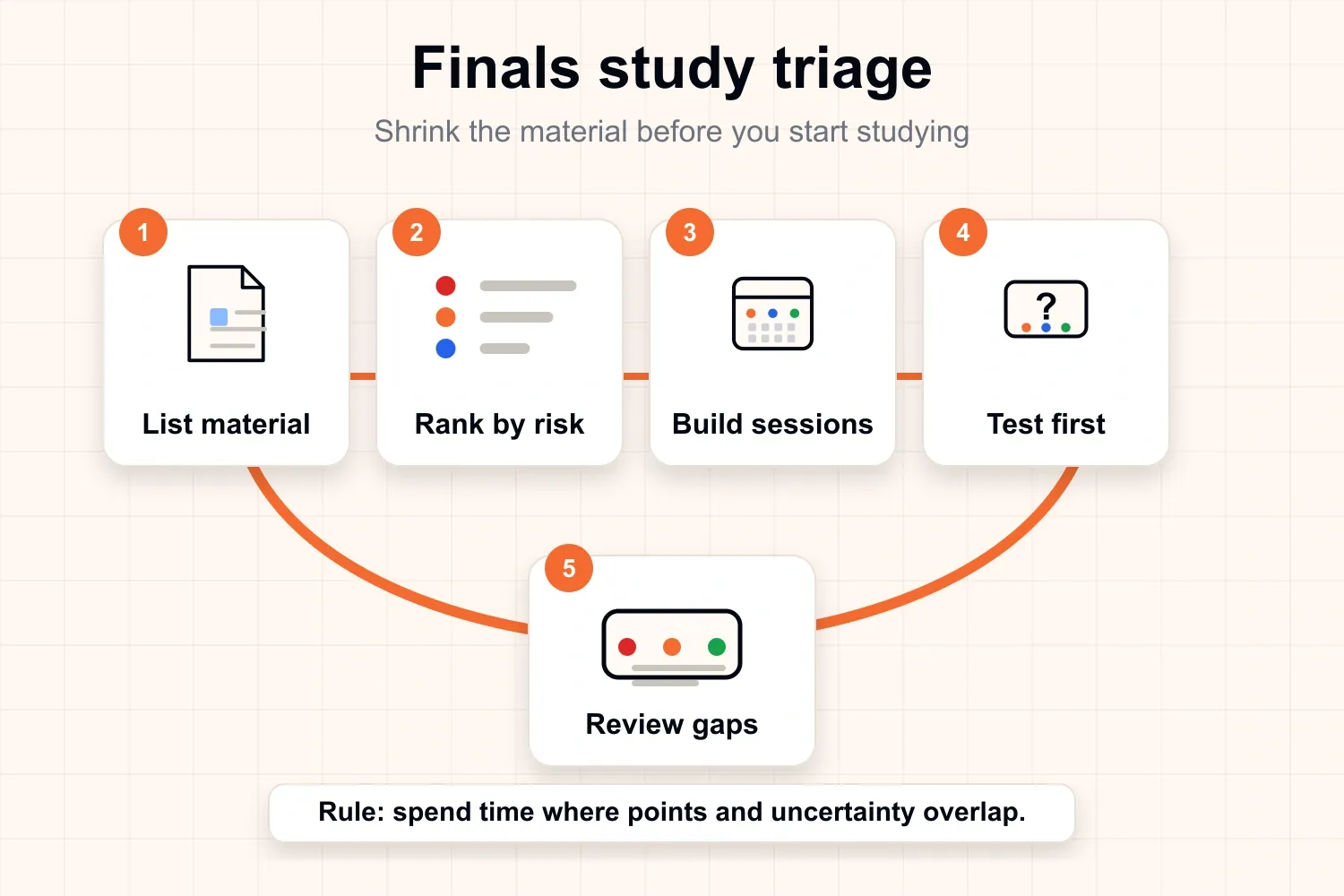
Before studying, make the exam smaller on paper. Start by writing every possible exam topic in one list, then mark each topic as high, medium, or low risk based on points and confidence.
Use the syllabus, revision guide, lecture titles, assignment topics, past quizzes, textbook chapters, and any instructor hints. Do not rewrite the notes yet. Just list the topics.
Then mark each topic with three simple signals:
- Points: how likely it is to matter on the exam.
- Confidence: how well it can be explained or solved without help.
- Source: where the best explanation, examples, or practice questions are.
This turns a vague feeling of being behind into a map. Some topics are important and weak. Some are important but already familiar. Some are low value and should not steal the whole week.
A practical rule: study where points and uncertainty overlap.
Build a finals priority list
Once the material is listed, sort it into three groups.
| Priority | What it means | What to do |
|---|---|---|
| High | Likely on the exam and still weak | Practice today |
| Medium | Likely on the exam but partly understood | Review after high-priority topics |
| Low | Unlikely, already strong, or too detailed | Skim only if time remains |
This is where many students lose time. They start with the first lecture because it feels organized, or with the easiest topic because it feels productive. Finals prep needs the opposite: the most valuable weak topics come first.
If the exam is cumulative, do not treat every week of class equally. Recent lectures, repeated themes, homework patterns, lab reports, and past test mistakes often reveal what deserves more attention.
If you have multiple finals
When several finals are close together, do not split time evenly by default. Rank each exam by date, difficulty, and weight. The next exam matters, but so does the exam most likely to lose points if it is ignored.
Use a simple rule: protect more time for high-risk exams, then rotate lighter review around them. If you have five study days and three subjects competing for attention, the first pass might look like this:
| Subject | Situation | Plan |
|---|---|---|
| Biology | Exam in four days, high weight, weak confidence | Daily block on past mistakes and likely diagrams |
| Math | Medium confidence, problem-solving exam | Three problem sets, then one timed mixed set |
| History | Later exam, mostly memorization | Short daily recall until Biology is stable |
The point is not to make a perfect timetable. It is to stop giving equal time to unequal risks.
Use a short study plan, not a giant schedule
A finals plan should be specific enough to use today and flexible enough to survive reality.
Cornell's Learning Strategies Center recommends a five-day study plan built around chunking material, preparing a new chunk, and reviewing earlier chunks across several days. The useful idea is not that every exam requires exactly five days. The useful idea is that finals study works better when material is split into chunks and revisited, instead of saved for one long cram session.
Use this structure:
- Choose the highest-priority topics.
- Assign each topic to a short session.
- Put practice before rereading.
- Leave review space for missed questions.
- Keep the last session for mixed practice, not fresh reading.
A simple three-day version can still work:
| Day | Main job | Output |
|---|---|---|
| Day 1 | Triage and practice the weakest major topics | Gap list |
| Day 2 | Practice medium topics and revisit gaps | Fewer weak questions |
| Day 3 | Mixed test conditions and final fixes | Exam-ready review sheet |
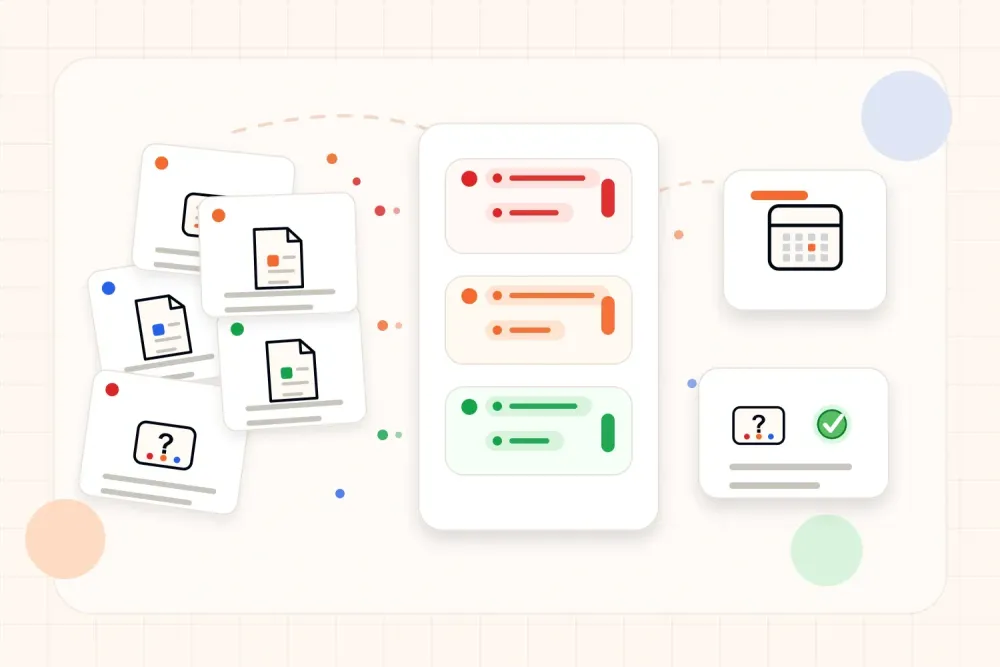
The point is not the exact number of days. Each day should produce evidence: answered questions, solved problems, corrected mistakes, or a shorter list of gaps. The planner example below shows the same idea in practice: exam date, available study time, subject priority, and confidence become a concrete revision plan.

This kind of plan is useful because it turns vague pressure into specific sessions. It still works only if each session includes active practice, not just more reading.
Stop rereading as the main activity
Rereading is tempting during finals because it feels safe. It also hides the problem. A page can look familiar while the answer is still impossible to produce under exam conditions.
Use rereading only as preparation for practice:
- Read a small section.
- Close the source.
- Write or say the answer.
- Check the source.
- Mark what was missing.
That pattern is the same reason active recall matters. Finals do not usually reward recognition. They reward being able to retrieve, explain, compare, calculate, or apply material when the notes are gone.
The Learning Scientists' guide to spaced practice makes the same point from another angle: learning improves when study is spread out and revisited over time, instead of massed into one session. During finals week, spacing can be small, but it still helps to return to weak topics after a delay.
Turn each source into questions
When there is too much material, every source should become a set of questions.
For lecture slides, turn each section title into a question. For example, "Causes of inflation" becomes "What are the main causes of inflation, and how are they different?"
For PDFs or textbook chapters, use headings, diagrams, bold terms, examples, and end-of-chapter questions. If the document is dense, you can generate practice questions from a PDF, then answer without looking before checking the source.
For problem-based subjects, questions should look like tasks:
- Solve this type of equation without notes.
- Explain why this code fails.
- Label this diagram from memory.
- Compare these two theories.
- Apply this formula to a new example.
Good finals questions should feel slightly uncomfortable. If every question can be answered instantly, the session is probably too easy.
Study in short exam-like blocks
A useful finals session does not need to be long. It needs to create the right kind of pressure.
Try this 45-minute block:
- 5 minutes: choose one high-priority topic.
- 10 minutes: review the source just enough to understand the task.
- 20 minutes: answer questions or solve problems without notes.
- 5 minutes: check answers and mark mistakes.
- 5 minutes: decide what to review next.
This is more useful than reading for 45 minutes and hoping it sticks. The session ends with a clear result: correct, incorrect, missing step, confusing definition, thin example, or needs another attempt.
If focus is low, reduce the block to 25 minutes. The method is the same. The important part is closing the source before answering.
Make a gap list, not prettier notes
During finals, notes can become a trap. Making them cleaner feels like progress, but it may not change what can be recalled.
Instead, keep a gap list. After every practice session, write down only what went wrong:
- Forgot definition of opportunity cost.
- Mixed up mitosis and meiosis stages.
- Could not explain why the derivative test works.
- Lost points on units in physics problems.
- Remembered the theory but not the example.
A gap list is more useful than a large summary because it tells tomorrow's session what to do.
| Mistake type | Next action |
|---|---|
| Forgotten fact | Make a quick recall question |
| Confused concept | Explain it in plain language |
| Calculation error | Redo two similar problems |
| Weak example | Create one new example from memory |
| Slow answer | Practice under a time limit |
This also keeps review honest. The goal is not to touch every page again. The goal is to reduce the mistakes most likely to appear on the exam.
What to do if the exam is tomorrow
If the exam is tomorrow, the plan changes. Do not try to learn everything evenly.
Use this order:
- Collect the exam scope and past mistakes.
- Pick the highest-value topics only.
- Practice questions before reading explanations.
- Check answers quickly.
- Make a one-page gap sheet.
- Sleep enough to avoid making avoidable mistakes.
| Do | Skip |
|---|---|
| Practice likely questions | Rewriting full notes |
| Review mistakes and missing steps | Chasing low-value details |
| Make a one-page gap sheet | Watching passive videos for hours |
| Sleep enough to think clearly | Building a perfect schedule |
The one-page gap sheet should contain only what is still fragile: formulas, definitions, examples, steps, or traps. It is not a full summary. It is the final set of items to review before the exam.
If there is still time to plan multiple sessions, build a revision timetable around high-priority topics first, then add lighter review around them.
What to avoid during finals week
Avoid these common traps:
- Rewriting notes without testing anything.
- Highlighting large sections without questions.
- Studying favorite topics first every day.
- Spending hours on low-value details.
- Watching explanations without trying problems.
- Making flashcards and never answering them.
- Planning the perfect schedule instead of starting.
Most of these feel productive because they look organized. But finals prep is not just organization. It is finding out what can be produced under pressure.
A simple finals checklist
Before ending a study session, check:
- Was one high-priority topic practiced?
- Were answers produced without notes?
- Were mistakes checked against the source?
- Is the next weak topic clear?
- Is there a short plan for the next session?
If most answers are yes, the session did its job. If most answers are no, the session may have been too passive.
The takeaway
When there is too much material, the best move is not to read faster. It is to choose better.
List the material, rank it by risk, practice before rereading, and let mistakes decide the next session. A useful finals plan is a filter: it protects time for the topics that matter, tests them under pressure, and turns each mistake into the next action.