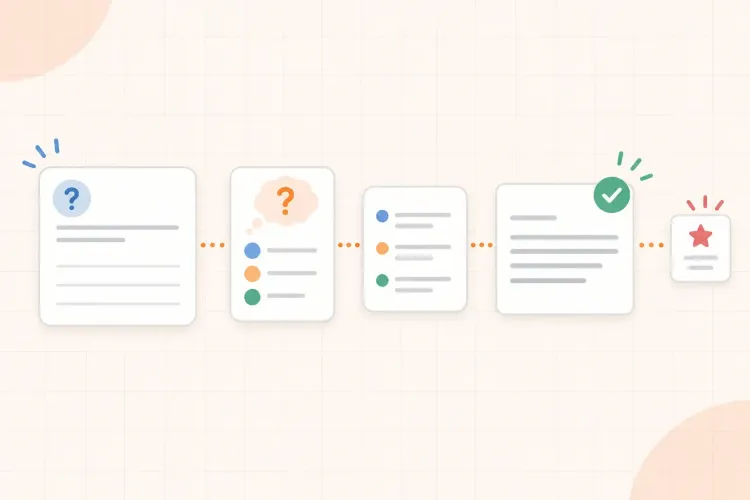

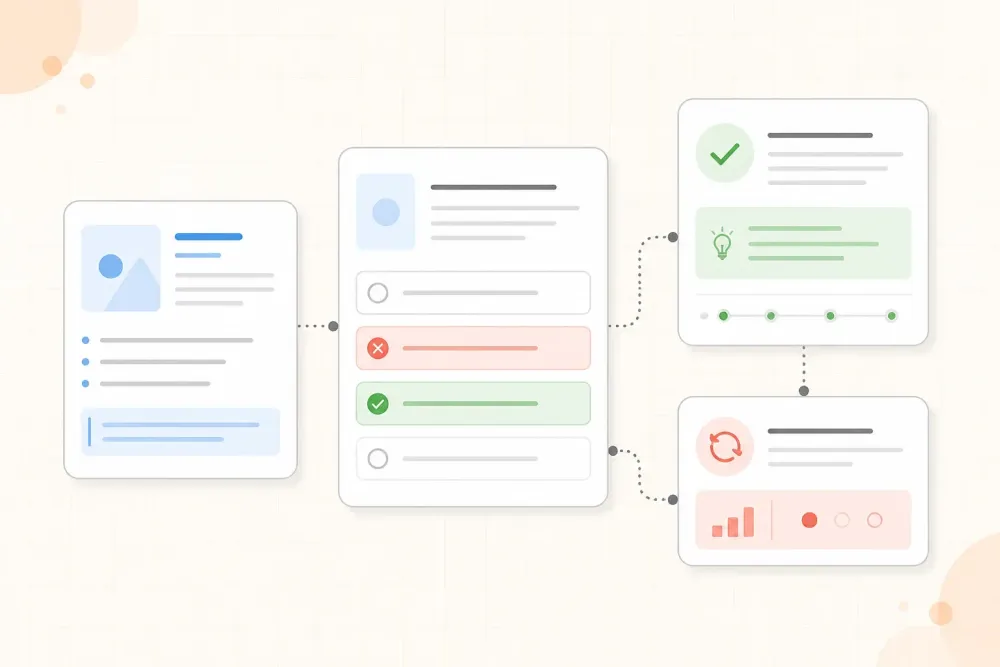
Multiple-choice exams can create a misleading kind of confidence. You recognize a term, the options look familiar, and the answer seems obvious until two choices differ by one condition or the question asks you to apply an idea in an unfamiliar situation.
The solution is not to memorize answer patterns or rely on longer lists of facts alone. Prepare by learning the material well enough to predict an answer before you see the options, then use the options as evidence to evaluate rather than as a set of clues to memorize.
This guide shows you how to study for a multiple-choice exam without memorizing answer patterns. You will learn how to map the course, practice different question demands, analyze distractors, track the reason behind each mistake, and build a final review around the gaps that matter most.
How to study for a multiple-choice exam without memorizing answers
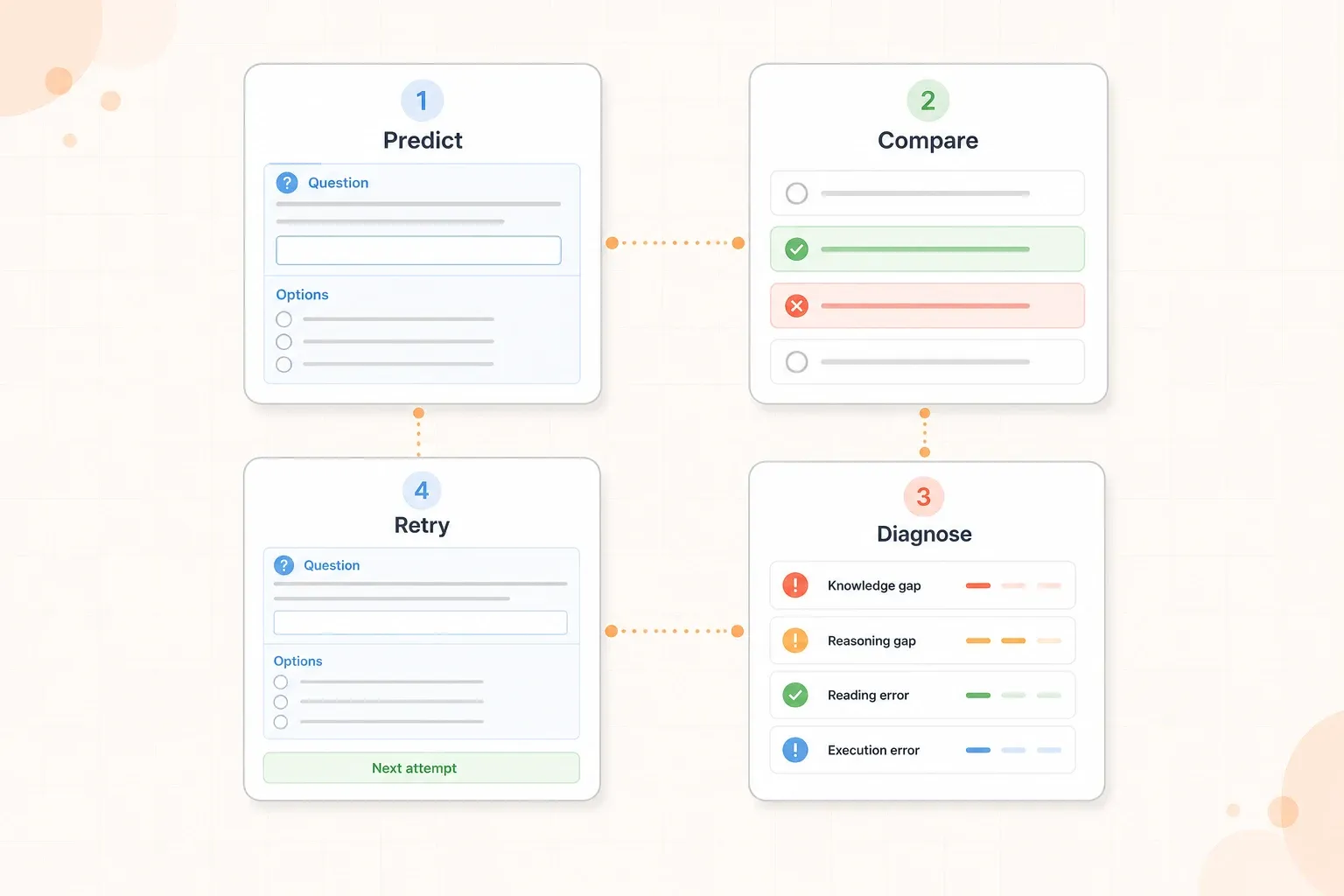
Use this loop for each important topic:
- Identify the idea, process, or problem type being tested.
- Close your notes and predict an answer in your own words.
- Choose the option that best matches your reasoning.
- Explain why the other options do not fit.
- Record the exact reason if you were uncertain or wrong.
- Retry the same idea later in a different question.
This approach trains more than recognition. Multiple-choice questions can test definitions, calculations, mechanisms, application, comparison, and judgment. Your preparation should therefore include questions that make you perform those different tasks rather than a single stack of term-definition cards.
Start with the exam, not a pile of questions
Before you practice, find out what the assessment actually covers. Check the syllabus, learning objectives, lecture headings, tutorials, assignment topics, and any information your instructor has provided about the format.
Write down:
- the topics and subtopics that can appear
- the question types you are likely to see
- whether there is negative marking
- how many questions you must answer and how much time you have
- whether calculations, diagrams, formulas, or reference material are allowed
This prevents a common mistake: practicing whatever questions are easiest to find rather than the skills the exam requires. A biology exam may include vocabulary, process sequences, experimental interpretation, and unfamiliar scenarios. A statistics exam may require choosing a test, reading a result, and interpreting a condition. A history exam may ask you to connect a source to a period, cause, or argument.
The format matters, but do not treat it as permission to study only through options. First understand the course material. Then use multiple-choice practice to test whether you can recognize the relevant concept, distinguish close alternatives, and apply it under constraints.
That distinction matters because multiple-choice questions are not limited to simple recall. Stanford's test-taking guidance explains that the format can assess reasoning, while Oregon State's strategy guide highlights the need to apply familiar concepts in unfamiliar situations. Your practice should therefore include both direct retrieval and changed-condition questions.
Build a topic map with question demands
Turn the course outline into a simple map. For each topic, note what you need to be able to do, not only what you need to know.
| Topic | Basic knowledge | Higher-demand question |
|---|---|---|
| Cell respiration | Define the electron transport chain | Predict what changes when oxygen is unavailable |
| Probability | State the meaning of conditional probability | Choose the correct model for a new scenario |
| Industrialization | Identify major developments and dates | Link a policy to its economic and social effects |
| Research methods | Define reliability and validity | Judge which design best supports a conclusion |
The second column gives you material for short retrieval. The third column tells you where memorization alone is likely to fail. Try to create at least one question for each important topic that changes the condition, introduces an example, or asks you to choose between similar explanations.
If your study material is spread across lectures, PDFs, and notes, you can turn key sections into practice questions. Read the generated questions critically, remove anything unsupported by your source, and rewrite broad or ambiguous prompts before using them.
Predict before looking at the options
Read the question stem first and pause before scanning the answers. Ask yourself:
- What is the question asking you to identify, calculate, explain, or apply?
- What answer would you give in a sentence, phrase, or rough calculation?
- Which condition or qualifier could change that answer?
This is the difference between retrieving an idea and searching the options for something familiar. If you look at the choices first, a plausible distractor can shape your thinking before you have decided what the question means.
Prediction does not need to produce the exact wording of the correct option. It gives you a standard to compare against. If your prediction and the best option differ, stop and investigate the difference rather than assuming the option must be right because it sounds academic.
For example, suppose the question asks what happens to the electron transport chain when oxygen is unavailable. Before reading the options, you should retrieve the role of oxygen as the final electron acceptor and predict that electron flow and oxidative phosphorylation will stop. An option saying that glycolysis stops immediately may sound plausible, but it does not match the full mechanism because fermentation can temporarily regenerate NAD+.
Learn from distractors instead of memorizing them
Distractors are wrong options designed to be plausible. They often represent a common misconception, a reversed relationship, a correct fact applied to the wrong condition, or an answer that is too broad or too narrow.
After each question, classify the distractor you nearly chose, or the reason your correct answer was not secure:
- Wrong concept: You confused two terms, processes, or theories.
- Wrong direction: You reversed a cause, trend, or sequence.
- Wrong condition: The statement can be true, but not in the situation described.
- Incomplete answer: The option mentions part of the explanation but misses the deciding detail.
- Overgeneralization: The option turns a qualified claim into an absolute one.
- Calculation or reading error: Your method was reasonable, but you mishandled a value, unit, graph, or word in the stem.
This classification is more useful than copying the question and answer into an error log. “You chose B” tells you almost nothing about what to repair. “You applied the rule for independent events even though the question described dependent events” gives you a next action.
Use question banks without memorizing the questions
Question banks are useful only when they make you retrieve and apply the material. If you repeat the same item too soon, you may remember its wording, the position of the correct option, or the visual shape of the answer without being able to solve a new problem.
Use each question in three passes:
- Answer it with the choices covered and explain your prediction.
- Compare every option, including the distractors you rejected, and record the deciding condition.
- Revisit the concept later through a changed example, reordered options, or a different question type.
You should still memorize foundational facts, formulas, definitions, and vocabulary when the course requires you to know them. The point is to make those facts available for reasoning, not to memorize that a particular question had answer C. You can remove a question from your retry list when you can solve a new version and explain why the alternatives fail.
Practice the main types of multiple-choice questions
Build variety into your question bank. A useful set includes at least these demands:
Definition and distinction
These questions ask whether you know a term and can separate it from a nearby term. Do not study the definitions in isolation. Write one contrast that shows the boundary between them.
Example: What distinguishes reliability from validity in a measurement?
Mechanism and sequence
These questions test whether you understand what leads to what. Draw the process, then predict the effect of removing or changing one step.
Example: What is most likely to happen if an enzyme's active site changes shape?
Application
These questions place a familiar principle in a new case. Practice identifying the principle before calculating or choosing an answer.
Example: Which sampling method best fits a study of a hard-to-reach population?
Interpretation
These questions use a graph, table, quotation, experiment, or data set. Practice describing what the evidence shows before deciding what conclusion it supports.
Example: Which conclusion is supported by the change in the control group's results?
Evaluation
These questions ask you to judge a method, explanation, source, or claim. Look for the criterion that makes one option better supported than the others.
Example: Which limitation most weakens the conclusion in this experiment?
Mixing these demands stops you from learning one answer format. It also makes your practice closer to the uncertainty of the real exam.
Use confidence as evidence, not as a verdict
Mark how confident you are before checking the answer. A simple scale is enough:
- Certain: You can explain the answer and reject the main alternatives.
- Uncertain: You have a likely answer but cannot explain the distinction clearly.
- Guess: You are choosing because you have eliminated options or recognized a phrase.
Then compare confidence with accuracy. The most important questions are not only the ones you got wrong. A correct answer that you guessed may still represent an unstable topic, while a wrong answer you felt certain about may reveal a deeper misconception.
| Result | What it may mean | Next action |
|---|---|---|
| Correct and certain | The idea is usable | Revisit it later in a different context |
| Correct but uncertain | Recognition is ahead of explanation | Explain the distinction and retry |
| Wrong and uncertain | You need a targeted repair | Check the relevant rule, example, or condition |
| Wrong and certain | Your mental model may be misleading you | Rebuild the explanation from the source |
This is why a score alone is not enough. A percentage can tell you how many items you answered correctly, but not whether you are relying on familiarity, eliminating options mechanically, or applying the wrong rule with confidence.
Review questions by cause, not only by topic
When you finish a practice set, do not simply reread every explanation. Sort the questions by what happened:
- Knowledge gap: You did not know the relevant fact, definition, or relationship.
- Reasoning gap: You knew the pieces but could not connect them.
- Question-reading gap: You missed a qualifier such as “most likely,” “except,” or “under these conditions.”
- Option-comparison gap: You recognized the topic but could not distinguish two plausible answers.
- Execution gap: You made a unit, sign, arithmetic, graph-reading, or time-management error.
Each cause needs a different repair. A knowledge gap may require a short source review followed by retrieval. A reasoning gap may require you to draw the mechanism or explain the relationship. A question-reading gap needs slower stem analysis. An option-comparison gap needs contrast questions. An execution gap needs a second attempt under similar conditions.
For a deeper review process, turn a completed practice test into your next study action. The goal is not to collect explanations. It is to make the next attempt more informative.
A worked example: biology multiple-choice practice
Imagine you are studying cellular respiration. You answer six questions and get four correct. The score is not the whole story:
- You answered a definition question correctly with high confidence.
- You answered a pathway question correctly but could not explain why NADH matters.
- You chose an option saying oxygen is used directly in glycolysis.
- You guessed correctly on a question about fermentation.
- You missed a question because you read “decreased” as “increased.”
- You selected a correct graph interpretation but could not explain what the control showed.
Your next study list should not say “revise cellular respiration.” It should say:
- explain where NADH transfers electrons and what happens when carriers cannot be reoxidized
- distinguish glycolysis from the electron transport chain
- define fermentation by its role in regenerating NAD+
- practice reading direction words in graph questions
- explain the purpose of a control in one sentence
Now create a second set that changes the surface details. Ask what happens when oxygen becomes available again, when the proton gradient is reduced, or when the concentration of a reactant changes. If you only repeat the original wording, you may memorize the answer rather than repair the concept.
Create realistic practice sets
Practice in stages so each set has a purpose:
Stage 1: Untimed topic sets
Use a small set to learn the structure of the topic. Predict before viewing options, explain the answer, and inspect every serious distractor.
Stage 2: Mixed-topic sets
Combine related topics in an unfamiliar order. The challenge is now to identify which concept applies before you solve the question.
Stage 3: Timed exam-shaped sets
Use the expected number and style of questions when possible. Work without your notes, mark uncertain items, and review your reasoning after the set rather than checking after every question.
Do not make every practice session a full simulation. A short diagnostic set can reveal a gap earlier and make the next study block more precise. A full timed set is useful later, when you need to test pacing and endurance.
If one of your sources is a lecture video, you can generate a practice set from that video. Keep the source attached to the questions so you can verify an explanation instead of trusting an unsupported answer.
Avoid the habits that create false confidence
Memorizing the answer letter
The correct answer may move from A to C in a new version of the question. Learn the concept and the reason the option fits.
Repeating the same questions too soon
Immediate repetition can test recognition of the wording. Change the example, condition, order, or question demand before you call the topic stable.
Reading explanations without attempting first
An explanation can feel obvious after you see it. Attempting first gives you evidence about what you could retrieve unaided.
Treating every wrong answer as a fact to memorize
The wrong option may expose a reversed relationship, missed condition, or faulty calculation. Repair the cause, not just the item.
Studying only the most difficult details
Multiple-choice exams often include foundational concepts that support harder application questions. Secure the basics, then use them in unfamiliar situations.
Changing answers from anxiety alone
Review a choice when you find new evidence in the question or identify a specific reasoning error. Do not change it only because another option suddenly feels more familiar.
Build a final review from your error log
In the last stage of preparation, stop expanding the question bank without limit. Use your errors and uncertain answers to build a short retry set.
Include:
- one question for each high-priority knowledge gap
- one contrast question for each pair of concepts you confuse
- one application question for each major process or rule
- one question that tests a condition or exception
- a few mixed questions to check whether you can select the right concept without a topic label
Answer the set with the source closed. For every miss, write the repair in one sentence and schedule a later retry. If the same idea survives a changed question, it is becoming usable knowledge rather than a memorized response.
Multiple-choice exam checklist
Before the exam, check that you can:
- describe the topics, question demands, timing, and scoring rules
- explain the main ideas without looking at the answer options
- distinguish similar terms, processes, and conditions
- interpret diagrams, tables, graphs, and short scenarios
- explain why plausible distractors are wrong
- classify mistakes by knowledge, reasoning, reading, comparison, or execution
- identify correct answers that were based on guessing
- complete mixed and timed practice without relying on memorized answer positions
- turn each important mistake into a specific repair and retry
Multiple-choice preparation works best when the options are the end of your reasoning, not the beginning. Predict the idea, compare the evidence, diagnose the mistake, and change the question before you try again.