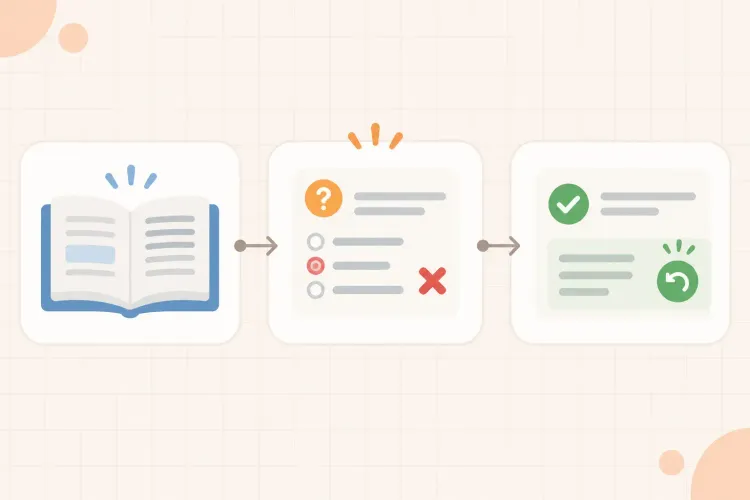


Most people do not forget a formula because they are incapable of memorizing it. They forget it because they have only recognized it while looking at the page, not written it out, explained it, or used it in a new situation. The goal is not only to remember the formula while studying, but to retrieve or reconstruct the right relationship when an exam question puts you under pressure.
The most reliable way to learn formulas for an exam is to link each one to its meaning, use, retrieval, and feedback: know what each symbol means, recognize when the formula applies, retrieve it with the source closed, and learn from application errors. A formula sheet can support this process, but rereading the sheet is not the process itself.
How to memorize formulas for an exam
Use this sequence for each formula you need to know:
- Understand the symbols and units. Say what every term represents and check the units on both sides.
- Name the situation. Write the kind of problem the formula solves and the clues that point to it.
- Reconstruct it once. If it can be derived from a definition or relationship you understand, work through that route so recall has a backup.
- Retrieve it from a blank page. Close the notes and write the formula, symbols, and conditions without looking.
- Choose it from mixed problems. Practice deciding which formula fits before substituting numbers.
- Use it in more than one form. Change the values, unknown, wording, or context so you learn the relationship rather than one worked example.
- Review the gap later. Mark the exact failure and return to that formula after a delay.
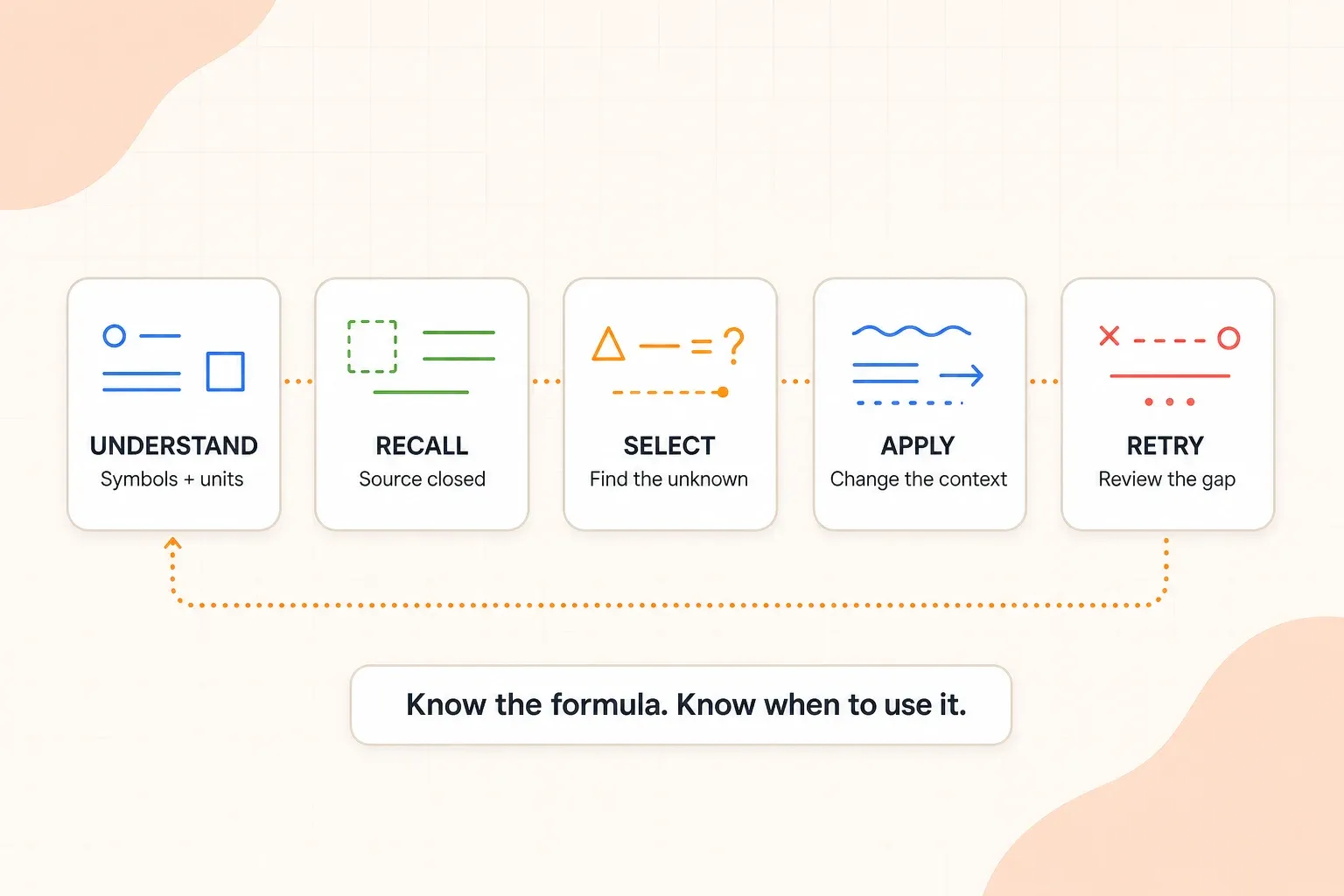
This order matters. If you begin with repetition before knowing what the symbols mean, you may remember a string of symbols while still being unable to recognize when it applies. If you only solve one familiar exercise, you may remember the worked example rather than the formula's structure.
Understand the formula before memorizing it
Start by translating the formula into a sentence. For example, v = d/t means that speed is distance divided by time. That sentence gives you more than a way to say the symbols aloud: it tells you which quantities belong in the relationship and what happens when one changes.
For every formula, answer these questions:
- What does each symbol represent?
- What units should each quantity use?
- What is the formula calculating?
- What information in a question would make this formula relevant?
- Are there conditions or assumptions that limit when it works?
- Can you rearrange it to find a different unknown?
Units are a particularly useful check. If you know that speed is measured in distance per time, the units can remind you which quantities should be divided. They can also expose a substitution error before you reach the final answer. Units do not replace understanding, but they give your memory a useful check.
Do not force a derivation where your course expects direct recall. The point is not to recreate every proof under exam pressure. It is to understand enough of the relationship that the formula is meaningful and easier to reconstruct rather than arbitrary.
Build a formula record, not a copied formula sheet
A useful formula record is compact enough to review and detailed enough to prevent confusion. For each formula, include:
| Record this | Why it helps |
|---|---|
| The formula | Gives you the exact relationship to retrieve |
| Meaning of each symbol | Prevents symbol-only memorization |
| Units | Provides a quick consistency check |
| Typical situation | Connects the formula to the wording of a problem |
| One worked example | Gives the relationship a concrete anchor |
| One common trap | Protects against a likely sign, unit, or selection error |
| A reconstruction cue | Gives you a route back when direct recall fails |
Keep related formulas together, but do not collapse them into one crowded page. A family might include the original relationship and its rearrangements, or several formulas that describe the same physical system from different angles. The grouping should help you distinguish them, not make them look interchangeable.
For example, if you are learning formulas for a circuit, do not write only a list of symbols. Add the meaning of each quantity, the units, and a short cue explaining that the formula relates potential difference, current, and resistance. Then include a question that asks you to identify the missing quantity before you calculate it.
Use derivation as a memory route
Some formulas are easier to remember when you know where they come from. Work through the derivation once slowly, then close the source and explain the key steps in your own words. You are building a route back to the formula, not trying to memorize every line of algebra as a separate fact.
Suppose you need the kinetic energy formula Ek = 1/2 mv². You might connect it to the work done while an object accelerates, or to the relationships used in your course to derive it. The useful question is: “What ideas would let you rebuild the shape of this formula if recall fails?”
Derivation is most helpful when it explains a distinctive feature: why a variable is squared, why a constant appears, why two quantities are multiplied, or why a term belongs in the denominator. It is less helpful to copy a proof repeatedly without understanding what each step changes.
Practice formula recall with the source closed
The first reliable test is whether you can produce the formula. Put the formula sheet, notes, and worked examples away. On a blank page, write the formulas for one topic, define their symbols, and add the condition or situation for each one. Then compare your attempt with the source.
Use a three-part check:
- Exactness: Is every sign, exponent, bracket, coefficient, and denominator correct?
- Meaning: Can you explain the symbols and units without looking?
- Use: Can you name a problem situation in which the formula is appropriate?
Record the failure precisely. “The formula did not come to mind” is less useful than “the variables were remembered but the ratio was reversed” or “the relationship was known but its application to this problem was unclear.” Different failures need different repairs.
Retrieval practice can include writing equations from memory, then checking them afterward. Spacing those attempts across several sessions usually supports more durable recall than repeating the same formula many times in one sitting. For a concise explanation of how these methods work together, read the Australian Mathematics Hub's overview of spaced, interleaved, and retrieval practice.
Learn when to use each formula
Remembering a formula and selecting it are separate skills. In an exam, the question rarely tells you which formula to use. You have to translate the question into a model first.
Before calculating, ask:
- What is the question asking you to find?
- Which quantities are given?
- What relationship connects those quantities to the unknown?
- Do the units and conditions match?
- Is there a similar formula that looks plausible but solves a different problem?
Try mixed sets instead of practicing ten nearly identical questions in a row. Put formulas from the same topic together, shuffle the problem types, and decide on the method before looking at the answer. This trains the selection decision rather than pattern matching.
For example, a question about a moving object might give you mass and speed, suggesting kinetic energy, while another might give mass, height, and gravitational field strength, suggesting gravitational potential energy. Both problems can mention energy, but the givens and the unknown point to different relationships. The decision is part of the exam skill.
Once you want to practice formula choice inside mixed problems, use this problem-solving system for a math exam. That article covers the wider workflow. This one focuses on the formula layer: knowing the relationship and recognizing when it belongs.
Apply formulas in varied problems
Once you can write a formula, change the task. Use the same relationship in at least four forms:
- substitute familiar values and calculate the original unknown.
- rearrange the relationship to find a different unknown.
- solve a word problem where the quantities are hidden in the prose.
- use a less familiar context or a different unit convention.
Take F = ma. A basic exercise may give mass and acceleration and ask for force. A varied set also asks you to find acceleration, compare two objects with different masses, check whether the units are consistent, and explain what changes if the net force is zero. The formula stays the same, but the retrieval and selection demands change.
This is where formula learning becomes more than memorization. You are practicing the relationship between quantities, the conditions under which it applies, and the decisions needed to use it correctly. If you get the arithmetic right but choose the wrong model, the problem is still not solved.
Space formula review across several sessions
Formula recall becomes more stable when you return after you have had time to forget some of it. A simple review pattern could be:
- First session: understand the formula, create the record, and retrieve it once.
- Next day: write it from memory and solve one straightforward problem.
- Two or three days later: mix it with related formulas and choose the correct one before calculating.
- About a week later: use it in an unfamiliar or timed problem.
- Before the exam: complete a short blank-page formula dump, then repair only the formulas that fail.
The intervals do not need to be perfect. The important change is replacing one long rereading session with several attempts separated by time. Keep a short list of weak formulas so your later review is targeted rather than a complete restart.
If you forget a formula during the exam
Do not immediately search your memory for the exact string of symbols. Rebuild the problem around what you do know:
- Write the givens and the unknown. Include the units and convert them if necessary.
- Name the relationship. Ask what concept connects those quantities: rate, conservation, force, probability, growth, or another course-specific idea.
- Use a definition or related formula. A familiar relationship may let you reconstruct the missing one or check its shape.
- Check the direction and units. Decide whether quantities should be multiplied, divided, squared, or placed in a denominator.
- Use the provided formula sheet if the exam allows it. Treat it as a lookup aid, then still check that the conditions and symbols match the problem.
If reconstruction does not work, move on and return later rather than spending all your time on one blank. Never invent a remembered-looking formula without checking whether it fits the units and the situation. Exam rules differ, so confirm in advance whether writing formulas on scratch paper, using a formula sheet, or deriving a relationship is permitted.
Use flashcards for retrieval, not recognition
Flashcards can help, but a card that shows the formula on the front and asks you to flip it immediately may test recognition more than recall. Make the prompt do a job:
- “Write the relationship between force, mass, and acceleration.”
- “Which formula connects these givens to the unknown?”
- “What do the symbols and units mean in this equation?”
- “What changes if the unknown is moved to the other side?”
- “What is the most likely trap when using this formula?”
Keep one retrieval task per card when possible. Some cards should ask for the formula itself. Others should ask when to use it or how to rearrange it. For the card-writing side of this process, follow this guide to making flashcards that actually work, then adapt the prompts to your subject.
If you create cards from lecture notes or a PDF, check the source before studying them. A generated card can be well-worded and still contain a missing condition or an incorrect symbol. The source remains the authority. The card is only a practice prompt.
Common formula-memorization mistakes
Copying the formula sheet repeatedly
Copying can make the notation feel familiar, but it does not show whether you can produce the formula without help. Replace some copying with blank-page retrieval.
Memorizing symbols without meanings
Letters are easy to swap when they are detached from quantities, units, and situations. Define every symbol and use the relationship in a sentence.
Practicing only one question shape
If every exercise gives the same quantities in the same order, you may memorize the route through that exercise instead of learning formula selection. Mix the wording, unknown, values, and context.
Ignoring conditions and units
Many formulas are not universal. A missing condition can make a correct-looking substitution invalid. Units can also reveal an error before the final line.
Treating a wrong answer as a verdict
A missed formula is feedback about a particular part of the workflow. Was the problem retrieval, selection, setup, rearrangement, units, or arithmetic? Name the failure, repair that part, and retry later.
Reviewing only the night before
Last-minute repetition can make a formula feel familiar without making it available under pressure. Start with short retrieval sessions earlier and use the final review to target the remaining gaps.
A final formula-learning checklist
Before you move on from a formula, check that you can:
- write it without looking.
- define every symbol.
- state the units and important conditions.
- explain what situation it describes.
- recognize the givens that make it relevant.
- rearrange it when the unknown changes.
- use it in a problem with different wording.
- identify and repair your most recent mistake.
Do not aim to remember formulas as isolated strings. Understand the relationship, retrieve it with the source closed, choose it from mixed problems, and apply it until the notation points naturally to the situation. That is what makes a formula usable when an exam question is unfamiliar.