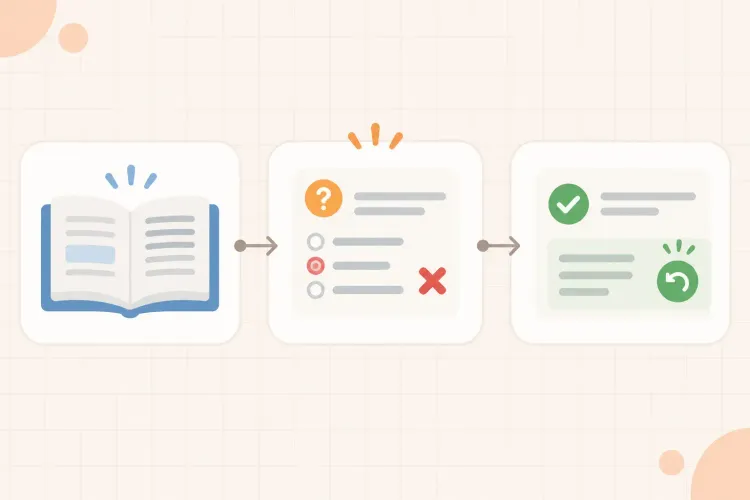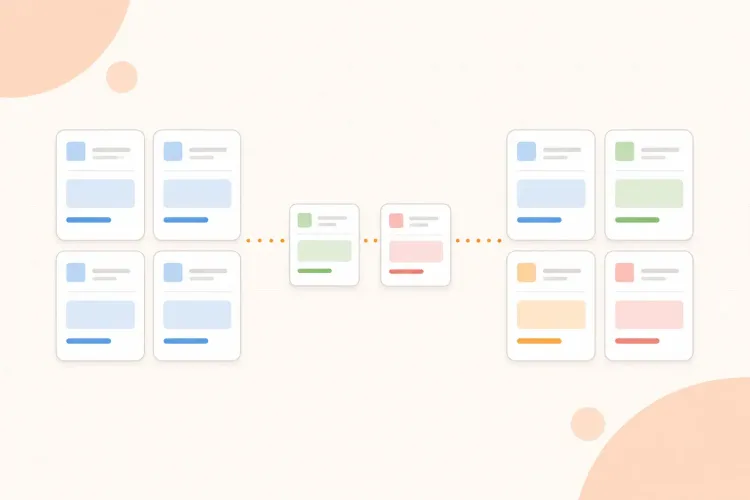

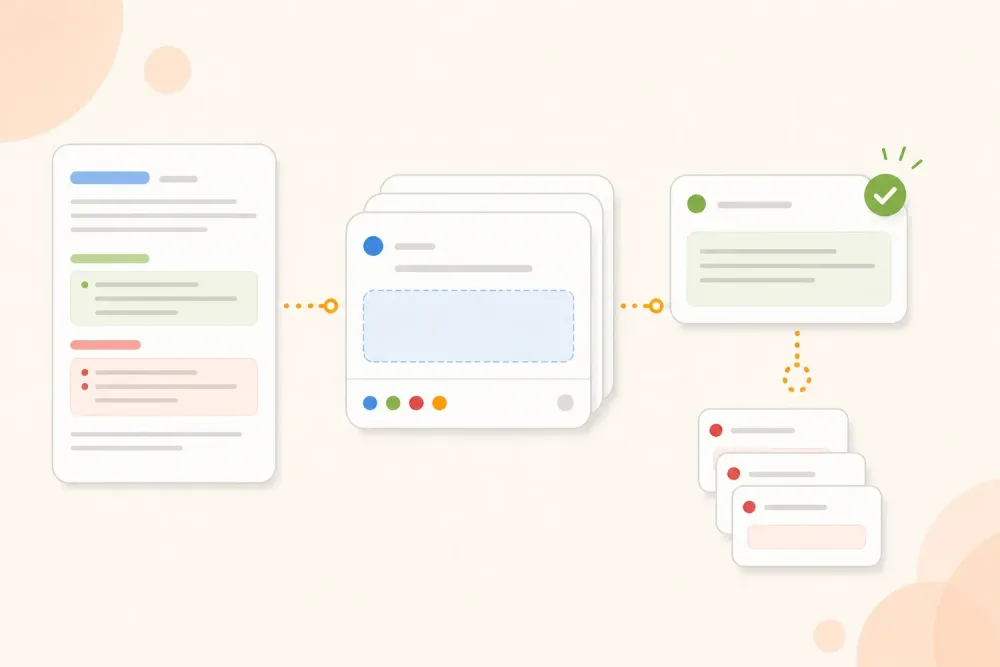
Flashcards work best when they make you produce an answer instead of asking you to recognize a page you have already seen. The goal is not to turn every line of your notes into a card. It is to choose the ideas you need to retrieve, write prompts you can answer honestly, and keep each correction small enough to remember.
A useful flashcard has one job: expose whether you can bring one idea to mind without looking at the source. That is why good card writing is part of using active recall to remember more, not just a way to organize information.
What makes a flashcard effective?
An effective card has three properties:
- One retrievable idea: the prompt points to a concept, relationship, process, or decision.
- A checkable answer: you can tell whether your response is complete enough.
- A useful next step: after answering, you know whether the card can wait or needs another attempt soon.
A card can look polished and still fail this test. A paragraph copied from a textbook may contain accurate information, but it does not tell you what to retrieve or how to judge your answer. A short question with a precise target usually creates better practice.
This matters because retrieval is not just a way to measure learning. In a study by Roediger and Karpicke, repeated testing produced stronger delayed retention than repeated studying, even though repeated studying created higher confidence in the short term. The study examined retrieval practice rather than a specific flashcard app, but the principle maps directly onto a card that makes you answer before revealing support. Read the testing-effect study.
Start with a learning objective, not a page
Before writing cards, identify what the material expects you to do. Is the objective to define a term, explain a cause, compare two processes, calculate a result, or apply an idea to a new situation? The objective gives you the shape of the prompt.
For example, a lecture section on cellular respiration might contain many details, but the useful targets are narrower: explain why oxygen matters, distinguish glycolysis from the citric acid cycle, or predict what happens when oxygen is unavailable. Those targets can become cards. Copying every bullet from the slide deck cannot.
If your material is a lecture video, first isolate the concepts worth remembering rather than making a card from every timestamp. You can create flashcards from a lecture video as a starting point, then edit the prompts so they match what your class or exam actually asks you to do.
A generated deck is only a first pass. Check that each card has one clear target, remove trivia, and rewrite broad prompts before you review them. For example, change an automatically produced card that says “Explain cellular respiration” with a paragraph-long answer into “Why is oxygen the final electron acceptor in cellular respiration?” with a short explanation of that role. The second card gives you a target you can actually retrieve and check.
Write one question per card
The most reliable card-writing rule is simple: one question should lead to one main answer. This does not mean every answer is one word. It means the question has a clear boundary, so you can recognize a missing part when you check it.
Good prompts often begin with verbs such as define, explain, compare, predict, or apply. They tell you what kind of thinking is expected without giving away the answer.
| Weak prompt | Stronger prompt |
|---|---|
| Cell biology | Why does oxygen matter at the end of cellular respiration? |
| The French Revolution | Give two causes of the French Revolution and explain how they differed. |
| Photosynthesis | What changes when light energy is converted into chemical energy? |
| Chapter 4 | How would you decide which statistical test to use in this example? |
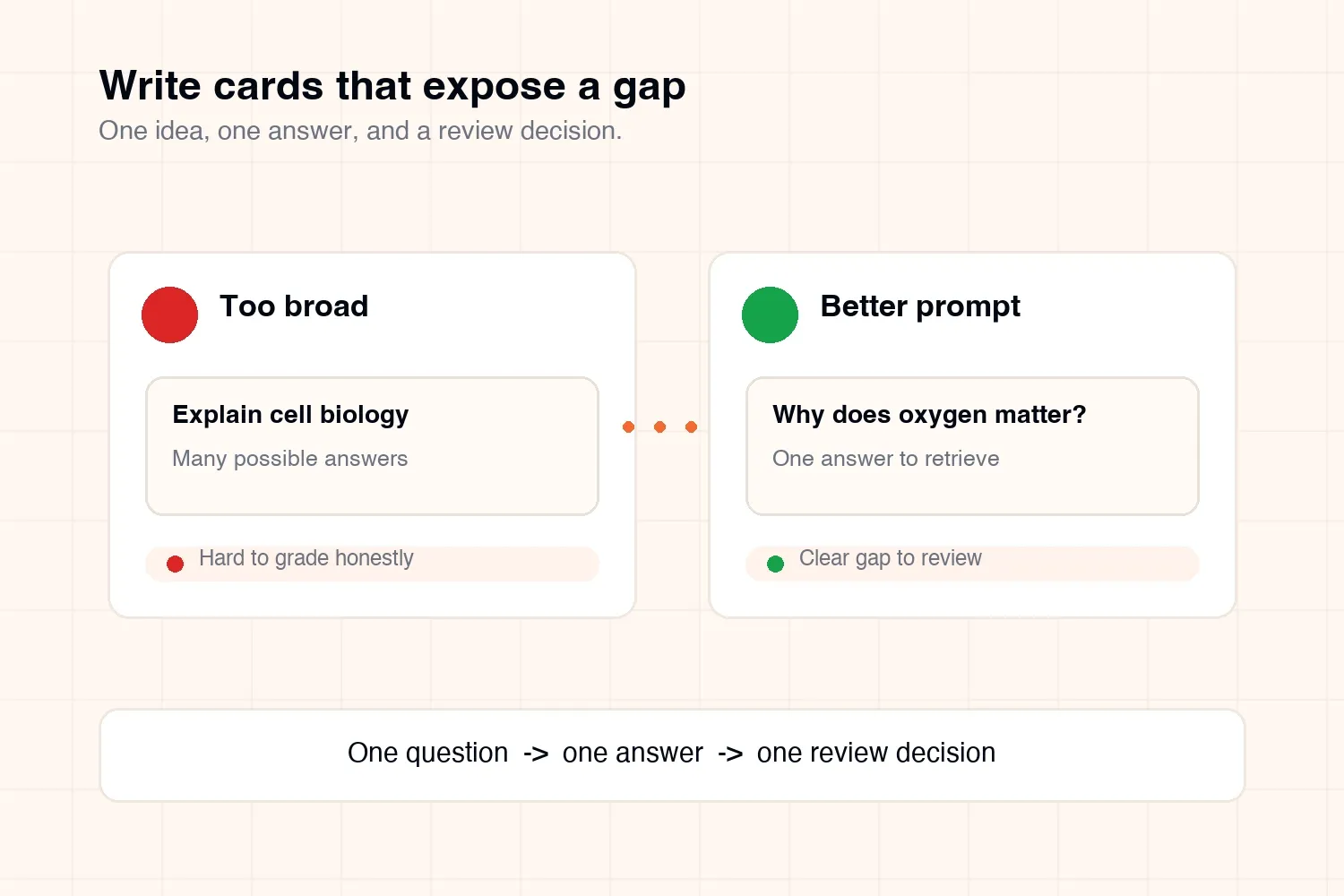
These prompts do not try to hold an entire chapter. Each one isolates a specific retrieval task, gives the answer a clear boundary, and makes it easier to tell what you know from what needs another look. That is the difference between a card that stores a summary and a card that creates useful practice. The visual below shows how narrowing the prompt makes the review signal clearer.
Use prompts that require more than recognition
A card is weak when the answer is visible in the wording. “What is the definition of diffusion?” can be useful, but a course may also expect you to explain a consequence or use the concept. Mix prompt types so you practice more than recalling labels.
Useful prompt patterns include:
- Definition: What does this term mean in this course?
- Mechanism: Why does this process produce that result?
- Comparison: What is the important difference between A and B?
- Application: What would happen if one condition changed?
- Sequence: What happens first, next, and last?
- Error check: What is wrong with this explanation or calculation?
Use the pattern that matches the material. A vocabulary-heavy language course may need more definitions. A biology, economics, or engineering course usually needs a mix of mechanisms, comparisons, and applications.
When a visual card is better
Some ideas are easier to retrieve from a diagram than from a paragraph. Use a labeled anatomy image, map, circuit, graph, or process figure when the relationships or locations are part of what you need to remember. Keep the prompt active: hide the labels, ask what changes between two points, or request the next step in the process.
Do not let the image become the answer. If every label is visible immediately, you are practicing recognition. Crop, cover, or annotate the visual so you must name the structure, explain the relationship, or reconstruct the sequence before checking it.
Keep the answer short enough to grade
The answer side should contain the minimum explanation needed to check the idea. If it becomes a page of notes, split the prompt. Long answers hide the exact point you forgot and make review feel like rereading.
A useful answer can include a definition, one mechanism, or a short example. For a multi-part topic, make separate cards for separate relationships. You can still add a small source detail or diagram when it prevents a common confusion, but the card should not become the source itself.
When you check an answer, do not demand identical wording. Ask whether you included the essential relationship. For “Why does oxygen matter at the end of cellular respiration?”, an answer that explains oxygen's role as the final electron acceptor may be correct even if it does not repeat the lecture's exact sentence.
When flashcards are not enough
Flashcards are useful for terms, mechanisms, distinctions, and the steps you need to retrieve before using a skill. They are weaker when the assessment asks you to sustain a long argument, solve an unfamiliar multi-step problem, draw a complete mechanism, or write under timed conditions.
Use the cards as a bridge in those cases. Retrieve the rule, definition, or decision point first, then close the deck and solve a fresh problem or explain the full process without prompts. If you only succeed when the card tells you what topic to think about, you have recognized the topic without practicing how to use it in a new situation.
That distinction is also supported by recent research on complex educational concepts: retrieval practice can improve application, but the benefit is clearer when learners get enough retrieval opportunities and are tested after a delay. This evidence concerns retrieval tasks rather than card design itself, so treat it as support for the review behavior, not proof that every flashcard format transfers automatically. See the retrieval-and-transfer study.
Turn mistakes into better cards
A missed card is feedback about both your memory and your prompt. If you miss the same broad question repeatedly, do not simply add more text to the answer. Ask what smaller distinction is missing and rewrite the card around it.
For example, replace “Explain the sodium-potassium pump” with two focused cards:
- Which ions move in which direction during one cycle of the sodium-potassium pump?
- Why does the pump require ATP?
The first card tests the movement pattern. The second tests the energy relationship. Separate prompts make the gap visible.
A card that repeatedly fails may also be testing an idea you have not understood yet. Return to the lecture, PDF, or notes, write the missing explanation in plain language, then try the smaller prompt again. Flashcards can reveal a gap; they cannot replace the explanation needed to repair it.
Avoid these common flashcard mistakes
Copying notes onto both sides. This creates a reference card, not a retrieval task. Convert the important sentence into a question before you add it.
Making cards too broad. “Explain the whole chapter” is difficult to answer and impossible to grade consistently. Name the concept, relationship, or decision you want to test.
Hiding several questions in one prompt. If a card asks for a definition, three causes, and an application, a partial answer becomes hard to interpret. Split it or use a clearly numbered answer.
Adding trivia because it is easy to copy. Prioritize what the course emphasizes, what connects ideas, and what you are likely to need in an explanation or problem.
Treating every miss as a reason to reread everything. Check the source for the missing point, correct the card, and return to that point. A small correction is more useful than another full pass through the chapter.
A 15-minute flashcard workflow from lecture notes
Imagine you have notes from a 50-minute biology lecture. Use the first few minutes to mark the learning objectives and repeated concepts. Then:
- Choose eight to ten targets. Prefer mechanisms, contrasts, and examples over isolated slide wording.
- Draft one prompt per target. Write the question without looking at the answer first.
- Open the notes to verify. Keep the answer short and add the source detail that prevents ambiguity.
- Test three cards immediately. If a prompt feels vague, rewrite it while the lecture is still fresh.
- Mark the review signal. Cards you missed or only partly explained return sooner; cards you could explain move to a later session.
The result is not a transcript turned into fifty tiny cards. It is a compact set of prompts that represents the lecture's important relationships and shows you what to repair.
How to review the cards
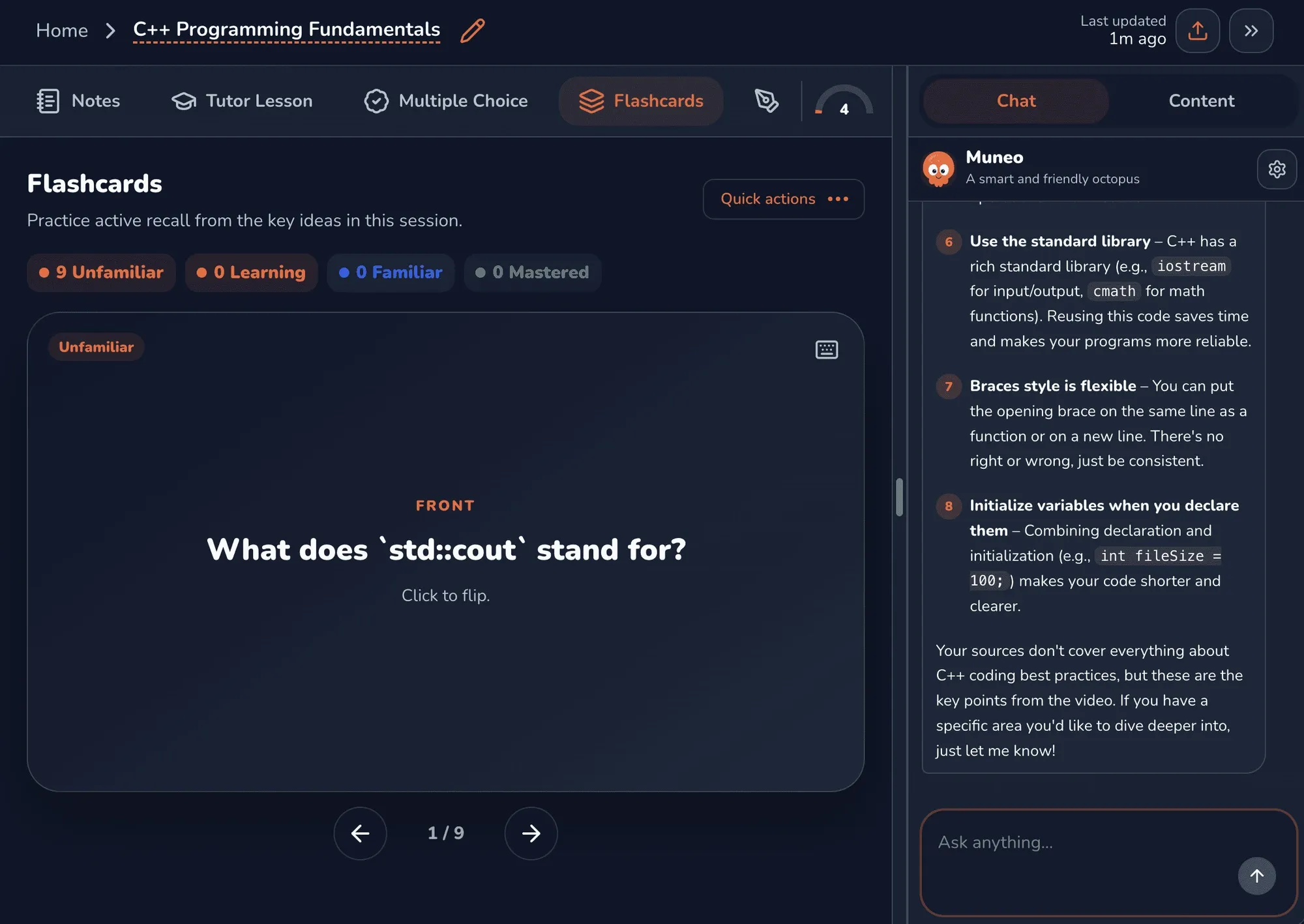
Review starts with an honest attempt. Read the prompt, answer before revealing the back, and compare your response with the essential answer. Then choose the next action: move on, shorten the prompt, check the source, or bring the card back sooner.
This is what a focused review looks like in practice: the card asks for one answer, the source remains available for checking, and the review status records what should return next.
Do not measure a session by how many cards you saw. Measure it by how clearly you can identify what you knew, what you almost knew, and what needs repair. That signal is what makes the deck useful for the next study session.
Good flashcards are small tests, not miniature summaries. Write one clear prompt, keep one checkable answer, and let each miss tell you how to improve the card or schedule the next attempt.