
When an exam is close and the syllabus still feels huge, the instinct is to read faster. That usually creates more pages of notes without telling you what you can actually answer. Effective last-minute studying is a triage problem: choose the material most likely to matter, test what you can retrieve, and spend the remaining time repairing the gaps that cost you marks.
You cannot learn an entire course deeply overnight. You can still make a short study window useful by replacing passive rereading with a focused loop of prioritization, recall, practice, and correction. The goal is not to make cramming your normal system. It is to use limited time deliberately when the exam is already close.
How to cram for an exam without wasting time
Start by defining the constraint. Write down the exam date, the number of realistic study blocks you have, the topics covered, and the question format. A multiple-choice exam, a problem set, and an essay all reward different kinds of preparation. Your plan should resemble the work you will have to do in the exam.
Then rank the material instead of treating every chapter equally. Put each topic into one of three groups:
- Likely and important: material named in the study guide, repeated in lectures, or used in previous assignments.
- Weak but recoverable: topics you recognize but cannot explain or solve without looking.
- Low-return: details that are obscure, unlikely to be assessed, or too large to learn properly in the time left.
Spend most of your time on the first two groups. Leaving some low-return material untouched is not a failure of the plan; it is what keeps a short study window from disappearing into one difficult chapter.
Build a last-minute study plan around blocks
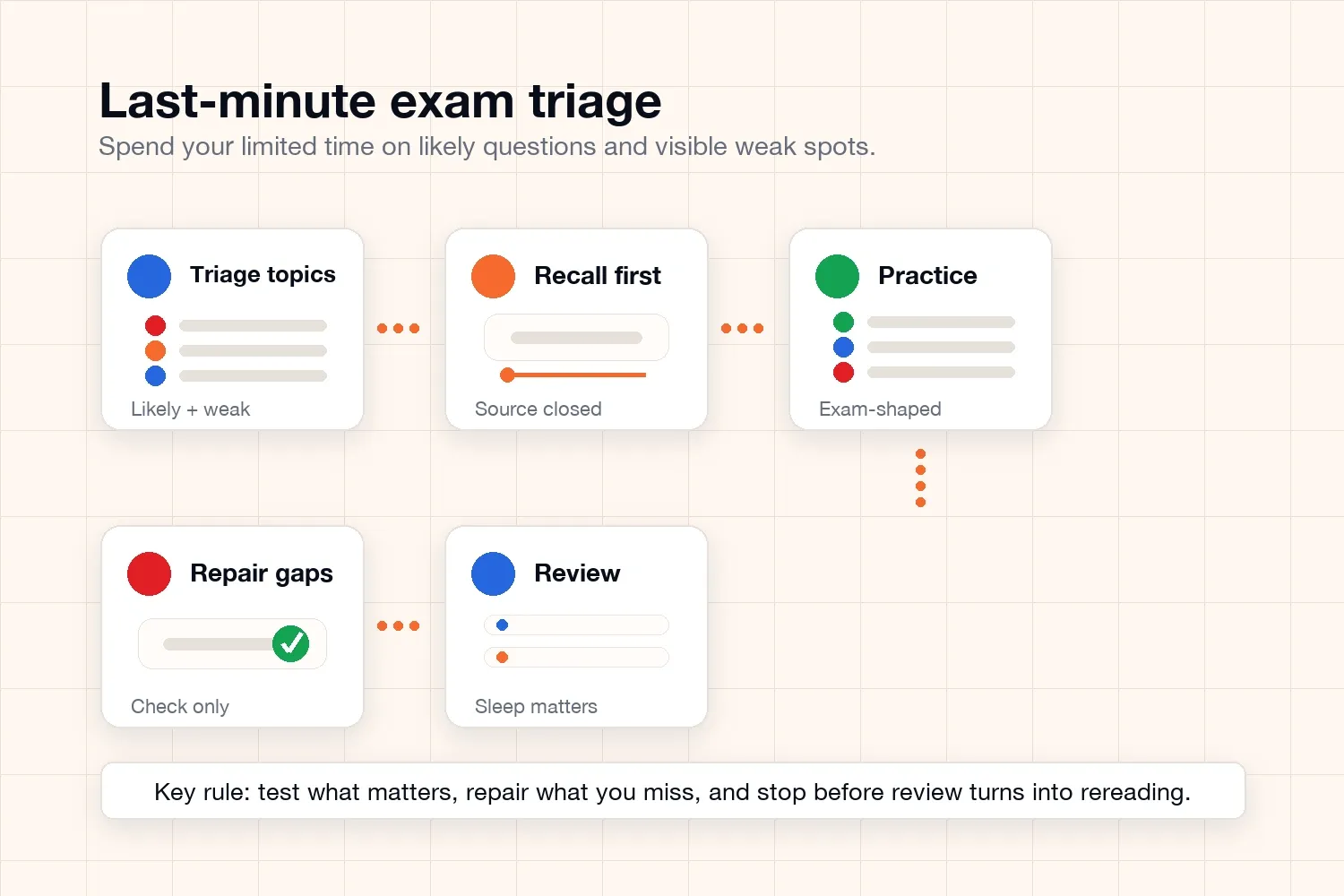
Give each block one job. A block should end with evidence of what you can do, not just with more material highlighted. Use a simple sequence like this:
| Time available | Main job | Evidence of progress |
|---|---|---|
| First 10–15 minutes | Triage topics and gather the exam scope | A ranked list of topics |
| Next 30–60 minutes | Recall the highest-value material | Answers written without notes |
| Next 30–60 minutes | Complete exam-shaped questions | Marked questions and mistakes |
| Final 20–30 minutes | Repair weak spots and plan the next review | A short weak-topic list |
If you have several hours, repeat the middle two blocks with a different topic. Keep the transition between blocks short. You are trying to create several opportunities to retrieve the material, not one long session that feels productive because it is exhausting.
How to cram for an exam in one day
If the exam is tomorrow, scale the same loop to the hours you have left. Use the plan below to set a stopping point instead of trying to cover every page.
| Time left | Plan |
|---|---|
| 6 hours | 30 minutes to rank topics, 2 hours of closed-book recall, 2 hours of exam-shaped questions, 1 hour to repair misses, and 30 minutes for a light final review. |
| 3 hours | 15 minutes to triage, 60 minutes to recall, 60 minutes to practice, and 45 minutes to correct the most important gaps. |
| 1 hour | Pick the two or three highest-return topics, spend 25 minutes recalling them, use 20 minutes on likely questions, and finish with 15 minutes of corrections. |
At every duration, keep the source closed while answering. If you have less than an hour, do not start a new chapter; focus on what the exam is most likely to ask and where you are still weak.
The most important rule is to decide what you are trying to prove before opening the source. For a biology chapter, that might be explaining the stages of cellular respiration. For a statistics unit, it might be choosing the right test and interpreting the result. For history, it might be connecting causes, events, and consequences. A specific target makes it easier to stop when the answer is good enough.
Use active recall before rereading
Rereading feels safe because the page looks familiar. Familiarity is not the same as being able to produce an answer under exam conditions. Close the notes and write what you remember, explain the idea aloud, or answer a question without checking the page first. Then compare your attempt with the source and mark the exact part that needs repair.
This is the same basic principle behind active recall for remembering what you study: make your memory do some work before you look for confirmation. During a cram session, the feedback loop matters even more because it prevents you from spending half an hour polishing material you already know.
For each topic, ask three questions:
- What is the core idea or procedure?
- What would an exam question ask you to do with it?
- Where did your answer become incomplete, inaccurate, or too slow?
Keep the correction short. Add the missing step, definition, relationship, or example to your weak-topic list, then move on.
Practice the shape of the exam
Practice questions are more useful than another pass through the entire chapter when time is short, but only if they resemble the exam. Use problems for calculation-heavy subjects, short explanations for concept-heavy subjects, and timed outlines for essays. If the course provides past papers, review guides, problem sets, or lecture questions, use those before generic questions because they reveal the instructor's preferred level and wording.
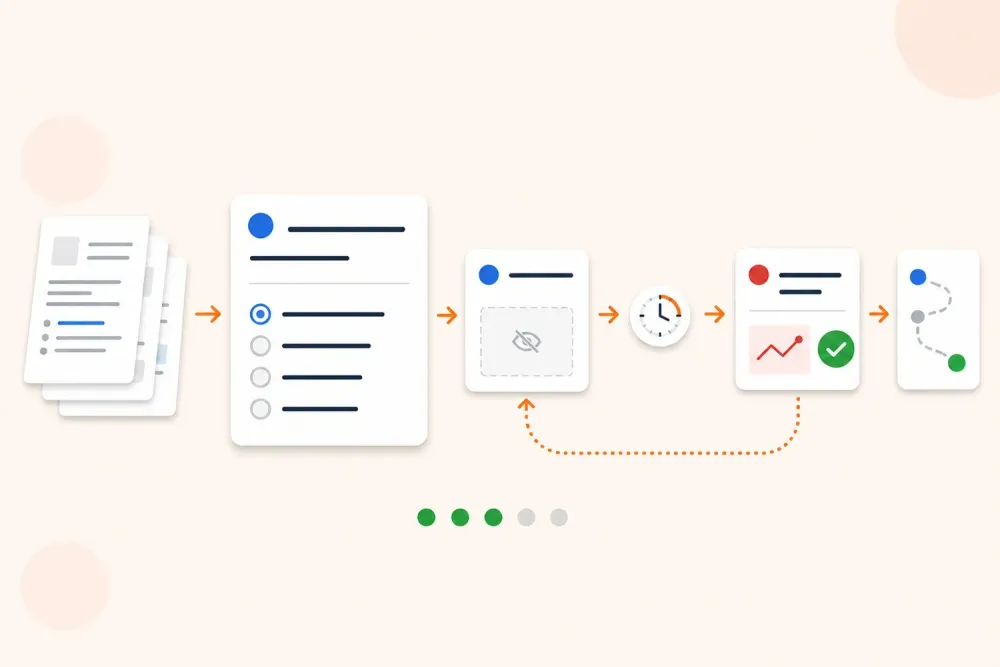
For source-heavy courses, you can turn a PDF section into focused quiz questions, answer them without looking back, and use the misses to choose your next block. The value is not the generated questions by themselves. It is the sequence of attempting, checking, and deciding what deserves another pass.
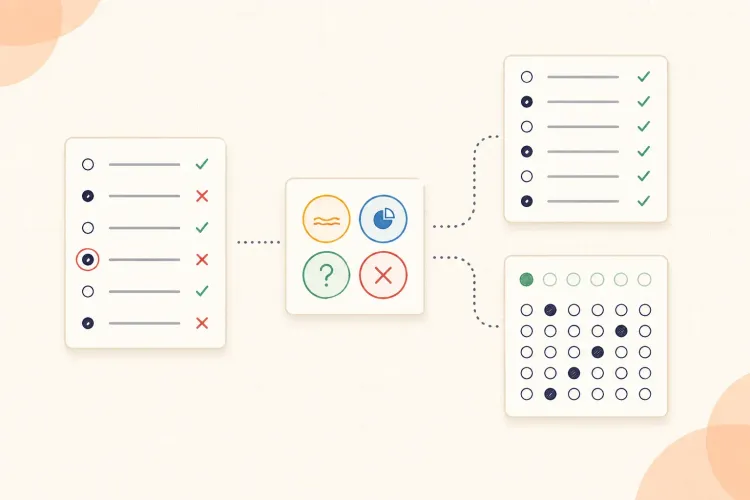
Avoid making every question a recognition task. Multiple-choice questions can help you check coverage, but include some prompts that require you to explain, compare, calculate, or apply. Those tasks expose weak connections that a familiar-looking answer choice can hide.
What to skip when you are cramming
Skipping is part of the method, but it should be deliberate. Set a stopping rule for difficult topics. For example, give a hard concept one focused attempt, check the worked explanation, try one similar question, and then decide whether another block is justified. Do not let one confusing page consume the time meant for five more likely questions.
You can also skip low-value study behaviors:
- Rewriting every slide into prettier notes.
- Watching long explanations without pausing to answer.
- Making elaborate flashcards for facts you already recall.
- Switching resources whenever the first explanation feels difficult.
- Spending the final hour organizing files instead of practicing.
The question is not whether a task looks academic. The question is whether it improves an answer you may need to produce soon.
A realistic example of cramming efficiently
Imagine you have a biology exam covering cell structure, cellular respiration, genetics, and enzyme activity. Instead of rewriting every slide, aim to leave the session with six short topic summaries, eight recall prompts, ten marked practice questions, and a weak-topic list with two items. That output is useful because it shows what you can answer and what still needs attention.
Protect the final review window
Do not spend all available time learning new material. Reserve a final block for the mistakes you have already found. Re-answer the missed questions without looking at the correction. If the answer is still weak, reduce the problem to one missing idea or step and review only that part.
Sleep is also part of the plan. The University of Waterloo's guide to effective cramming recommends focusing the remaining time on the most important material and treating sleep as a constraint, rather than assuming every waking hour is useful.
On the morning of the exam, use a light recall pass: a few key definitions, formulas, processes, or weak-topic prompts. Do not start a brand-new chapter unless the exam scope makes it unavoidable. The aim is to arrive with a usable map of the material, not to create a new source of panic.
How to cram without making the next exam worse
Cramming can help you organize an emergency study window, but it does not replace spaced review. After the exam, note which topics required the most repair and schedule them earlier next time. A revision timetable that puts difficult topics first can turn that information into future study blocks instead of leaving it as a vague intention.
If you have limited time right now, use this compact loop: rank the topics, close the source, answer from memory, practice the exam task, check the mistake, and review the weak point once more. If you want to keep your material, questions, answers, and corrections together, you can study with Muneo and keep the workflow grounded in your own sources.
Cramming works best when it becomes a short decision system, not a race through every page. Test what matters, repair what you miss, and stop before review turns into rereading.