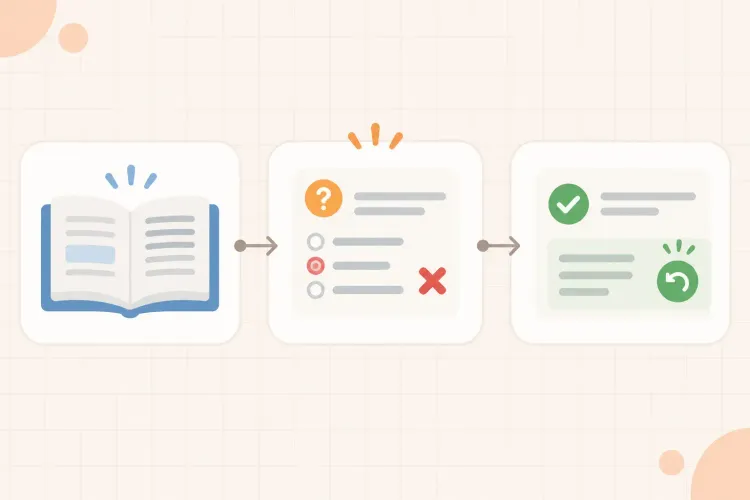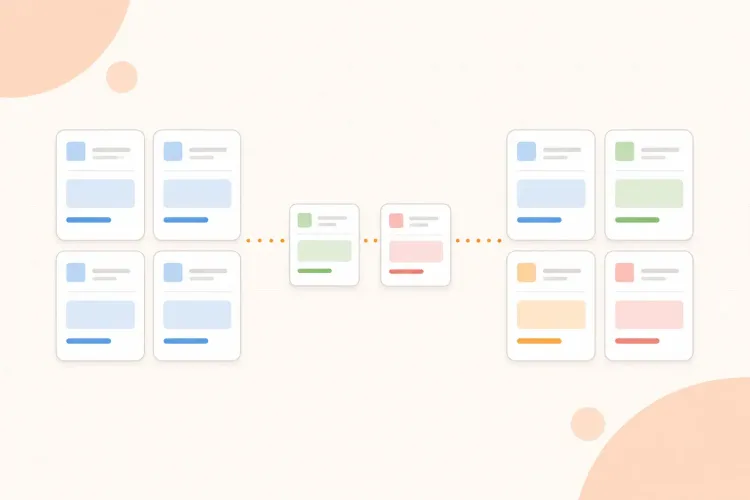

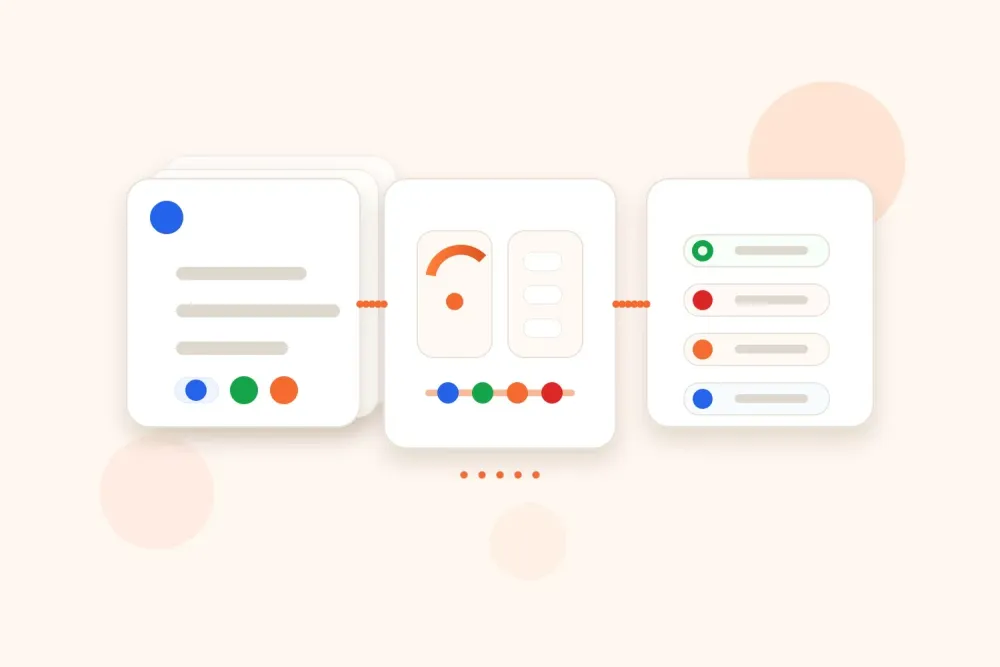
Flashcards and quizzes are both self-testing tools, but they train different study tasks. Flashcards are best when you need to remember small, reusable pieces of knowledge. Quizzes, practice questions, and practice tests are better when you need to apply that knowledge, choose between similar answers, or prepare for the way an exam will actually test you.
So the short answer is: use flashcards for facts, terms, formulas, and quick prompts. Use quizzes or practice questions for problems, mixed topics, explanations, and exam-style practice. If your material has both facts and application, use both in sequence.
The mistake is treating flashcards vs quizzes like a competition. The better question is: what kind of memory task are you training?
Flashcards vs quizzes: the quick difference
Flashcards usually test one small recall unit at a time. You see a prompt, try to remember the answer, then flip or reveal the answer. That works because you retrieve information instead of simply rereading it.
Quizzes usually test a broader decision. A quiz question might ask you to choose the right answer, solve a problem, explain a process, or apply an idea to a new example. That makes quizzes useful when recognition is not enough.
Here is the quick comparison:
| Question | Use flashcards when... | Use quizzes when... |
|---|---|---|
| What are you training? | Small facts, terms, or definitions | Decisions, reasoning, or application |
| What does a good answer look like? | Short and stable | Mixed, explained, or exam-style |
| Best moment | Building a foundation | Checking readiness |
| Mistake it helps reveal | A forgotten detail | A weak connection between ideas |
Both formats can support retrieval practice. For the deeper science behind testing yourself, read the practice-testing guide on why testing yourself beats rereading.
When flashcards work best
Flashcards are strongest when the answer is small enough to retrieve cleanly. That makes them useful for:
- Vocabulary
- Dates
- Definitions
- Formulas
- The steps of a process
- Key people, cases, laws, or theories
- Diagram labels
- Short cause-and-effect relationships
For example, a biology flashcard might ask: "What does osmosis mean?" That is a good flashcard because the answer is a compact definition. You can retrieve it quickly, check it, and review it again later.
Flashcards become weaker when you put too much on one card. If the back of a card contains half a page of notes, you are no longer testing one recall unit. You are asking your brain to judge whether a long explanation looks familiar.
A better card is specific:
- Weak card: "Explain photosynthesis."
- Stronger card: "What molecule provides the carbon used to build glucose in photosynthesis?"
- Stronger card: "Why does photosynthesis need light-dependent reactions before the Calvin cycle?"
The stronger cards force a clear answer. They also make it easier to know whether you remembered the idea or only recognized the topic.
When quizzes work best
Quizzes are stronger when the material asks you to use knowledge, not just name it. That includes:
- Solving practice problems
- Choosing between similar concepts
- Applying a rule to a new example
- Explaining why an answer is correct
- Mixing old and new topics
- Preparing for multiple-choice, short-answer, or written exams
For example, a quiz question might ask: "A cell is placed in a solution with higher solute concentration outside the cell. What happens to water movement, and why?" That question tests whether you can use the definition of osmosis in a situation.
Quizzes also reveal weak spots that flashcards can hide. You might know the definition of "opportunity cost" on a flashcard, but still miss a quiz question that asks you to identify the opportunity cost in a scenario. The quiz exposes the transfer problem: you know the term, but not yet the decision.
This is why quizzes and practice tests are useful near an exam. They make you practice under conditions closer to the real task.
Are quizzes the same as practice tests?
Not exactly. In this article, "quiz" means any focused set of questions you use to check understanding: a few multiple-choice questions from a lecture, short-answer prompts from a PDF, or a quick review after notes.
A practice test is the exam-like version: mixed topics, stricter timing, fewer hints, and questions closer to the real assessment. The choice is still the same: use flashcards for small recall, quizzes for application, and practice tests when you need to rehearse exam conditions.
Use flashcards first, then quizzes
For many subjects, the best workflow is not either/or. It is a sequence.
- Turn the source into small recall units.
- Review those units with flashcards.
- Use quizzes to test whether you can apply them.
- Turn missed quiz ideas back into new flashcards or weak-topic notes.
For a YouTube lecture, you might first create flashcards from the key terms. Then, after you can answer the basics, test the lecture with quiz questions to see whether you understood the examples and arguments.
For a PDF chapter, use the same sequence. Build flashcards for definitions, formulas, and labeled diagrams. Then write practice questions that mix sections together and force you to choose the right idea without the source open.
This sequence prevents a common trap: collecting hundreds of flashcards and assuming the deck equals exam readiness. Flashcards can build recall, but quizzes show whether that recall works in context.
The pattern looks like this when you move from simple recall to exam-style practice.
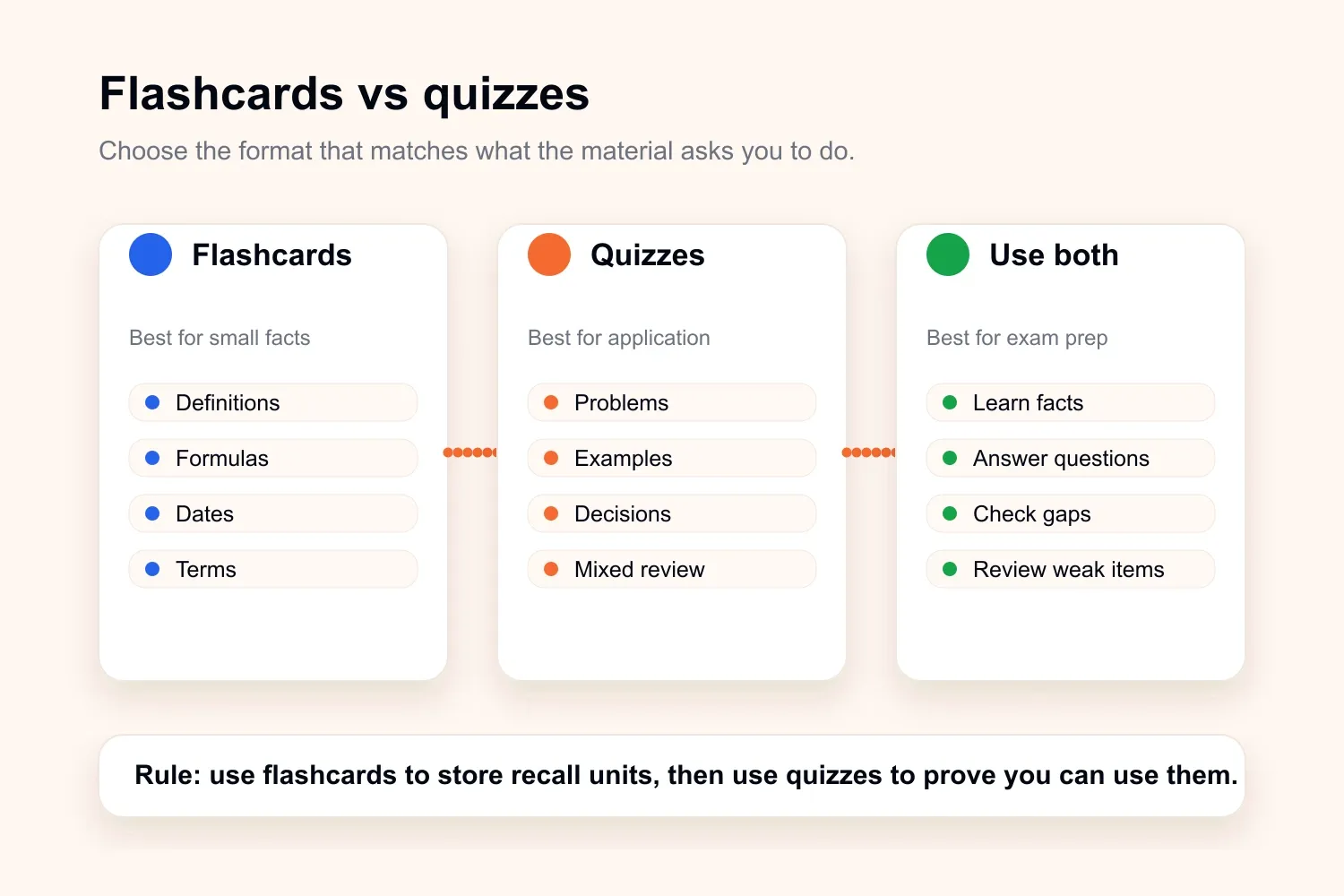
A concrete example: one biology lecture
Imagine you have one lecture on cellular respiration. The flashcards should capture the small pieces you need to retrieve quickly:
- Glycolysis breaks glucose into pyruvate.
- ATP is the cell's usable energy molecule.
- The mitochondrion is where most aerobic respiration happens.
- Oxygen is needed at the end of the electron transport chain.
Those cards help you remember the vocabulary, but they do not prove you can use it. After that first recall pass, quiz yourself with questions that connect the pieces:
- Why does a muscle cell need many mitochondria?
- What would happen to ATP production if oxygen were unavailable?
- Which part of the process changes first during intense exercise?
Then sort your mistakes. If you missed "pyruvate," make or review a flashcard. If you knew the words but could not explain the oxygen question, add another quiz question. That is the real decision: forgotten facts go back to flashcards; weak reasoning becomes quiz practice.
A simple decision rule
Ask one question before choosing the format: what would a good answer look like?
If a good answer is short, use a flashcard.
Examples:
- "Define judicial review."
- "What is the formula for acceleration?"
- "What do mitochondria do?"
- "What year did the treaty happen?"
If a good answer requires a choice, explanation, calculation, or comparison, use a quiz.
Examples:
- "Which case best shows judicial review, and why?"
- "A car changes speed over 8 seconds. What is its acceleration?"
- "Why would a muscle cell need many mitochondria?"
- "Which treaty changed the balance of power, and what changed?"
If you are unsure, start with a quiz. A quiz question can reveal whether you need a flashcard underneath it. If you miss the acceleration problem because you forgot the formula, make a formula flashcard. If you remember the formula but choose the wrong numbers, practice more quiz problems.
How to avoid weak flashcards
Most bad flashcards fail for one of three reasons.
First, the prompt is too vague. "Chapter 4" is not a question. "Explain the whole respiratory system" is too broad. A good prompt tells you exactly what to retrieve.
Second, the answer is too long. If you need to read a paragraph to decide whether you were right, the card should probably be split into smaller cards or changed into a quiz question.
Third, the card only tests recognition. A card that says "Osmosis = movement of water across a membrane" can become passive if you only glance at it. Hide the answer, say it first, then check.
Researchers and learning specialists often frame flashcards as a form of self-testing, not just a storage system. In their guide to studying with flashcards, The Learning Scientists describe flashcards as a way to find weak spots before those weak spots appear during a real test.
How to avoid weak quizzes
Weak quizzes can also waste time. A quiz is not automatically better because it has more questions.
A weak quiz repeats the same clue again and again. It asks for definitions without changing the context. It marks answers wrong without helping you understand the gap.
A stronger quiz mixes question types:
- One definition question
- One example question
- One "why" question
- One comparison question
- One problem or scenario question
For example, after studying supply and demand, do not only ask "What is supply?" A stronger set would include:
- "What is supply?"
- "What happens to price when demand rises and supply stays the same?"
- "Why can a shortage happen even when demand is high?"
- "How is a shift in demand different from movement along the demand curve?"
That mix shows whether you understand the concept or only remember the vocabulary.
What to use by subject
Different subjects lean toward different formats, but most still need both.
Use this subject-by-subject shortcut:
- Languages: use flashcards for vocabulary, then quiz yourself on translation and grammar.
- Biology: use cards for terms and diagrams, then answer scenario questions about processes.
- Math: memorize formulas with flashcards, then spend most of the session solving problems.
- History: review dates and people with cards, then quiz cause, change, and comparison.
- Law: learn cases and rules with cards, then apply those rules to facts.
- Medicine: store core facts in cards, then use quizzes for diagnosis and decision-making.
The pattern is simple: flashcards help you carry the pieces. Quizzes help you assemble them under pressure.
A 30-minute flashcard and quiz session
Here is a practical way to combine both formats without turning study into a long setup project.
- Choose one source for 3 minutes: a PDF section, lecture segment, slide deck, or note page.
- Make 8 to 12 flashcards for 8 minutes. Keep each card focused on one recall unit.
- Review the flashcards for 7 minutes with the answers hidden.
- Make or answer 5 quiz questions for 9 minutes. Include at least one example or scenario question.
- Mark weak points for 3 minutes. Turn missed facts into flashcards and missed reasoning into quiz questions.
In Muneo, this works best when the cards and quiz questions come from the same source. Keeping the PDF, video, notes, flashcards, and quiz attempts connected means a missed quiz answer can point back to the exact material that needs repair.
Do not choose flashcards or quizzes because one feels more productive. Choose the format that matches the task: store the small pieces with flashcards, then prove you can use them with quizzes.