
How to study a scientific paper
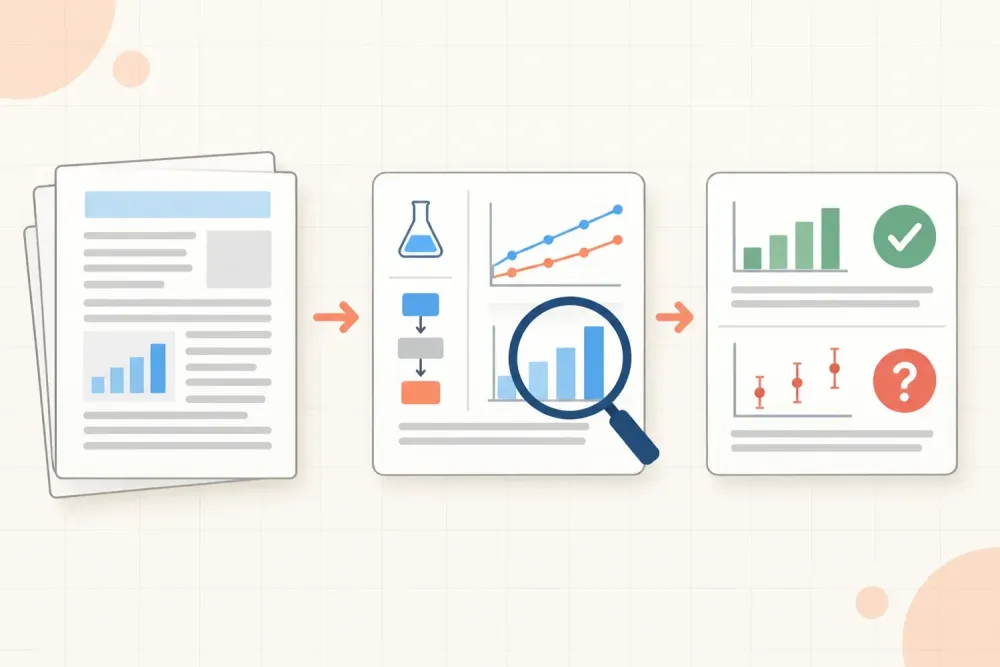
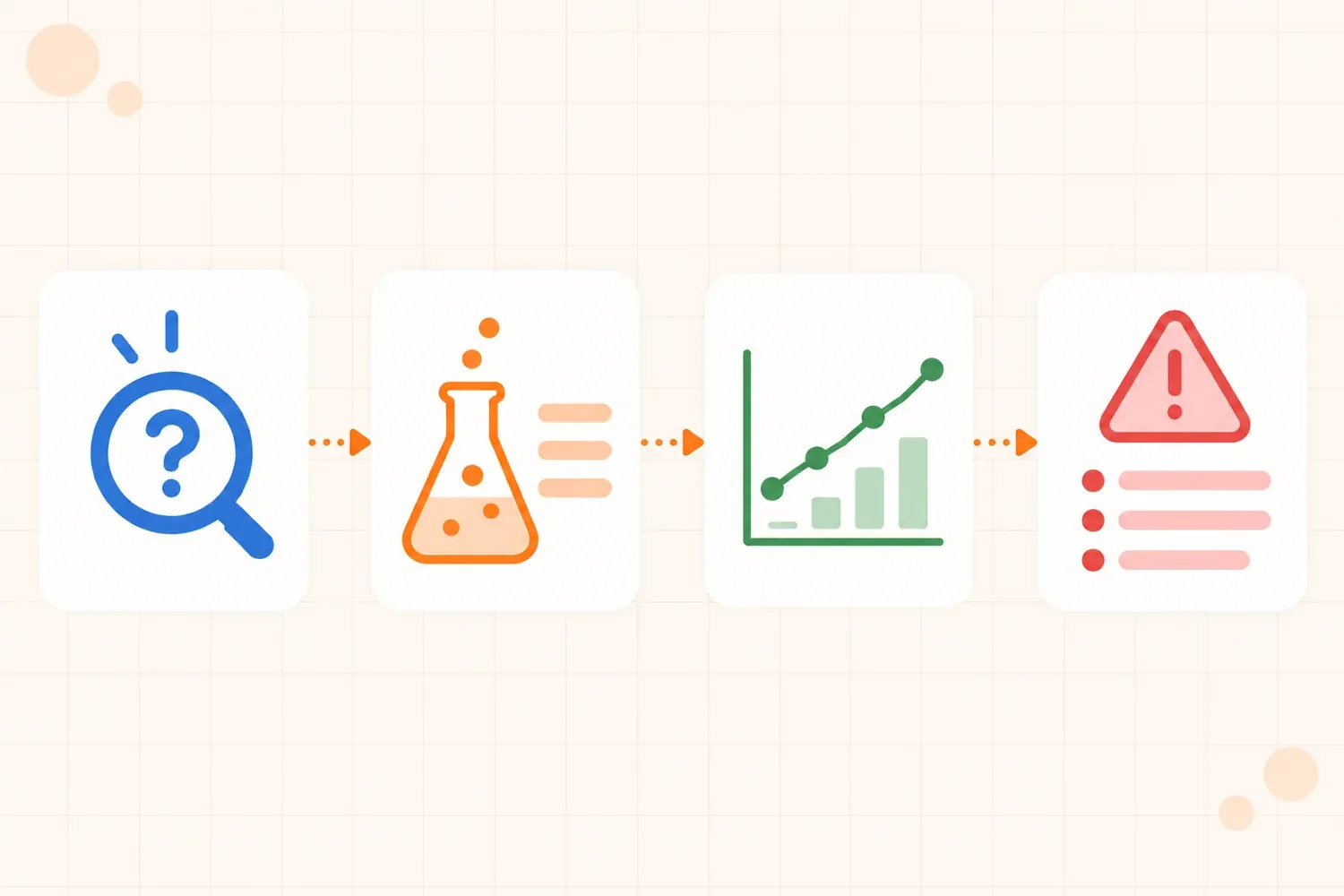
To study a scientific paper, follow the chain from research question to method, evidence, and claim. Do not begin by trying to memorize every term or read every paragraph at the same speed. First work out what the researchers wanted to find out, then check how they tested it, what the figures actually show, and where the conclusion stops being certain.
By the end, you should be able to explain the paper without looking at it: what question it asked, what was measured, what the main result was, why the result matters, and what the study could not establish. That is a useful study output. A pile of highlighted sentences is not.
This method is for studying a research paper for a class, seminar, or exam. It is not a guide to writing a literature review or reproducing the researchers' analysis.
Check whether the paper is worth a close read
Before spending an hour on a paper, make sure it is the right paper for the question you need to answer. Check:
- Topic: Does it actually address your course question, or does it only share a keyword?
- Study type: Is it an experiment, observational study, review, theoretical paper, or something else?
- Date and context: Is it recent enough for the topic, and does it fit the period or debate your class is studying?
- Access: Do you have the full text, including figures, tables, methods, and limitations?
- Interests: Do the funding, author affiliations, or declared conflicts of interest matter when you interpret the claims?
This quick screen does not tell you whether the paper is good. It tells you whether it is relevant and what context to keep in mind. A paper can be useful for a class even when it has limitations, but you should know which question it can help you answer before you take detailed notes.
Start with the paper's basic question
Before reading the details, write four short answers:
- Question: What relationship, process, or effect are the researchers investigating?
- Expectation: What outcome did they predict, if the paper states a hypothesis?
- Evidence: What people, organisms, materials, or data did they study?
- Claim: What do they say the results mean?
Keep these answers provisional. The abstract and introduction may describe the problem broadly, while the methods reveal a narrower question that the experiment could actually test.
For example, a paper may sound as if it asks whether exercise improves memory. Its experiment may really ask whether three weeks of moderate cycling changes performance on one memory test in a defined group of adults. The second version is more precise, and it gives you something you can evaluate.
Read a scientific paper in purposeful passes
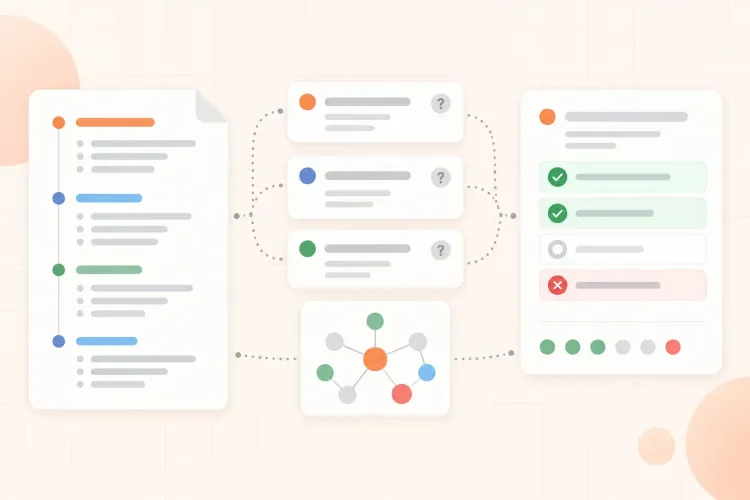
Reading from the first line to the last at one pace makes it easy to lose the argument. A paper's abstract, methods, results, and discussion do different jobs, so use different passes and give each pass a concrete output. This basic section map is also reflected in the National Center for Complementary and Integrative Health guide to scientific journal articles.
Pass 1: Map the argument
Read the title, abstract, section headings, figure titles, and conclusion. Do not take detailed notes yet. Write a provisional sentence in this form:
> The researchers tested whether [factor] changed [outcome] in [sample] using [general design], and they found [main result].
If you cannot complete the sentence, you have found the part that deserves closer reading. You do not need to understand every technical term before you know the paper's shape.
Pass 2: Reconstruct the test
Read the introduction and methods with one question in mind: What would have counted as evidence for the hypothesis? Note the comparison, the outcome measure, the timing, and any important conditions.
A method is not a list of equipment. It defines what the result can and cannot mean. A study that compares two groups at one point in time answers a different question from a randomized experiment that measures the same participants before and after an intervention.
Pass 3: Read the results through the figures
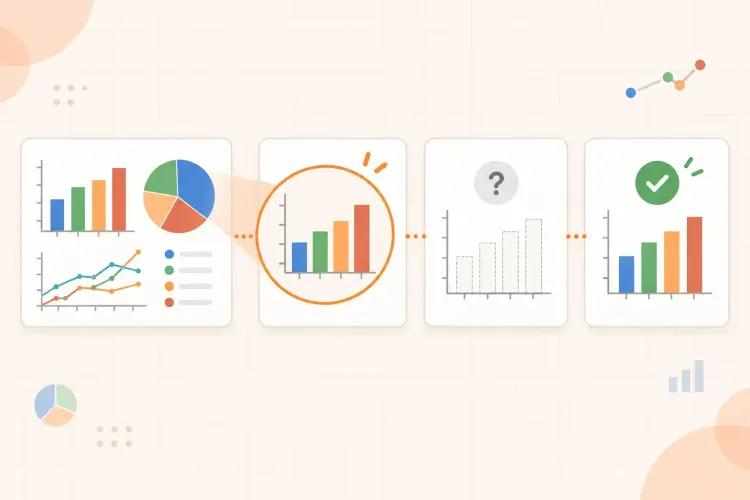
Look at each figure or table before rereading the paragraph that discusses it. Record the comparison, the direction of the pattern, and the uncertainty or variation shown. Then check whether the prose makes a claim that the visual evidence supports.
Pass 4: Test the conclusion
Return to the discussion and conclusion. Separate three things:
- What the data directly show.
- What the researchers infer from those results.
- What they suggest might happen in a wider setting.
Those are not interchangeable. A careful study can have an interesting result without proving the broadest version of its headline claim.
Read the methods as the conditions of the answer
When studying a scientific paper, ask these questions in order:
- Who or what was studied? Note the sample size, selection criteria, and relevant characteristics.
- What was changed or compared? Identify the independent variable, intervention, exposure, or grouping.
- What was measured? Write the outcome in plain language and note how it was operationalized.
- When and how was it measured? Timing, instruments, controls, and repeated measurements can change the interpretation.
- What alternative explanation was addressed? Look for randomization, a control group, adjustment for confounders, blinding, or another relevant safeguard.
Do not copy the whole methods section. Build a compact evidence record instead:
| Part of the method | Your note |
|---|---|
| Sample | Who or what was included? |
| Comparison | What differed between conditions or groups? |
| Outcome | What was actually measured? |
| Design | Experiment, observation, survey, review, or another design? |
| Important condition | What limits the interpretation? |
This record helps you avoid a common mistake: treating a measured outcome as if it were the whole concept. A reaction-time task may provide evidence about one kind of performance. It does not automatically measure attention, intelligence, or learning in every situation.
Turn the research question into a testable sentence
Scientific papers often use broad language because they sit inside a larger field. Your study notes should make the test narrower.
Use this pattern:
In [population or material], does [exposure or intervention] change [measured outcome] compared with [comparison] over [time or condition]?
Example:
In first-year university students, does a short retrieval-practice intervention improve scores on a delayed vocabulary test compared with rereading over one week?
Now list what the sentence leaves out. It may not tell you whether the intervention helps other subjects, longer delays, older learners, or real exam performance. Those unanswered questions become part of your limitations notes rather than accidental assumptions.
Interpret figures and tables without guessing
Figures are often where the paper's most important evidence lives. Many readers find it useful to inspect the figures and tables before working through every results paragraph, then return to the prose to understand the analysis. The NCBI guide to reading scientific manuscripts recommends a similar figure-first check. Use the same sequence every time:
- Read the figure title and caption.
- Identify the x-axis, y-axis, units, groups, and legend.
- State the comparison in one sentence.
- Describe the pattern without explaining it yet.
- Check error bars, spread, sample size, and statistical information if provided.
- Compare your description with the authors' claim.
For a graph, first say what changed. For example: “The intervention group had a higher mean score than the control group at the delayed test.” Only then ask what might explain it.
Avoid turning visual impressions into certainty. A large-looking gap may be based on few observations. A statistically detectable difference may be too small to matter in practice. Overlapping error bars are not a complete statistical test, and a line moving upward does not by itself prove that one variable caused the other.
For tables, identify the rows and columns before reading individual values. Mark the one or two cells that answer the paper's main question. If a table contains many analyses, do not treat every significant value as equally important. Ask which result was expected, which was central, and which may be exploratory.
Connect each result to the claim it supports
Make a claim map rather than a paragraph-by-paragraph summary:
| Evidence | What it supports | What it does not establish |
|---|---|---|
| Main comparison | Whether the groups or conditions differed on the measured outcome | Why the difference occurred unless the design tests that explanation |
| Secondary analysis | A related pattern or possible moderator | A confirmed new theory if it was exploratory |
| Null result | No detectable difference under these conditions | Proof that the effect can never exist |
This is where correlation and causation need careful separation. An observational paper can identify an association while leaving several causal explanations open. An experiment may support a causal interpretation, but only for the intervention, sample, outcome, and conditions it actually used.
Useful study language is precise:
- “The results are consistent with...”
- “The study provides evidence that...”
- “The design cannot determine whether...”
- “The finding may not generalize to...”
This is not empty hedging. It tells you how far the evidence travels.
Evaluate limitations and generalizability
Do not treat the limitations section as a ritual paragraph to memorize at the end. Use it to ask whether the result answers the question you care about.
Check five boundaries:
- Population: Does the sample resemble the people you want to learn about?
- Setting: Was the study done in a lab, clinic, classroom, online task, or natural environment?
- Measure: Is the outcome a direct measure of the concept or a proxy?
- Design: Can the method support a causal claim, or does it mainly show an association?
- Time: Does the study show a short-term response, a lasting change, or only one snapshot?
For each limitation, write the consequence. “Small sample” is incomplete. “A small sample may make estimates less stable and may not represent the wider population” is useful. “Self-report measure” becomes useful when you add that participants may interpret or report their behavior differently from an objective measure.
A worked example: studying one paper without summarizing everything
Imagine a simplified paper about whether retrieval practice improves delayed recall of biology terms. The researchers assign students to either reread a list or answer questions about it, then test both groups one week later.
Your notes could look like this:
- Question: Does answering questions during study improve delayed recall compared with rereading?
- Method: Two study conditions, the same vocabulary list, and a delayed test after one week.
- Result: The retrieval-practice group scores higher on the delayed test.
- Interpretation: Retrieval practice improved performance on this delayed vocabulary measure under these conditions.
- Limit: The result does not show that the same activity improves every kind of biology learning or long-term course performance.
Then ask one transfer question: Would the result necessarily apply to explaining a new biological mechanism? No. The paper measured recall of terms, so applying the result to explanation or problem solving would require further evidence.
That final question turns a summary into study. It makes you use the paper's method and outcome instead of repeating its conclusion.
Turn the paper into material you can retrieve
Once you understand the paper, create a small set of outputs:
- One question about the research question.
- One question about the design and comparison.
- One question about the main figure or table.
- One question asking what the result supports.
- One question about a limitation or boundary.
- One transfer question that changes the population, condition, or outcome.
Answer these with the paper closed. If the paper is long or scanned, start by breaking the PDF into sections worth studying, then return to the original figures and captions when checking your answers. Once the paper is structured, you can generate a first set of questions from one section, but check each question against the paper before using it. A machine-generated question can sound plausible while changing the sample, result, or strength of the conclusion.
Keep the paper open only for checking. Your first attempt should reveal what you can reconstruct and what still depends on recognition. When an answer is wrong, label the cause: missed method detail, misread figure, overstated claim, or forgotten definition. Each cause points to a different repair.
Common mistakes when studying research papers
Reading every section with equal attention
The abstract, methods, figures, and discussion do different jobs. Spend time where the paper's answer is built, especially around the main comparison and its measurement.
Copying the abstract as your notes
An abstract gives the paper's compressed story. It rarely gives enough detail to evaluate the design, figure, or limitation. Use it to make a map, not as the finished explanation.
Treating the authors' interpretation as the data
Write the result first, then the interpretation. This small separation makes overclaiming easier to notice.
Memorizing terms without their role
Record what each important term does in this paper. A control group, confidence interval, or proxy measure matters because of how it shapes the evidence.
Highlighting instead of retrieving
Highlighting can mark a useful passage, but it does not show whether you can explain the paper. Close the paper and answer your own five or six questions before reviewing the highlighted text.
The final check
You have studied the paper effectively when you can give a short, accurate explanation without the source open:
- What was the question?
- How was it tested?
- What was measured?
- What did the main result show?
- What does the result support?
- What remains uncertain?
If you can answer those questions and defend the limits of the conclusion, you know more than the paper's vocabulary. You understand how its evidence was built, which is the part most worth carrying into an exam, seminar, or later reading.