

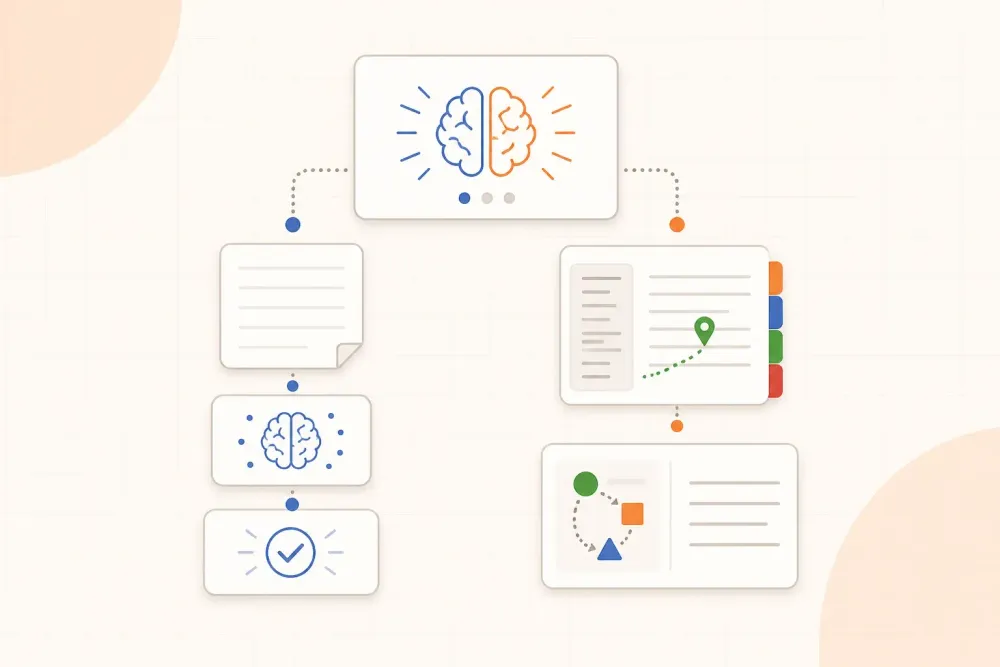
An open-book exam is not a permission slip to study less. A closed-book exam is not a reason to memorize every sentence in your notes. The format changes what you need to retrieve, what you need to organize, and how you should use your limited exam time.
The most reliable approach is to prepare for both formats around the same question: what must you be able to do without help, and what should you be able to find quickly when help is allowed? This guide explains how to study for open-book and closed-book exams, how the two approaches differ, and how to adapt your practice when the rules are mixed or unclear.
Open-book vs closed-book exams: the essential difference
In a closed-book exam, your memory must supply the facts, definitions, formulas, and relationships needed to begin. In an open-book exam, your sources can supply some details, but you still need enough understanding to identify the relevant source, interpret it, and apply it to the question.
That means the two formats reward different forms of readiness:
| Exam format | You need to do quickly | Your main preparation task |
|---|---|---|
| Closed-book | Retrieve and use information without notes | Build reliable recall, then practise under exam conditions |
| Open-book | Locate, evaluate, and apply information | Build a selective reference system, then practise using it |
| Mixed or online | Switch between recall and source use | Rehearse the exact rules, tools, and time limits |
Neither format is automatically easier. Open-book questions often make simple memorization less useful because the assessment can spend more time on application, analysis, comparison, or unfamiliar cases. Cornell's guidance on preparing for open-book exams makes the same practical point: you still need to study, and you should not spend the exam searching through material for the first time.
Is an open-book exam easier?
Not necessarily. An open-book exam removes some pressure to recall an isolated detail, but it can give you a harder task in its place: deciding which idea applies, weighing competing evidence, or explaining a conclusion under time pressure. Having a source open does not tell you which page matters or whether the passage you found actually answers the question.
That is why the safest preparation starts with closed-book attempts even when the exam is open-book. Try to explain the idea or outline the answer first. Then use your materials to verify a detail, add evidence, or correct a condition. This shows you what you already understand and prevents your reference pack from becoming a substitute for preparation.
Confirm what “open book” actually allows
Before choosing a study method, check the instructions. “Open book” may mean a printed textbook, a single page of notes, course materials in a locked platform, or a take-home assessment with specific rules. It may not allow the internet, messaging, generative AI, shared documents, or help from another person.
Write down:
- which books, notes, websites, calculators, or devices are allowed
- whether the exam is supervised, online, take-home, or time-limited
- whether you may search within digital files
- whether collaboration or AI assistance is prohibited
- how long you have and whether you can pause or return to questions
- how answers will be graded and whether citations or working are required
If the instructions are vague, ask the instructor before you build your reference system. A beautifully organized set of notes is useless if it violates the exam rules.
How to study for a closed-book exam
Closed-book preparation should move information from recognition toward unaided retrieval. Reading a chapter and feeling that it looks familiar is not enough. You need to practise producing the answer when the page is unavailable.
1. Map what must be recalled
Start with the syllabus, learning objectives, lecture headings, problem sets, and previous feedback. Separate the material into:
- facts, terms, dates, or definitions
- formulas, procedures, and sequences
- relationships you must explain
- problem types you must solve
- exceptions, conditions, or common contrasts
This prevents you from treating every line of a textbook as equally important. A definition may need precise recall, while a complex process may need a diagram and an explanation of what changes when one condition changes.
2. Retrieve before checking
Close your notes and answer a question in your own words. Write a formula from memory, draw a process, define a term, or solve a small problem without looking at the worked example. Then check the source and correct the answer.
Record the cause of each miss. “Forgot it” is too vague to guide your next session. Note whether you confused two terms, skipped a condition, used the wrong procedure, or knew the idea but could not retrieve it under time pressure.
3. Space and vary the practice
Do not complete one large memorization session and assume the material is stable. Revisit important ideas after a gap, then change the question, example, or order. A formula that works in one familiar exercise should also be tested in a problem where you must first decide whether the formula applies.
4. Rehearse closed-book conditions
Use timed sets without notes as the exam approaches. When available, past papers can help you rehearse the real format, but change repeated questions so you test the concept rather than remember the wording. Mark uncertain answers rather than opening your materials immediately. Afterward, review the uncertain and incorrect items, repair the relevant gap, and retry a changed version later.
Closed-book study is not about perfect recall of every detail. It is about making the core information available quickly enough that you can reason with it.
How to study for an open-book exam
Open-book preparation has two parts: learn the material well enough to recognize what a question is asking, and build a reference system that helps you verify or extend your reasoning quickly.
1. Study the concepts before organizing the sources
Do not begin by highlighting an entire textbook or downloading every file. First create a topic map. For each topic, write the central claim, process, rule, or framework and one question that would require you to apply it.
Then identify where the strongest explanation lives. Your lecture notes may preserve emphasis and examples. A textbook may provide a fuller mechanism. A journal article may define the evidence or limitation. Use each source for its strongest job instead of treating every source as a duplicate.
2. Build a small, searchable reference pack
Your reference pack should reduce search time, not become a second course to read. Include:
- a one-page topic index
- key terms and the pages or sections where they are explained
- formulas with a note about when each one applies
- diagrams or tables that are difficult to reconstruct
- examples that show how a rule works in context
- likely contrasts, exceptions, and instructor-specific terminology
For digital files, use clear filenames and consistent headings. For printed material, use tabs or page markers. Test the system by giving yourself a topic and finding the relevant section without reading around it.
3. Practise finding, then applying
Open-book practice should not mean searching for the answer to every question. Attempt the question first. If you are stuck, identify the exact gap: a definition, a condition, an example, or a source disagreement. Search for that item, then close the source and explain how it changes your answer.
This keeps the source in a supporting role. The goal is not to copy a paragraph into the answer. It is to use the material accurately and add your own reasoning.
4. Practise with unfamiliar cases
Because you can look up details, an open-book exam may ask you to compare evidence, apply a framework to a new case, or explain why one interpretation is better supported. Build practice questions that change the facts while preserving the underlying concept.
For example, do not only memorize the steps of a research method. Practise choosing the method for a new study, identifying a limitation, and explaining how that limitation affects the conclusion.
What to memorize for an open-book exam
“Open-book” does not mean “nothing needs to be memorized.” You should know the material that helps you think and navigate:
- the structure of the course and where major ideas fit
- essential definitions and distinctions
- the purpose of important formulas, models, or procedures
- the names of the sources, cases, theories, or experiments you are expected to use
- the questions each source can help you answer
You do not need to memorize every supporting detail if you can find it quickly and use it correctly. The best test is whether you can begin an answer without opening your notes and then locate only the detail that genuinely improves it.
Prepare for both formats with one study workflow
If the exam format might change, or if your course includes both open-book and closed-book assessments, use a two-layer workflow:
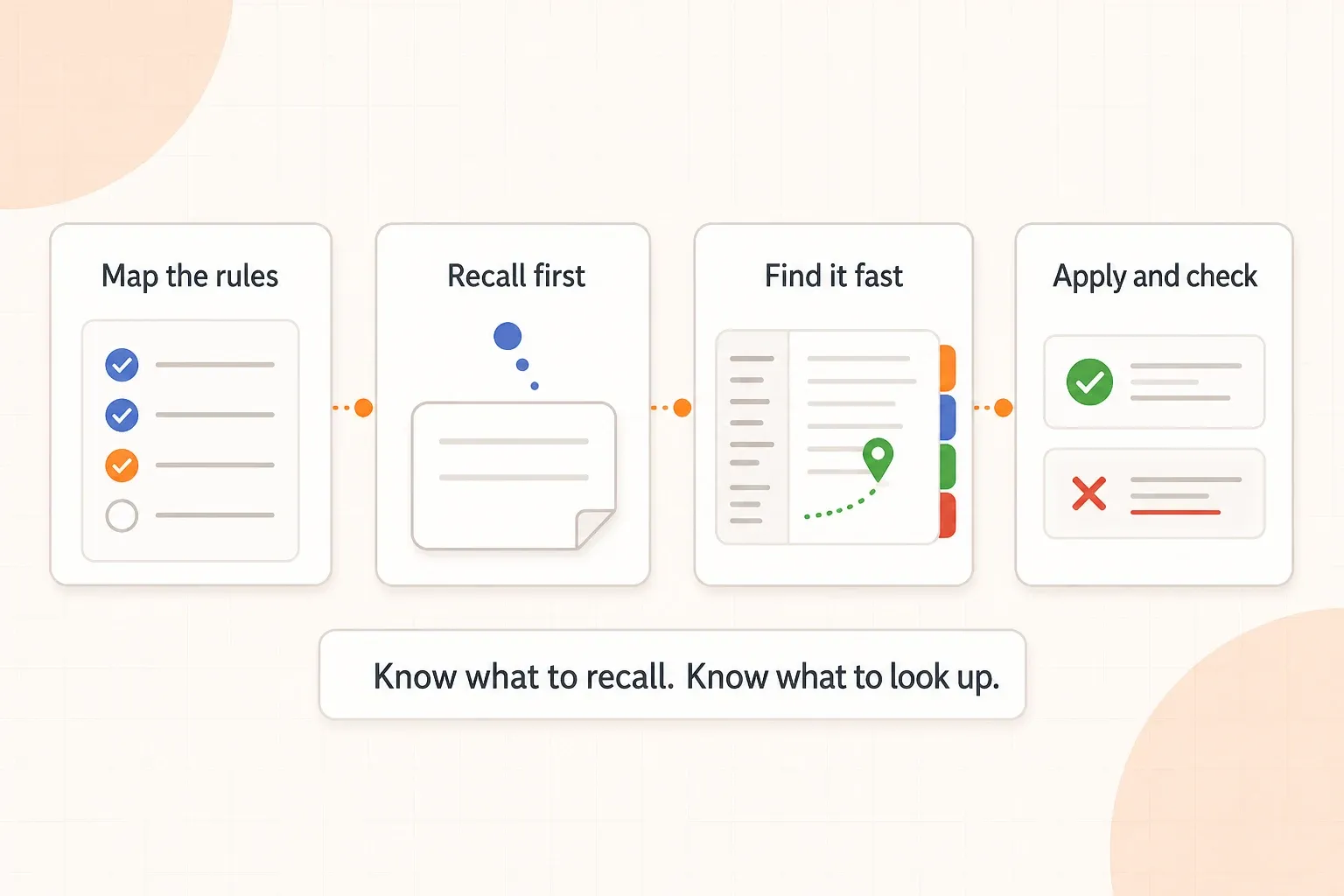
- Build a topic map from the course materials.
- Write a source-closed explanation or solve a problem from memory.
- Check the source and mark missing details, conditions, or evidence.
- Add only useful items to your reference index.
- Retry the same concept in a changed scenario.
- Finish with a timed set using the exact exam rules.
This workflow prevents open-book preparation from becoming passive browsing. It also gives closed-book practice a useful second step: learning where to verify a detail when a source is allowed. The same answer-first approach is central to practice testing that reveals what you can actually retrieve. It is a reliable default when the exam rules are still changing or the instructor has not explained how much source use will matter.
Use a different practice set for each format
The same topic can support different questions depending on the assessment rules.
| Topic | Closed-book practice | Open-book practice |
|---|---|---|
| Research methods | Define reliability and validity from memory | Choose the best method for a new study and justify the choice |
| Biology | Draw the pathway and explain each stage | Use a source to compare two mechanisms and evaluate a limitation |
| History | Reconstruct the causes and sequence of events | Find and use evidence to support a comparison or interpretation |
| Mathematics | Recall the conditions for a formula and solve | Select the appropriate method, verify assumptions, and explain the result |
The content overlaps, but the task changes. Closed-book questions expose missing knowledge. Open-book questions expose weak navigation, source evaluation, or application. Review the failure that actually occurred instead of blaming the format generally.
Manage time differently during the exam
In a closed-book exam, answer questions you can retrieve first and flag those that need more reasoning. In an open-book exam, add a limit to source searches. If you cannot find the relevant detail quickly, write down what you know, move on, and return later.
Before the exam, estimate how much time you can spend on each question. During practice, include the transitions that the real format requires: opening a permitted file, locating a page, checking a formula, or returning to an unfinished answer. These actions feel quick until they happen dozens of times.
For open-book responses, keep your own explanation at the center. Use sources to verify a claim, recover a detail, or compare interpretations. Do not fill the answer with copied material that does not respond to the question.
Common mistakes in both formats
Assuming open-book means easier
An open source does not replace understanding. If you do not know which concept applies, searching will produce too many plausible passages and consume your time.
Treating closed-book study as a memory contest
Memorizing isolated facts without practising relationships and applications leaves you unprepared for questions that change the example or combine ideas.
Bringing too much material
An unfiltered reference pack makes retrieval slower. Keep the sources that answer likely questions and create an index for anything you may need to verify.
Using the source before attempting
Opening the textbook at the first sign of uncertainty can hide what you actually know. Attempt first, then use the source to repair a specific gap.
Ignoring the exact rules
Online, take-home, and open-note exams can have different expectations. Confirm the allowed tools and rehearse under those conditions before exam day.
A final checklist
Before an open-book exam, check that you can:
- explain the main ideas without opening your sources
- find the relevant section quickly from a topic or question
- distinguish evidence, examples, definitions, and your own analysis
- apply a framework or method to an unfamiliar case
- use only permitted materials and tools
- stop searching when the source is not helping
Before a closed-book exam, check that you can:
- retrieve key facts, definitions, formulas, and relationships
- solve representative problems without looking at worked answers
- explain why a procedure or concept applies
- handle changed examples, conditions, and question wording
- complete a timed source-closed set
- turn each mistake into a specific repair and later retry
If you are preparing for both formats, keep the same foundation: understand the material, attempt before checking, and practise the task the exam will actually demand. The difference is what happens after the attempt. Closed-book study strengthens retrieval. Open-book study strengthens selective navigation and application.